


Please rotate your device
We don't support landscape mode yet. Please go back to portrait mode for the best experience
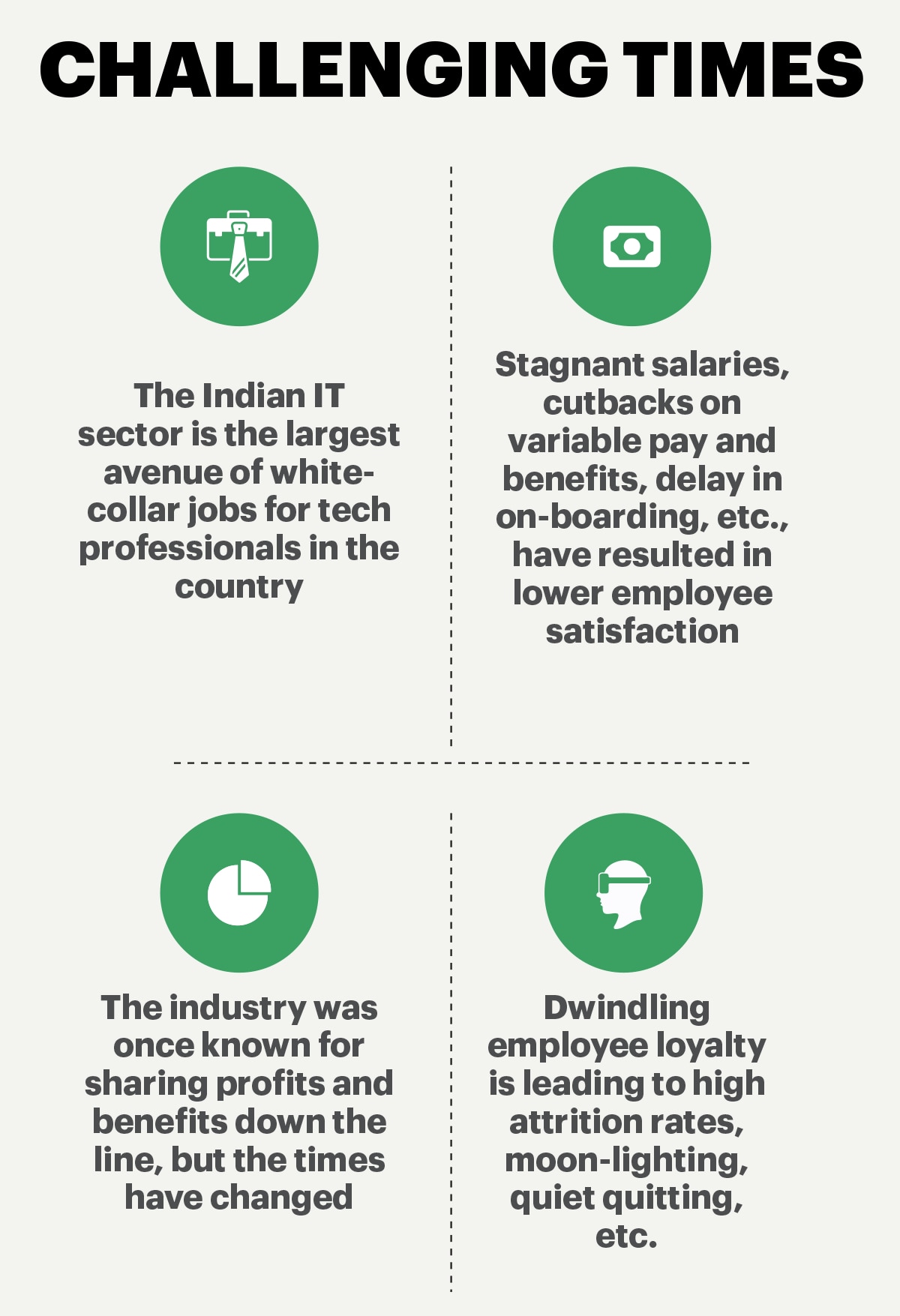
Precisely what ails the Indian IT sector is anyone’s guess today. But one overarching challenge the sector—noted to be a top global outsourcing IT/ITeS hub—faces today is related to human resources. What was once known to attract top talent from across the country is now embroiled in a protracted controversy over issues such as stunted salary hikes, cutbacks on variable pay and inordinate delays in on-boarding new employees. The sector is also witnessing a steep downfall in employee loyalty as high attrition, moonlighting, and quiet quitting become maladies for the industry in the post-Covid-19 era.
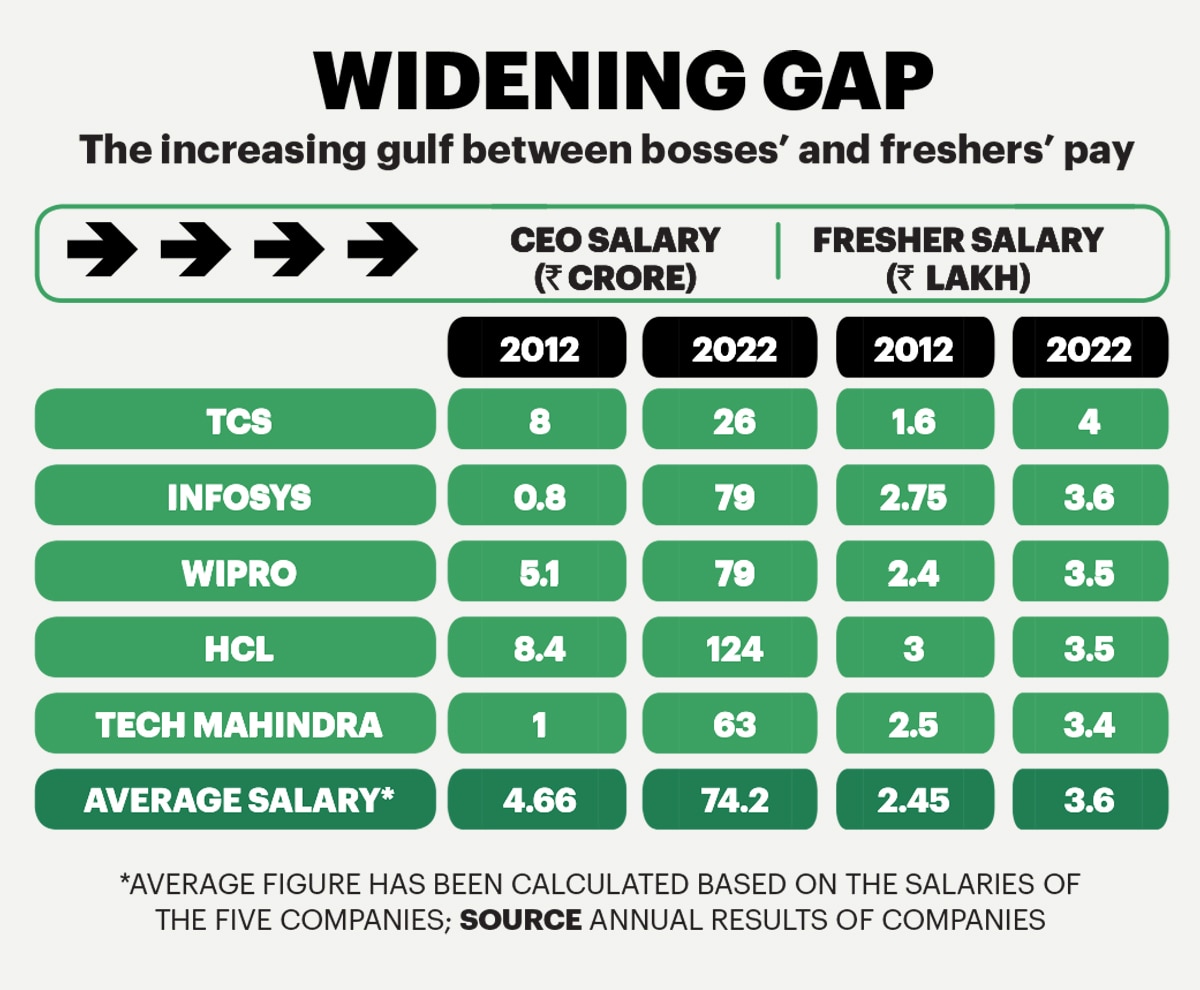
Over the past decade, the IT sector has witnessed a stagnation of sorts when it comes to salary hikes for freshers and the lower band of employees. An analysis of average salary packages of CEOs and freshers, per companies’ earnings reports and publicly available data, shows that fresher salaries have increased only 46.94 per cent in the past 10 years while the salary of CEOs has zoomed a whopping 1,492.27 per cent.
This industry used to put people first [and] take care of everybody. Over the last 10 years, the idea of looking out for the people at the bottom of the pyramid has gone
T.V. Mohandas Pai
Former CFO and Board Member
Infosys
This huge discrepancy in salaries between the CXOs and those at the bottom of the pyramid is not lost on industry veterans. T.V. Mohandas Pai, former CFO and Board Member at Infosys, for instance, tells BT, “There has been no increase in compensation for freshers. They are being paid the same Rs 3.5-4 lakh that the companies were paying 10-12 years ago. During this time, the salary for managers and seniors has gone up 4x, 5x, 7x.”
Industry experts point out that this disparity in salary increases of freshers compared to the top management has created a wide gulf between the two rungs. Kiran Karnik, the erstwhile president of the IT industry body Nasscom, says that “by relative standards, compared to what his or her CEO is getting, the current salary of freshers is a big pain point”.
There seems to be a lot of truth in Karnik’s statement. As per data from a TeamLease Digital report, the specific ratio of pay between the CEO and a fresher working in the same company highlights how disproportionate the salaries are at both levels. At Infosys, this ratio is 1,973; at Wipro, it is 2,111; at HCL Technologies it is 1,020; at Tech Mahindra it is 644; and at TCS it is 619.
Industry insiders, such as Vineet Nayar, former CEO of HCL Technologies, note that this discrepancy highlights a lack, or even ignorance, of the important role employees play in an organisation. “I truly believe that great organisations are built on the shoulders of passionate and purpose-led employees,” he says.
As Nayar explains, if employees are not motivated and passionate about the purpose of the organisation, “you will not be able to create value for your customers”.
Loyal No More
This growing salary chasm could be one of the reasons why the sector at large is currently plagued by issues like high attrition and moonlighting, both pointing towards dwindling employee loyalties to their respective organisations. “I come from a generation where if you have a job, you are devoted to that one job, but times have changed now,” says Karnik.
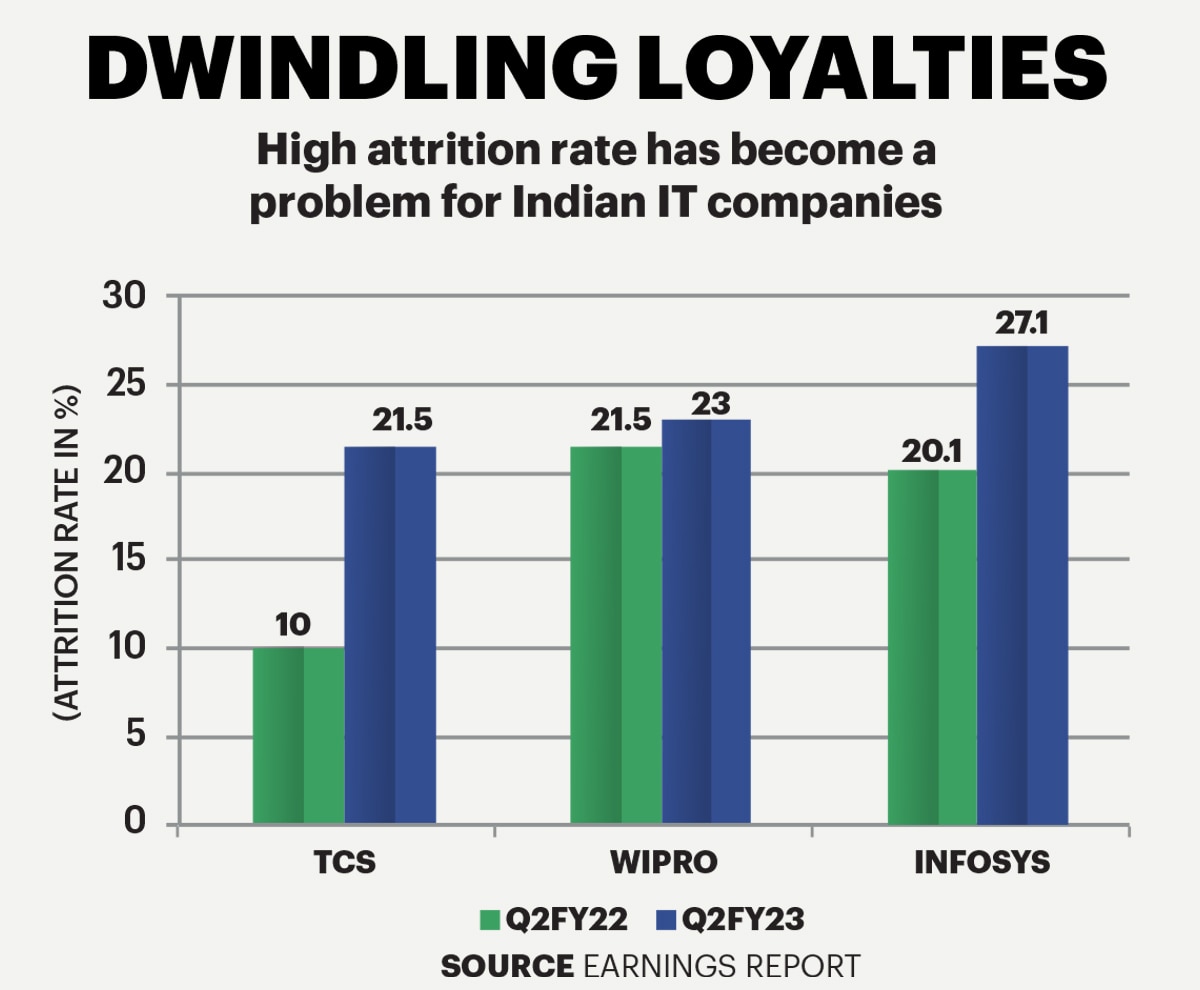
As data shows, attrition levels at India’s top IT companies have touched new highs, especially in the post-Covid-19 work environment. In Q2FY23, Infosys reported a 27.1 per cent attrition rate, up 7 per cent year-on-year (YoY); Wipro reported an attrition rate of 23 per cent, up 2.5 per cent YoY; and TCS’ attrition rate stood at 21.5 per cent, an almost 10 per cent jump YoY.
When CEOs focus on cultural transformation, you see that even if your strategies are average, they result in significant gains in market share, profit margins and m-cap
Vineet Nayar
Former CEO
HCL Technologies
Some factors contributing to the rising attrition are digitisation across sectors and job opportunities in start-ups. Bhavna Udernani, Managing Director of Adhaan, an HR services company, says, “Rapid digitalisation across sectors has led to increased demand for IT professionals across sectors. Moreover, start-ups have also become major employers of IT professionals.”
Further, the pandemic and the subsequent ‘work from home’ culture that it spawned could also be a reason behind this phenomenon. Udernani notes, “As soon as offices started opening, many employees started flocking to jobs that gave them the flexibility to work from home. Another factor for high attrition is that if an employee started working with a company during the work-from-home era, they did not create any camaraderie with peers, which is often a factor when people try to leave jobs. This made it easier for them to switch jobs,” she says.
Research also backs this statement. A recent study by tech giant HP Inc. noted that Indian employees are more likely to stay in their current job if they are given a hybrid work option. Per the study, 88 per cent of the respondents agreed that hybrid work increases employee retention.
But attrition is a matter of serious concern because it comes with a price tag for the company. “The cost of attrition comprises three things: when an employee leaves the company, the position needs to be filled soon because there is loss of productivity— this is one part of the cost; the next part is the cost of finding a replacement; then when the replacement starts working… they need to be trained; this makes up another part of the cost of attrition,” explains Udernani.
But high attrition is not the only issue pointing towards dwindling employee loyalty. Buzzwords like moonlighting and quiet quitting have also started creeping into the Indian IT sector.
Yeshab Giri, Chief Commercial Officer of Staffing at Randstad Technologies, an IT recruitment solutions company, says slipping employee loyalty might create a host of other problems. “Some of the major challenges that the IT industry is facing now include employee retention, controlling attrition, managing employee burnout, quiet quitting, and moonlighting. In fact, moonlighting is one of the major concerns for IT companies as it might lead to malpractices like conflict of interest and breach of confidentiality in terms of data and other information,” he says.
Moonlighting, in particular, has divided the sector, with myriad ways being employed by various firms to deal with it, without any coherent strategy. While companies like Infosys and Wipro decided to let go of many employees who were said to have indulged in the practice, other firms like TCS and Tech Mahindra have publicly noted that they are working on policies to embrace the practice.
New Recruits Distraught
Then there is the issue of delays in on-boarding recruits. For instance, Rohan Singh (name changed), the son of a daily labourer, was overjoyed when he got job offers from three multinationals—Wipro, Infosys and Capgemini in January 2022. Singh thought he would be able to pay back his education loan and could finally give his parents a comfortable life. But he’s still waiting for a joining date and has no source of income, he tells BT.
Singh isn’t an exception. Per estimates by IT employees’ association NITES, around 30,000 IT professionals have been impacted by the delay in joining dates.
Former HCL Technologies CEO Nayar notes that this delay was caused by a misjudgement of demand by the IT companies. Siva Prasad Nanduri, Chief Business Officer of TeamLease Digital, says that a major chunk of these offers were rolled out when the IT sector was booming in late 2021. “But 2022 rang in a war, inflation, and a wider economic slowdown, impacting the West worse than other places. Since a major chunk of business IT companies get is from the West, there is delay in the process of on-boarding new recruits,” he says.
Most companies such as TCS, Infosys and Wipro, among others that BT reached out to on this issue, got back saying they were allocating dates of joining based on their business requirements.
The Way Forward
How can the Indian IT sector, the biggest avenue of white-collar jobs in India, fix its human resources challenge?
“There is an argument to be made for looking after your people well. Looking after your people includes all your people, not just the top ones,” says former Nasscom president Karnik. For him and many other experts, a way forward could be by offering better employment terms to those who come under the lower band of the salary structure. Nayar agrees. “If you were to spend a part of your budget in encouraging and enabling your employees, you will get 10x higher returns.” Pai, too, is of the same view. “They must pay their fresher employees more,” he says.
The other solution seems to be in building a coherent company culture. While CEOs are focussed on new products, new pricing and new strategies, they should also focus on cultural transformation and its execution, says Nayar. “When CEOs start focussing on cultural transformation, you would see that the strategies that you have, even if they are average strategies, would result in significant amount of gains in market share, profit margins as well as market cap,” he explains.
For Pai, the real answer lies in soul-searching. “This is an industry that [used to] put people first, which took care of everybody. Over the last 10 years, the idea of looking out for the people at the bottom of the pyramid has gone. The human spirit is what made these companies great. This industry was built with great human culture; if they diverge from that, they would turn into mercenary organisations,” he says.
Story: Aakanksha Chaturvedi
Producer: Arnav Das Sharma
Creative Producers: Raj Verma, Nilanjan Das
Videos: Mohsin Shaikh
UI Developer: Pankaj Negi