





Search
Advertisement
BT Explainer | Gold loans surge 83% to ₹5.77 lakh crore: What happens if gold prices fall 15%?

BT Explainer | Gold loans surge 83% to ₹5.77 lakh crore: What happens if gold prices fall 15%?

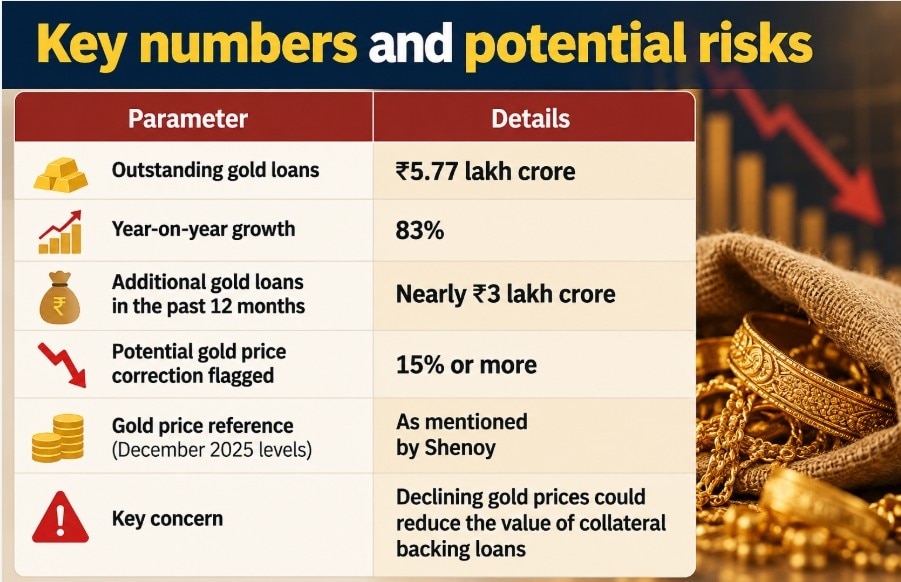
Highlighting the trend in a post on X, Deepak Shenoy pointed out that gold loans from banks had grown 83% year-on-year to ₹5.77 lakh crore. Nearly ₹3 lakh crore has been added to outstanding gold loans over the past 12 months.

Basudha Das
Basudha Das
  • Updated Nov 1, 2026 6:30 AM IST
BT Explainer | Gold loans surge 83% to ₹5.77 lakh crore: What happens if gold prices fall 15%?A further 15% decline in gold prices would reduce the value of jewellery pledged with banks and NBFCs.

India's gold loan market is witnessing a sharp expansion, with outstanding loans against pledged jewellery reaching ₹5.77 lakh crore, even as gold prices have begun correcting from their record highs. The rapid growth is raising questions about collateral risks for banks and non-banking financial companies (NBFCs), particularly if bullion prices decline further.

Advertisement

Highlighting the trend in a post on X, Deepak Shenoy pointed out that gold loans from banks had grown 83% year-on-year to ₹5.77 lakh crore. Nearly ₹3 lakh crore has been added to outstanding gold loans over the past 12 months. Shenoy warned that this could become a problem if gold prices fall another 15% or so, given the amount of additional lending against gold.

His concern comes at a time when gold prices have already witnessed a significant correction. According to the latest price data in the supplied figures, 24-carat gold was trading at ₹1,38,481 per 10 grams, while MCX December gold futures were down 7.9% in October to around ₹1,38,419 per 10 grams.

What happens to gold loans if prices fall 15%?

Advertisement

A further 15% decline in gold prices would reduce the value of jewellery pledged with banks and NBFCs. For instance, at a gold price of ₹1,38,481 per 10 grams, a 15% correction would bring the indicative value down to approximately ₹1,17,709 per 10 grams.

For lenders, this would mean a reduction in the collateral backing their outstanding loans. For borrowers, it could mean a higher loan-to-value (LTV) ratio, as the outstanding loan remains unchanged while the value of the pledged gold falls.

LTV measures the loan amount as a percentage of the value of the gold pledged. A lower LTV gives lenders a larger cushion against price fluctuations.

Shreepal Doshi, senior analyst covering NBFCs at Equirus Securities, said most gold loan lenders currently operate at LTV ratios of around 60-70%. Lenders maintaining ratios of 60-65% are generally in a more comfortable position.

Advertisement

For example, if a borrower has taken a loan equal to 65% of the value of pledged gold, a 15% fall in gold prices would push the effective LTV to approximately 76.5%, assuming the loan outstanding remains unchanged. This reduces the lender's collateral buffer.

Doshi cited LTV ratios of 64% for Muthoot Finance, 65.6% for Manappuram Finance, 68% for Fedbank Financial Services and 70% for IIFL Finance. Capri Global Capital's ratio stood at 73.35%, which he considered relatively less comfortable.

Will borrowers have to repay loans or pledge more gold?

A decline in gold prices does not automatically mean borrowers must immediately repay part of their loans or provide additional jewellery. The implications depend on the lender's loan terms, applicable LTV requirements and the repayment structure.

However, a sustained correction can reduce the borrowing capacity of existing customers seeking fresh loans or top-ups. It can also leave lenders with a smaller collateral cushion if borrowers default.

Ponmudi R, founder and CEO of Enrich Money, said falling gold prices could reduce collateral values and limit borrowing capacity for new customers. Existing loans sanctioned at higher LTV ratios could also face reduced collateral protection.

Are gold loan companies facing a bigger risk?

Advertisement

Doshi said a sharp contraction in gold prices could push up non-performing assets (NPAs) and credit costs, although he did not expect a 20-25% decline from current levels under prevailing macroeconomic conditions. Gold's high liquidity also offers lenders some protection because pledged jewellery can be liquidated through established recovery processes.

However, competition is emerging as another challenge. Gold loan yields have declined to 75-79 basis points a month from 100-105 basis points earlier, while operating costs remain elevated, according to Doshi.

The concern is therefore not just a potential fall in collateral values but also pressure on lenders' profitability.

For borrowers, the correction could mean lower loan eligibility against the same quantity of gold. For lenders, conservative LTV ratios, prudent underwriting and effective collateral monitoring will be crucial in managing risks as India's gold-backed lending market continues to expand.

ABOUT THE AUTHOR

Basudha Das
Basudha Das

With over 16 years of experience in the newsroom, I am currently covering personal finance, banking, financial services, and insurance sector, bullion and metals, sports, and other trending topics. When not chasing interest rates and new-age investment tools, I like to follow and cover climate change trends and environment-friendly initiatives across the world. When not at work, I spend time learning Bharatnatyam from my guru, and baking from my daughter.

Published on: Nov 1, 2026 6:30 AM IST