





Search
Advertisement
Heatwaves aren't the only reason Indians are buying more sunscreen; skincare awareness is the bigger driver

Heatwaves aren't the only reason Indians are buying more sunscreen; skincare awareness is the bigger driver

India's sunscreen market is witnessing rapid growth, with the number of sunscreen-buying households more than tripling in four years. Be Neude founder Aayshya Jhunjhunwala says rising skincare awareness, concerns over pigmentation and premature ageing, and changing weather patterns are driving demand beyond seasonal use.

Basudha Das
Basudha Das
  • Updated Nov 3, 2026 2:49 PM IST
Heatwaves aren't the only reason Indians are buying more sunscreen; skincare awareness is the bigger driverConsumers are increasingly connecting sun exposure with pigmentation, tanning and premature ageing, making sun protection relevant throughout the year.

India's sunscreen market is witnessing a significant shift, with consumers increasingly moving from occasional sun protection to everyday skincare. While rising temperatures and harsher weather conditions have accelerated demand, growing awareness about pigmentation, premature ageing and long-term skin health is emerging as a more fundamental driver of consumption, according to Aayshya Jhunjhunwala, founder of skincare brand Be Neude.

Advertisement

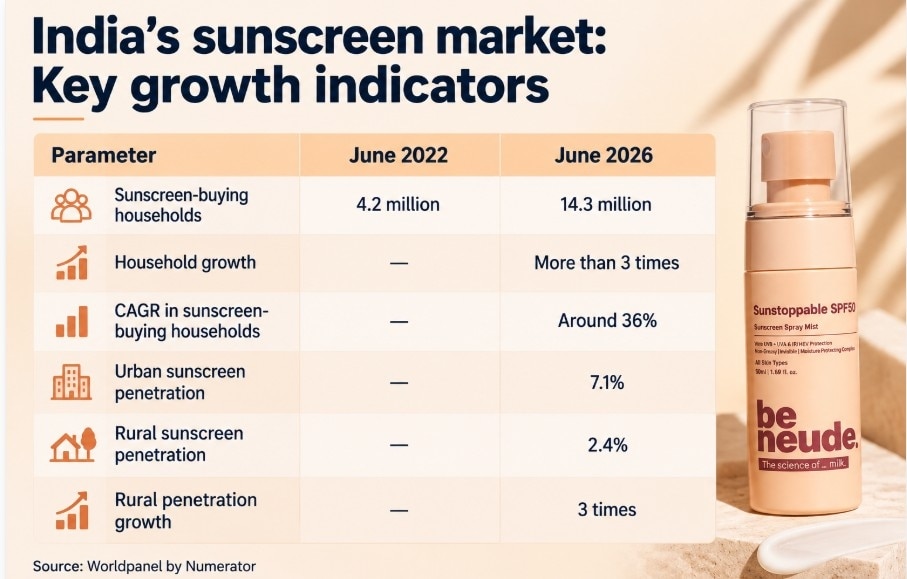
The shift is reflected in the rapid expansion of the category. The number of Indian households buying sunscreen has more than tripled in four years, rising from 4.2 million in June 2022 to 14.3 million in June 2026, according to a Worldpanel by Numerator report shared exclusively with ET. This represents a compound annual growth rate of around 36%.

According to Jhunjhunwala, consumers are increasingly understanding that sunscreen is not merely a product for beach holidays, summer vacations or particularly sunny days, but an essential part of everyday skincare.

"Both have played a role, but I would say skincare awareness has been the more fundamental driver. People are much more conscious today about pigmentation, tanning, premature ageing and maintaining skin health. Social media and the growth of dermatology-led skincare education have accelerated that understanding," she said.

Advertisement

Skincare awareness overtakes seasonal sun protection

For years, sunscreen consumption in India was largely seasonal and occasion-led. However, the growing popularity of skincare routines, social media conversations and dermatology-backed information is changing consumer behaviour.

MUST READ: Sugar-free, but at what cost? 6 popular sweeteners linked to faster brain ageing

Consumers are increasingly connecting sun exposure with pigmentation, tanning and premature ageing, making sun protection relevant throughout the year. Jhunjhunwala believes changing weather patterns have made the need for protection more tangible, but awareness is what is driving the underlying shift.

"Indians are experiencing more intense heat and longer periods of harsh sun exposure, so the need for protection is becoming much more tangible. Consumers are connecting what they experience physically, heat, tanning, pigmentation, with the need for sun protection. So I see climate as an accelerator, while awareness is the underlying structural driver," she said.

Advertisement

India's sunscreen market triples in four years, but low penetration signals massive growth opportunity

Despite the sharp increase in sunscreen purchases, penetration remains relatively low, suggesting considerable headroom for expansion. Urban sunscreen penetration stood at 7.1%, while rural penetration reached 2.4%, having tripled over the four-year period.

Jhunjhunwala believes the next challenge for brands is to convert growing awareness into a consistent daily habit.

"Sunscreen has already crossed the awareness barrier in urban India. I think the next step is for it to become a habit, not an occasion," she said.

She added that product experience would play an important role in driving repeat purchases. Consumers increasingly want lightweight formulations that are neither sticky nor chalky and can be easily incorporated into their morning routines.

The opportunity also extends beyond metropolitan consumers. Tier 2 and smaller towns, younger consumers and men represent potential growth segments. However, awareness, availability, affordability and established consumer habits will determine how quickly sunscreen adoption expands beyond urban markets.

₹10 sunscreen versus premium SPF 50

Advertisement

As brands attempt to expand the category, sunscreen is becoming available across a wider range of price points. Hindustan Unilever, for instance, has introduced a ₹10 SPF 50 Lakme sunscreen, while premium brands are targeting consumers willing to pay more for specialised formulations.

However, Jhunjhunwala cautioned that affordability should not come at the expense of product performance and safety.

ALSO READ: Isha Ambani-led Reliance Retail, OYO, Perplexity lead funding among U35-led businesses, Hurun Report shows

A sunscreen's formulation involves costs associated with the quality and concentration of UV filters, formulation stability, safety testing, efficacy testing and packaging. These factors are important in ensuring that the product delivers its claimed protection throughout its shelf life.

"At very low price points, the important question is not simply, 'How cheap can sunscreen become?' but 'What level of protection and consumer trust are we delivering at that price?' I think affordability and efficacy have to move together," she said.

The issue of product credibility has also gained importance amid increasing scrutiny of SPF claims and sunscreen testing. Jhunjhunwala said independent testing, transparent communication and proper substantiation of protection claims would be critical to maintaining consumer confidence.

"If a consumer buys a sunscreen claiming SPF 50, they are trusting that it will actually provide that level of protection. If there is a gap between the claim and the actual performance, it damages much more than just one brand," she said.

Advertisement

With consumers becoming more discerning about formulations, textures and additional skincare benefits, the next phase of growth may depend on brands offering products suited to different skin types and Indian weather conditions.

For the industry, the challenge is no longer simply to persuade consumers to try sunscreen. It is to make regular sun protection an affordable, trusted and automatic part of everyday skincare.

DO READ: Gen Z, Gen Alpha to drive half of India’s beauty spending by FY31: Brands prepare for new-age consumer

ABOUT THE AUTHOR

Basudha Das
Basudha Das

With over 16 years of experience in the newsroom, I am currently covering personal finance, banking, financial services, and insurance sector, bullion and metals, sports, and other trending topics. When not chasing interest rates and new-age investment tools, I like to follow and cover climate change trends and environment-friendly initiatives across the world. When not at work, I spend time learning Bharatnatyam from my guru, and baking from my daughter.

Published on: Nov 1, 2026 5:45 AM IST