
Search
Advertisement
India's $133-billion NRI deposit haul: How much was fresh money, and what happens when it matures in 2029?

India's $133-billion NRI deposit haul: How much was fresh money, and what happens when it matures in 2029?

India’s $133-billion NRI deposit mobilisation through the RBI’s special swap window may have boosted banks’ funding, but questions remain over how much represented fresh savings and the true cost of raising the money.

Business Today Desk
Business Today Desk
  • Updated Oct 28, 2026 2:05 AM IST
India's $133-billion NRI deposit haul: How much was fresh money, and what happens when it matures in 2029?The RBI swap facility helped banks convert dollar funding into rupee liquidity, reducing the immediate currency-funding challenge.

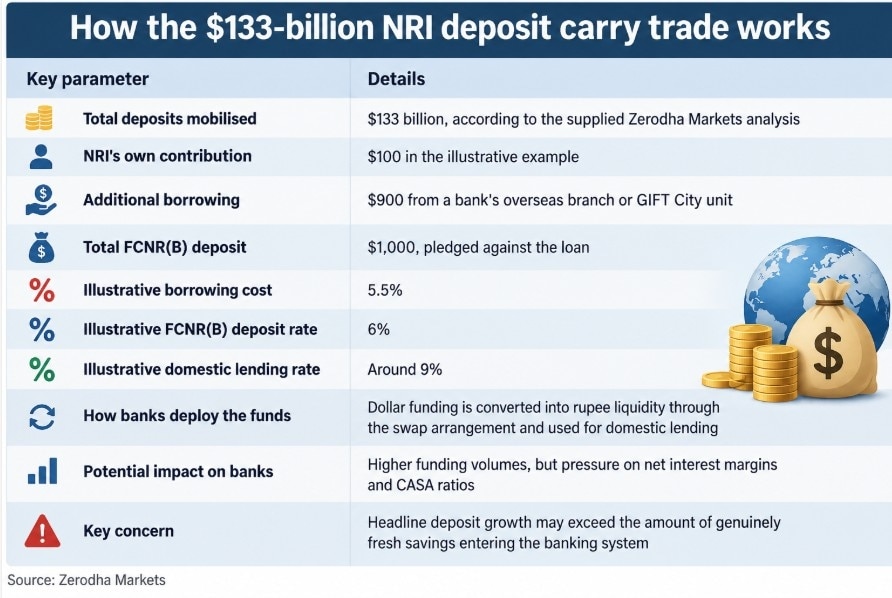
India's special Reserve Bank of India (RBI) swap window attracted $133 billion in non-resident Indian (NRI) deposits, nearly five times the amount mobilised under a similar exercise in 2013. However, the scale of the inflows may not tell the full story, as a portion of the money could have been generated through borrowing-backed transactions rather than fresh savings, according to an analysis by Zerodha Markets.

Advertisement

The arrangement helped banks access dollar funding and convert it into rupee liquidity for domestic lending. But the funding strategy also raises questions about the true extent of incremental deposits, the cost of borrowing and the pressure on banks' net interest margins (NIMs).

According to Zerodha Markets, a leveraged carry trade can help explain how a relatively small amount of an NRI's own money can support a substantially larger deposit. In an illustrative example, an NRI contributes $100, while a bank's overseas branch or GIFT City unit lends another $900. The combined $1,000 is then placed in a foreign currency non-resident bank (FCNR(B)) deposit, with the deposit pledged against the loan.

This structure can increase reported deposit mobilisation without an equivalent increase in fresh savings entering the banking system. The extent to which such transactions contributed to the $133 billion, however, needs to be established through bank-level disclosures.

Advertisement

The economics depend on the full cost of funding and how the proceeds are deployed. The illustrative transaction shows the bank paying around 5.5% on the borrowing and 6% on the FCNR(B) deposit, while the rupee proceeds are lent domestically at approximately 9%. These rates are illustrative rather than uniform terms applicable across banks or transactions.

Advertisement

The RBI swap facility helped banks convert dollar funding into rupee liquidity, reducing the immediate currency-funding challenge. However, the spread between lending rates and deposit costs does not, by itself, establish the bank's final profitability. Borrowing costs, swap pricing, hedging, liquidity requirements and other expenses must also be considered.

The pressure is visible in the broader funding trade-off highlighted by Zerodha Markets. Banks may have gained access to substantial funding, but a greater reliance on term deposits can weigh on margins and dilute the share of current and savings account (CASA) deposits, which generally provide a lower-cost source of funds.

The 2029 test: What happens when the funding matures?

The next challenge could emerge when these deposits mature. If banks need to renew them, the cost of retaining the funds will depend on prevailing global interest rates, depositor expectations and the availability of alternative funding. If renewal becomes expensive or depositors withdraw their money, banks may have to replace the funding with domestic deposits or other market borrowings.

Advertisement

The consequences could extend beyond funding costs. Banks facing higher replacement costs may need to raise deposit rates, moderate lending growth or accept thinner margins. The impact will depend on each bank's maturity profile, liquidity position and ability to attract fresh deposits.

For borrowing-backed deposits, the maturity process also requires scrutiny of the associated loan and repayment arrangements. The deposit's maturity, the underlying borrowing and the bank's funding obligations must be assessed together to understand the actual refinancing exposure.

The $133-billion mobilisation figure therefore needs to be viewed alongside the quality, cost and durability of the funding it represents. The key questions are how much money was genuinely incremental, how much the transactions cost banks after accounting for all associated expenses, and how much funding will need to be renewed or replaced as maturities approach.

For India's private banks, the ultimate test will not be how much money they attracted through the swap window, but whether that funding can be retained or replaced without putting further pressure on profitability.

ABOUT THE AUTHOR

Business Today Desk
Business Today Desk

Business Today brings you the latest news, views and analysis from the world of finance, economy, markets, corporates, startups, tech, and the digital economy. You can find everything from breaking news to deep dives to immersive essays and more on a variety of subjects across all formats - online, magazine, television, data visualisation, et al.

Published on: Oct 28, 2026 2:05 AM IST