“From November 1, Direct Plans will be the default option on digital platforms of AMCs. Investors choosing Regular Plans must be informed about their higher expense ratio,” he said.
The move comes as more Indian households invest in mutual funds through systematic investment plans (SIPs) and digital platforms. But what are direct plans, how do they differ from regular plans, and should investors opt for them?
What are direct mutual fund plans?
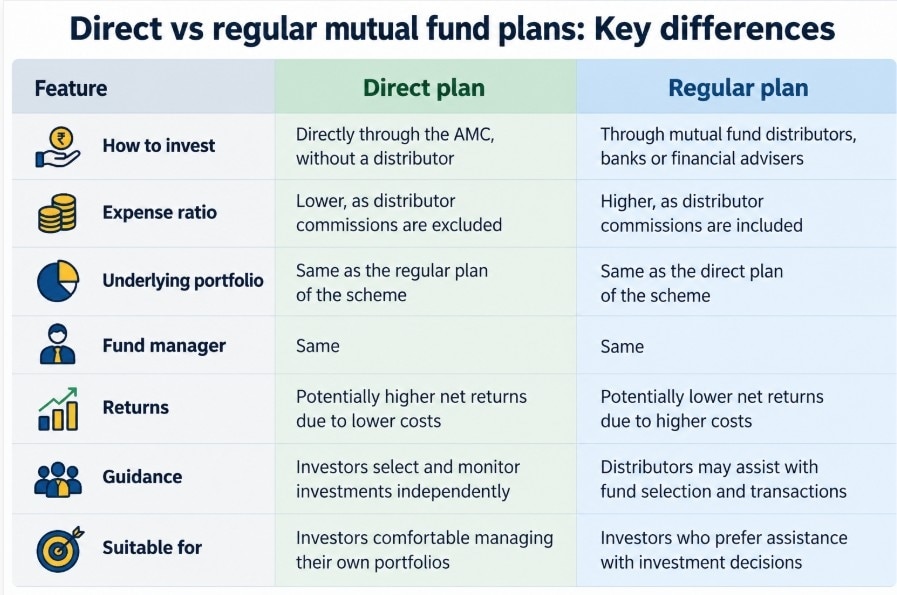
Direct plans allow investors to purchase mutual fund units directly from an asset management company without going through a mutual fund distributor. Since there is no distributor commission, these plans have lower total expense ratios (TERs) than regular plans of the same scheme.
MUST READ: Jio IPO: Which mutual funds bet big, and where did your SIP money go?
According to an ICICI Bank blog, both direct and regular plans invest in the same underlying portfolio and are managed by the same fund manager. Their investment objectives, asset allocation and risk profiles are also the same. The primary difference is the cost of distribution.
Direct plans are available through AMC websites and other permitted direct-investment channels. Investors can choose schemes, start SIPs or make lump-sum investments and monitor their portfolios independently.
Direct vs regular mutual fund plans: How do costs differ?
Regular plans are purchased through intermediaries such as mutual fund distributors, banks or financial advisers. These intermediaries may assist investors with scheme selection, transactions and other investment-related services.
The commissions paid to distributors are incorporated into the expense ratio of regular plans. Consequently, their TER is generally higher than that of the direct plan of the same scheme.
ALSO READ: Nifty 50 down nearly 14% from September 2024 peak: Which equity mutual funds have cushioned the fall, and which have lost the most?
Direct plans, by contrast, do not include distributor commissions and therefore have lower expense ratios. Since mutual fund expenses are deducted from scheme assets, a lower expense ratio can translate into marginally higher net returns over time, assuming all other factors remain equal.
For example, if a regular plan’s annual expense ratio is 0.5 percentage points higher than that of its direct counterpart, the difference on an investment of ₹5 lakh would amount to ₹2,500 over a year, assuming the investment value remains unchanged throughout that period. The actual difference will vary with the investment value and the expense ratios applicable to the scheme.
Over longer investment horizons, even small differences in costs can affect the final corpus because expenses reduce the amount available to generate returns. Investors should compare the expense ratios of the direct and regular plans of the same scheme rather than comparing plans across different schemes with different investment strategies and risk profiles.
Should investors choose direct plans?
Direct plans may suit investors who understand mutual funds, can assess their risk appetite and financial goals, and are comfortable selecting and monitoring schemes independently. Their lower expense ratios can help improve net returns over the long term.
Regular plans may be more appropriate for investors who value assistance with fund selection, transactions and portfolio monitoring. However, they should understand the additional costs and the services they receive in return.
A lower expense ratio does not eliminate investment risk or guarantee better investment performance before expenses. Returns continue to depend on the underlying portfolio and market conditions.
Investors should also exercise caution before switching existing investments from regular to direct plans. Such a change generally involves redeeming units in the regular plan and purchasing units in the direct plan. The redemption may trigger capital gains tax and applicable exit loads, depending on the investment and holding period.
DO READ: Diwali investment: Invesco launches silver ETF, FoF; ICICI Prudential opens BSE Power ETF NFO
What does SEBI’s move mean for investors?
The November 1 change is intended to make the lower-cost direct option the default on AMC digital platforms and ensure investors receive clearer information about the higher expenses associated with regular plans.
The announcement specifically refers to AMC digital platforms. It does not establish that all independent investment platforms will adopt the same default or specify how existing investments will be treated.
For investors, the key is to understand the plan they are buying, compare the expense ratios of the direct and regular options of the same scheme, and weigh the cost savings against their need for guidance. A lower expense ratio can make a meaningful difference over time, but the appropriate choice also depends on how confidently an investor can manage their portfolio.
DON'T MISS: Already investing in Reliance shares or mutual funds? Do you need additional Jio IPO exposure?
















 Direct plans may suit investors who understand mutual funds, can assess their risk appetite and financial goals, and are comfortable selecting and monitoring schemes independently.

 BT BIG STORY | More sales, less profit: FMCG's margin trap
 Jio shares jump 5%, surpass analyst targets; m-cap tops Rs 13.6 lakh crore as dream run continues
 US Fed holds interest rates steady, plans reduced rate-setting meetings by 2027
 Food security risk? World Bank warns global commodity prices to surge 23% amid overlapping crises
 NSE shares: 'Buy' market leader, says Jefferies, values it at premium over BSE; here's why
 Large Cap Stocks: Banks, Pharma And Consumer Staples Attractive Buys After The Market Correction?
 Rupee Outlook: Can The Indian Currency Recover To 92 Against The Dollar As Oil Prices Ease?
 I.T. Stocks, Banks & Growth Sectors: Where Should Investors Look For Opportunities In Indian Markets?
 Theatre Releases This Week: 4 New Films To Watch, Ramayana Buzz Builds
 Yamuna River Pollution EXPOSED: Toxic Froth Vs Delhi's Cruise Safari Dream!

 Adani Ports shares surge post Q2 earnings; key factors behind the rise, targets
 Birlasoft shares jump 12% as Q2 marks first QoQ growth after six quarters; highest, lowest targets
 Punjab National Bank shares gain 2% as Q2 net profit climbs 13%
 Jupiter Wagons shares rise 9% on Rs 1,140-crore order win
 Property, stocks & bonds: BlackRock sees 4-fold jump in Indian household investments by 2035
 Apple opens pre-orders for 8 new products in India, from ‘Welcome Home’ to ‘Pro and Tell’: Full list
 ‘AI could end humanity in...’: Why this former Google engineer stopped retirement plans
 Noel Tata pushes for strict scrutiny over major capital investments by Tata Sons


