











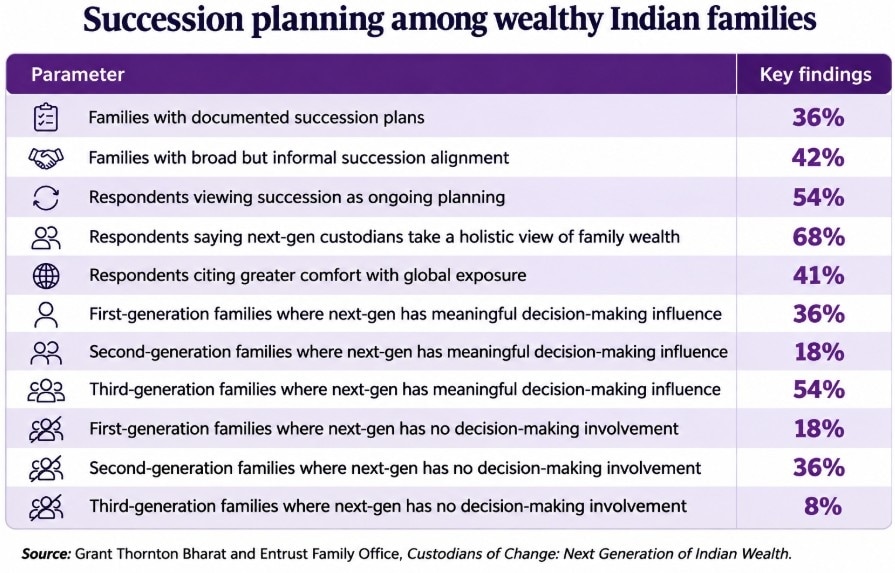



 Without documented succession plans, questions around business leadership, responsibilities and decision-making during transitions can remain unresolved.
Only 36% of wealthy Indian families have a clear, documented succession plan, highlighting a significant gap in how family businesses are preparing for leadership transitions and intergenerational wealth transfer. While another 42% have broad alignment on succession, these arrangements remain informal and have yet to be translated into documented plans, according to a study by Grant Thornton Bharat and Entrust Family Office.
The findings point to a succession challenge for India's family enterprises, where agreement among family members does not necessarily translate into clarity on roles, responsibilities and decision-making authority when leadership changes hands.

 'Settle it among yourselves': FM Sitharaman calls for amicable resolution of Tata Sons dispute
 Will Budget 2027 roll out red carpet for FPIs? FM Sitharaman says, 'I recognise the voice'
 'FIIs are sheep': Aswath Damodaran says now is a good time to invest in Indian stocks
 India hits climate target 5 years early, targets 500 GW green capacity: PM Modi
 NSE at BSE: The celebrity tenant and its modest rent cheque
 Why WhiteOak Capital Is Shifting From Small Caps To Large Caps Amid Changing Market Valuations
 Large Caps Set To Outperform As Market Rotation Begins, Expert Flags Global Risks For Indian Markets
 Sun Pharma Q2 Sales Rise 11.8% To ₹16,100 Crore; India Grows 17.3%, US Sales Decline 8.2%
 EXCLUSIVE | Market Masters | Diwali Special: Motilal Oswal's Raamdeo Agrawal On Samvat 2083 Outlook
 Daily Calls: Ask Your STOCK MARKET TODAY QUERIES | Market Update | Share Market News Today

 Muthoot FinCorp looks beyond gold loans with ₹3,000 crore IPO
 Sensex soars 1,233 points; Nifty nears 23,450 as markets extend rally for third straight session
 Analyst expects rally in large caps, banking stocks; here's why
 Reliance Industries shares surge 12%, biggest single-day gain since April 2020
 Small caps, mid caps still have room for rally in 2027 despite large cap expectations, says analyst
 Rs 8,000 Diwali bonus scam: PIB warns against fake WhatsApp messages claiming PM's cash benefit
 India's real estate investment boom: Why choosing the right asset matters more than location
 From cotton to medicines: Pakistan businesses push to restore India trade after $40 billion loss'FIIs are sheep': Aswath Damodaran says now is a good time to invest in Indian stocks
 Nitin Gadkari to launch Toyota's flex-fuel Innova Hycross in November; says carmakers gearing up for 100% ethanol cars


