Must read: From reactive to proactive AI: Qualcomm’s Sumit Sonal lays out vision for on-device agentic AI in India
Central to this transition is the diversification of form factors. While earbuds and smart glasses continue to command headlines, Asghar revealed that Qualcomm sees the new platform driving even smaller hardware silhouettes.
"For Snapdragon Sound Elite Gen 2, it actually goes beyond glasses, in my opinion," Asghar explained. "It actually goes to devices like rings. It goes to devices that could be very small pendants, for example, that you wear... All of those can now leverage the amazing power consumption and all the architectural changes that we've brought into the Snapdragon Sound Elite Gen 2."
The Visual Modality Without Storage Constraints
One of the company's recent standout showcases involved an audio-vision concept in collaboration with Cleer, which pairs an audio wearable with miniature cameras. Addressing concerns over whether such wearables require internal storage or high-bandwidth video pipelines, Asghar clarified that these optical sensors exist primarily to feed ambient visual context into local AI agents.
"What is AI trying to do with the visual cue?" Asghar noted. "What it's trying to do is, for example, in this room, when you ask that question, it tells you, well, there are a lot of people in the room, number one. Number two, it's not a home; it's probably an office-like setting or a meeting. Or if you're outside, it tells you it's day, it's a bright day, there are no clouds in the sky. Those inputs are what make that agentic AI experience better."
Must read: Qualcomm's post-app blueprint: Don McGuire on Agentic AI, 6G and India's next frontier
Asghar emphasised the architectural separation between context gathering and high-resolution photography. While devices capturing crisp pictures for social sharing rely on platforms like the Snapdragon AR1, audio wearables and smart pins can utilise visual data primarily as sensory telemetry.
"Now, of course, there is higher-end AI processing where you may want to read a text, where you may want to translate a menu that you're holding in a dark restaurant, to be able to do OCR on that," Asghar said. "For that, you need higher-end cameras. That's not what we are talking about here. We're just talking about bringing in the visual modality into the device."
He added that this capability extends readily to form factors pinned to clothing: "Even if it's not on the ears, what if it's over here? It's on the chest as a pin or a pendant... it brings in that additional modality that makes the agent do a much better job for you."
The 1-Bit AI Paradigm: Tackling the Memory Wall
As on-device AI expands, silicon designers face a punishing memory and power trade-off. That challenge becomes particularly acute in small wearables, where memory, thermal headroom and battery capacity are tightly constrained. Qualcomm highlighted its work with PrismML, which has demonstrated 1-bit AI models running locally on low-power wearable architectures.
Asghar categorised this development as a structural breakthrough for the electronics bill of materials (eBOM). "This is very critical in my opinion," Asghar said. "Especially for small devices which are really very limited from a memory perspective, as you know, if you do a model in 8-bit versus if you do it in 1-bit, it's one-eighth the size. So let's say it was taking 1 gigabyte of DRAM; once you go to a 1-bit model, it takes 125 megabytes. That's a small fraction of what it was taking before. So now, by doing this, we can actually enable these small devices to be able to do so much more AI processing."
The theoretical reduction is significant because each model weight can be represented using one bit rather than eight, although the actual memory footprint of a complete model also depends on its architecture and the precision used for other components.
Addressing questions regarding accuracy degradation during extreme model quantisation, Asghar pointed to PrismML's compression benchmarks. "Typically, when you quantise a model, you actually lose some accuracy. The work that PrismML has done, if you look at some of the material that they have shared, they're actually able to maintain the accuracy to a great extent as you go from a 4-bit model to a 1-bit model... accuracy loss is very, very limited with the way they have done the technology."
This reduction in model footprint aligns directly with memory pressures currently confronting hardware makers. Asghar observed that while memory cost spikes have pressured smartphones and complex computing platforms, audio wearables have so far operated with much smaller baseline DRAM allocations. Furthermore, code optimisation is driving down memory demands in smart eyewear.
"In the past, many glasses used to even use 4 gigabytes of DRAM," Asghar noted. "Increasingly, all the glasses that I see coming out now are using 2 gigabytes of DRAM. And people are actually working on optimising even beyond that. And then connecting that to the 1-bit model, it does take much smaller space and memory, and that really is the opportunity there, and that will significantly reduce the memory requirement, thus making the eBOM much lower for these kinds of devices."
That matters because memory is not simply a technical constraint in a wearable. It is also a physical one: more memory can mean more power consumption, more silicon and, ultimately, a larger device.
Aggregating Context Across Disparate Ecosystems
A persistent dilemma in personal computing is ecosystem fragmentation: consumers routinely wear a smartwatch from one manufacturer, earbuds from another and carry a smartphone running a competing operating system. When asked who will own the contextual thread uniting these devices, Asghar indicated that intelligence will not reside in a single master gadget, but will circulate through a coordinated device mesh.
"We believe one of the devices that's there in this constellation of devices will aggregate these different inputs, and then be able to use it to provide the device that's going to run the AI," Asghar stated.
To facilitate this cross-brand orchestration without relying entirely on top-layer mobile operating systems, Qualcomm has developed low-level connective software.
"We have built something like that that we've in the past discussed; we call it the Multi-Device Experience," Asghar explained. "And with that, we actually built the framework to be able to, for example, share device information, to be able to understand how much compute and how much AI capability a device might have. That's the building block for it, but it has to almost be an industry standard to do it right, in my opinion."
The Connectivity Roadmap: Micro-Power Wi-Fi to Standalone 5G
In terms of untethering wearables from mobile phones, Qualcomm relies heavily on its Expanded Personal Area Network (XPAN) architecture, combining Bluetooth with integrated low-power Wi-Fi 6E. By establishing direct cloud communication through local Wi-Fi networks, wearables can process agentic queries without routing data through a handset.
Looking further ahead, Asghar confirmed that Qualcomm is exploring direct cellular integration for smart eyewear as thermal budgets and power curves improve.
"We think that as the glasses improve, we can improve power consumption as time goes by; I think the battery will be enough for us to add some sort of 5G connectivity to the glasses as well," Asghar revealed. "And we have that technology, as you know, quite well, so I think that is something that we are seeing quite a lot of interest from our operator partners as well. That would make the glasses a completely independent device, and for certain applications, that can be very valuable."



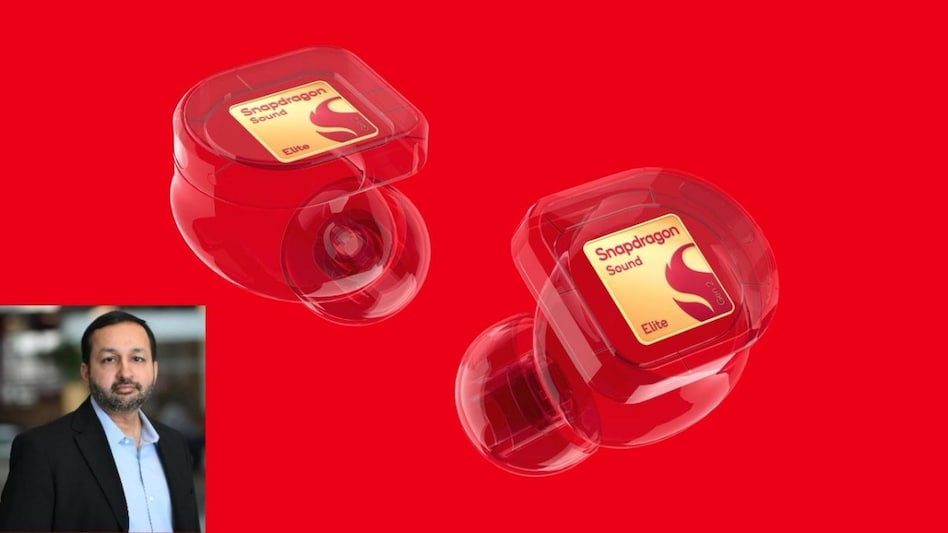 Ziad Asghar, Senior Vice President and General Manager of XR, Qualcomm

 Sensex, Nifty see sharp recovery; is the worst finally over?
 Equitas SFB shares crash 20% as CEO Vasudevan resigns to remove ‘overhang’
 Rupee under pressure despite $721 billion forex reserves: Why is the Indian currency falling?
 Adani Enterprises, Adani Ports, Adani Green, Adani Power: Why Adani stocks are rising today
 India-US trade deal: 'Farmers or domestic industry won't be compromised,' says Piyush Goyal
 4 States, 28 Seats, ZERO For Congress In Karnataka: MLC Results Give BJP Fresh Ammunition
 Spain Train Disaster: Two High-Speed Trains Collide, Rescue Teams Search Mangled Carriages
 Pidilite Top Management On Q2 Performance, Consumer Demand And Growth Strategy
 INDIA Bloc Rally At Ramlila Maidan: 3,000 Cops, Traffic Curbs And Traders’ Concerns
 Tata Group Row Escalates: Chandrasekaran’s Reappointment Draws Rahul Gandhi And BJP Into The Fray

 Ambuja Cements shares rise 2% despite 90% drop in Q2 net profit
 ITC, Mazagon Dock, Swiggy, L&T among top Diwali picks for Samvat 2083 for upto 115% upside
 Laurus Labs shares close higher as Q2 net profit jumps 126%
 Star Health shares rise 4% as brokerages share positive stance on Q2 earnings
 India’s manufacturing sector expands, adding jobs and lifting wages
 Onion prices surge 108% as food inflation bites harder in rural India












