


We don't support landscape mode yet. Please go back to portrait mode for the best experience

Ajay Banga, President of the World Bank, talks about the institution’s new vision and mission, reforms, the debt crisis and India’s G20 presidency
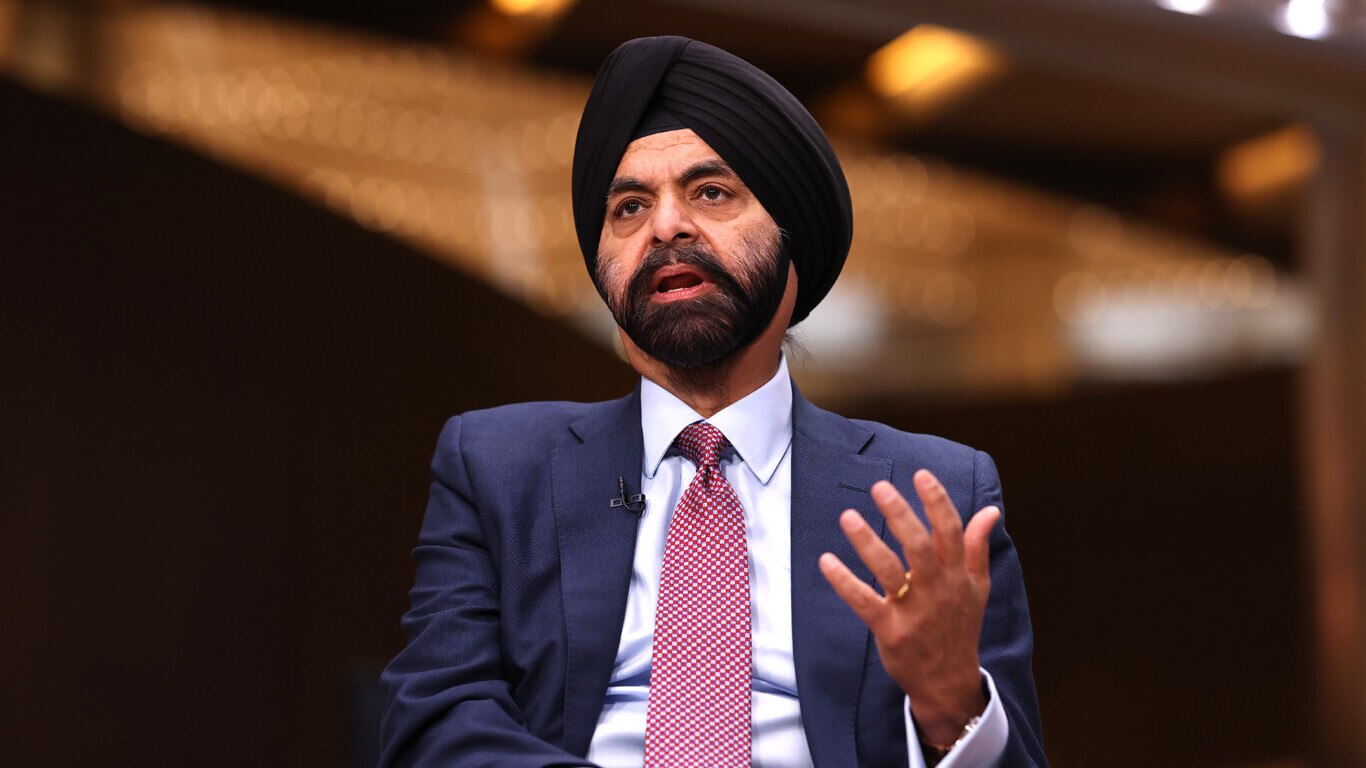
One of the key thrusts of India’s G20 presidency has been the urgent need to reform multilateral development banks (MDBs). And the World Bank features prominently in the New Delhi Declaration. US President Joe Biden is putting in a lot of effort to ensure that more funds are available with the World Bank and is looking at reforming the institution. The man entrusted with this job is Ajay Banga, President of the World Bank. In an interview with Rahul Kanwal, News Director of India Today and Aaj Tak, and Executive Director of Business Today, Banga—a former President and CEO of Mastercard—talks about how he plans to reform the World Bank, the debt crisis, and more. Edited excerpts:
A: My view got informed a great deal in the three months between being a nominee and getting elected. In those three months, I got a chance to meet leaders or finance ministers of 93 different countries... civil society, private sector companies, asset managers and the like. And that gave me a really good perspective… The first thing I learnt was that the idea of… fighting poverty, and [aiming for] shared prosperity on the one hand, separating it from climate, or pandemics, or fragility, and refugees, or food insecurity, or biodiversity… doesn’t make sense because these are intertwined crises. And when you grow up in India, you realise very quickly that if you don’t have enough rainfall, you don’t have the two crops, you don’t have the cattle because you can’t afford them, you lose your dairy income, you lose the farm labour, and you bring your child back from school to work with you. When you do that, this gain you made in poverty over decades—of getting the girl child in particular to go to school—gets reversed over the course of a few years of lack of rainfall.
When the western world speaks about climate [change], they’re speaking mostly about the emissions-heavy growth of the past. When the developing world speaks about [it]… it’s
about soil degradation, biodiversity, lack of rainfall, heat resistant varieties of seeds, catastrophes like hurricanes, and floods
The second [learning] was that people feel nervous about what climate change means. When the western world speaks about climate [change], they’re speaking mostly about the emissions-heavy growth of the past. When the developing world speaks about [it]… it’s about soil degradation, biodiversity, lack of rainfall, heat resistant varieties of seeds, catastrophes like hurricanes, and floods… And you have to be careful because both are required. You cannot tell the developing world that I’m going to focus on climate change, whichever of the two types, at the cost of giving you a school for girls or a health centre. So that’s the second big thing… [being] careful about not recognising the trade-offs that need to be made. When you put these together, what we are trying to do is … [a few] things in the evolution road map of the bank, prompted by the G20 before I came in. The first is to get a new vision and mission. The vision is to go from just poverty and prosperity to say, we want to create a world free of poverty on a liveable planet.
That liveable planet [bit] allows us to widen the aperture through which we look at the world to include climate, pandemics, fragility and food insecurity—so you can dedicate your resources to the intertwined nature of these challenges. The second thing we’ve done is to make it inclusive… [people] speak about inclusion to include marginalised people. That’s important, but half of the world’s population—women—are still not able to access the same opportunities that a man does… So I’m focussing on women and young people, because young people are the energy of the developing world, and we’ve got to give them quality of life and jobs.
A: This whole reform of MDBs has been part of the G20 evolution framework. And India took it on and aid, ‘Let’s get something done during our year.’ For a guy who’s new to the institution, who sees the need for change, this is like getting wind in your sails. Because you get people contributing their thinking, you have to be careful to listen to everyone, then prioritise what you want to pick on and focus on that. My focus has been to get to the better bank. And the better bank idea is the vision and mission that we were talking [about], and then get the right partnerships going for this bank with other MDBs… so I just announced a partnership with the Inter-American Development Bank, focussing on the Amazon, the Caribbean climate situation, and digitised governance. And then, the private sector and its partnerships… we’ve announced the Private Sector [Investment] Lab. And Chandra [N. Chandrasekaran, Chairman] of Tata [Sons] has volunteered his time to be a part of it. That’s to help get more private sector money into renewable energy in the developing markets… And then the third part… is getting better capital, re-sweating our balance sheet—the loan to equity ratio, hybrid capital portfolio guarantees, global public good funds… So we can sweat our balance sheet without losing our AAA rating. If I can do these three things—a clear vision and mission, good partners with a number of people, including crowdsourcing private finance money, and get the right capital work going—I think then we get the right to go back and look at a bigger bank, which is kind of what the N.K. Singh-Larry Summers report [suggests].
If I can do these three things—a clear vision and mission, good partners with a number of people, including crowdsourcing private finance money, and get the right capital work going—I think then we get the right to go back and look at a bigger bank
A: I completely disagree with the Washingtondominated word… [At] the World Bank, 55 per cent of the employees are outside of the US… India has a huge office… Nigeria, Ethiopia, Peru, Jamaica, the Pacific Islands, Indonesia… these are big offices with dedicated people. So I don’t subscribe to the Washington dominance. I think what they’re referring to is this shareholding pattern of one part of the bank, in particular, the International Bank for Reconstruction and Development (IBRD). And I think that’s because of voting power. You shouldn’t allow that to divert from the ability of management to connect with countries. [What] we do with every country is a threeyear country partnership framework; it agrees with the country what the priorities for it are. That’s not done in [Washington,] DC; it’s done in New Delhi… Jakarta… Nairobi. That’s the first link. The second link is, we put projects on the ground … these are very country driven models. What we have globally are Centres of Excellence… because the bank is both a source of financing… [and] a source of knowledge. That knowledge bank has global practices with people based not only in DC, but in India and other countries.
If you get $1 of capital into the bank and everybody else also puts in money to keep their shareholding, that leads to $6 or $7—the US puts in $1, you end up with $6 or $7 in
total in capital, you lever that five times in the balance sheet at a AAA rating, and you end up with $35 to lend in the world.
A: No, that’s not true… I think that’s the conclusion drawn from geopolitics. When I got on board with the World Bank, and I met President Biden, he was very clear [about] the leverage ability of the bank’s resources. So let me give you a very simple math: if you get $1 of capital into the bank and everybody else also puts in money to keep their shareholding, that leads to $6 or $7—the US puts in $1, you end up with $6 or $7 in total in capital, you lever that five times in the balance sheet at a AAA rating, and you end up with $35 to lend in the world. You show me a government programme of any country where $1 becomes $35, and I’ll give you a medal. So the President of the US basically said to me, ‘this is a great programme… $1 becomes $35… I should back you every day of the week.’ That’s where he’s coming from... So I think, yes, there is the geopolitics… But China is a large shareholder [of the World Bank]. And I have an excellent working relationship with them. So as far as I’m concerned, there’s work to do together.
If our International Development Association and IBRD were not able to access AAA rating, we will be no cheaper than any commercial bank
A: Absolutely not. And if you look at the final Larry Summers-N.K. Singh report, they stayed away from that topic... When you don’t do AAA rating, your ability to do that leverage [$6-7 becoming $35 is lost]… The benefit is AAA rating. You get cheaper cost of funds, which allows you to then use that differential to reduce the cost of borrowing for countries around the world. If our International Development Association and IBRD were not able to access AAA rating, we will be no cheaper than any commercial bank... That’s not going to be useful for development finance—you need blended finance, lower cost of money, longer tenors… You can’t do that without AAA rating.
A: My view is that these trillions and many zeros that people keep tossing about, you can’t be sure of the accuracy. What you are sure of is [that it’s a] very large number. One little study, I will [share]... If countries introduce the right policy frameworks, and the right regulatory frameworks, and the right basic principles of where they’re going on a topic, it can reduce the investment you need to meet an SDG goal by half…. That’s the first thing… [and] this has a double benefit; not only does it reduce the friction in getting there, it enables the private sector without whom you cannot get to these goals. You’re not going to get to these goals with multilateral bank balance sheets, or with government balance sheets; you’re going to need the private sector balance sheet, ingenuity, technology and people.
That’s what the private sector lab is about... What can we do to be helpful to make them come in? Starting with policy, it could be first risk, blended finance, concessional capital for feasibility studies; it could be help with… the supply side of this… creating projects that are bankable, helping them implement them, it could be originating to distribute, it could be managing the asset lifecycle—I take part of the balance sheet load in the early part, once the gestation is done and the utility is paying for the energy, the bank moves to the next deal. You know, there’s a lot of ways to think about how to sweat this and work with the private sector. None of it is easy. All of it will test us, but not doing anything is not an option.
A: The G20 has a common framework for this situation. The IMF and the World Bank together—the IMF takes the lead on this—have created a Global Sovereign Debt Roundtable. What happens at the roundtable is that all the creditors for that country show up and talk about what debt they have outstanding, what are covenants what the repayments are. That’s what got done recently for Zambia. And that’s the work we need to do for a few other countries. And then you can take the decision on what kind of haircuts will be taken both by the sovereign lenders, but also by other bilaterals. In the past when the World Bank and the IMF have participated and helped, what essentially happens is we are not part of the haircut regime. We are the guys who are there when the country needs new lending. So we are right now putting together a package for Zambia to look forward for the next 20 years. So that’s the role we play… get them on the table together, get an agreement and then step in to put more money on the table for them to be able to do the right thing… I want to end by [saying] one thing on debt… The debt that was taken by some of these countries in the time period of low interest rates was probably either not well enough thought through or well enough planned for in a scenario of rising interest rates. What will be very challenging also for these countries will be if these rising interest rates stay higher for longer, which is entirely possible today, because the US economy, India, ASEAN are doing better than what people thought… And so I think there is a case to be made that this entire debt situation needs to be taken on a war footing.
I’m the biggest example of ‘Make in India’—because I was born here, did my schooling from here, went to college from here, did an MBA from here, and I have not studied anything outside India
A: I told PM Modi jokingly that I’m the biggest example of ‘Make in India’—because I was born here, did my schooling from here, went to college from here, did an MBA from here, and I have not studied anything outside India—not even a training course—after moving out of India. So, I’m the ultimate example of Make in India. So, my view is what India was able to do at the G20—not only was it successful in bringing out a communiqué, more than that [what is important] is the global positioning and branding of India during the G20… meetings were held in 60 cities, people went everywhere—this is not normal; in addition, India’s efforts at digital public infrastructure, along with the few other countries, got noticed; even the World Bank made a report about it. So, the benefits for India are not only in terms of leadership, but also of India’s own global image, and I think it has been quite well handled.
UI Developer : Pankaj Negi
Creative Producer : Raj Verma
Videos: Shakshi, Gaurav Khera