
China’s battery profit boom exposes India’s toughest EV manufacturing challenge: Why it matters
China’s battery profit boom exposes India’s toughest EV manufacturing challenge: Why it matters
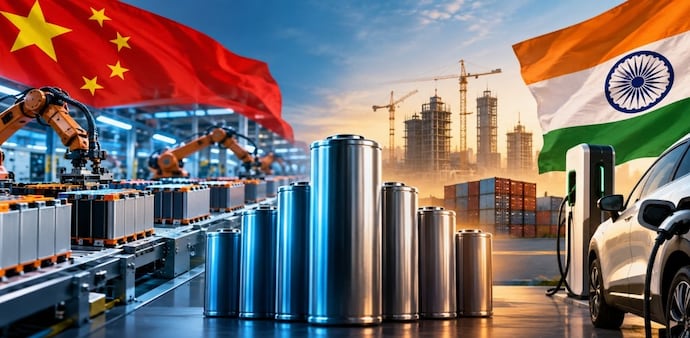
China’s battery industry is seeing record profits and renewed investment, shifting earnings towards manufacturers. India’s ₹18,100-crore battery push faces a tough test from China’s scale, technology and cost advantages.
Business Today Desk
- Oct 12, 2026,
- Updated Oct 12, 2026 1:30 AM IST
China’s battery industry is witnessing a revival in profitability and a shift in where earnings are generated across the value chain, highlighting the challenge facing India as it attempts to build a competitive domestic battery manufacturing ecosystem.
China’s battery value-chain earnings before interest and tax (EBIT) reached a reported RMB 64 billion in the second quarter of 2026, rising 6% sequentially, according to figures cited from a Citi analysis. The recovery comes alongside renewed capital expenditure across the industry, indicating that manufacturers are continuing to invest even as the competitive landscape evolves.
Advertisement
The more significant development is the changing distribution of profits. Battery manufacturers, excluding BYD, are now estimated to account for nearly 45% of industry profits, compared with the dominance of lithium miners during the commodity boom of 2022. The shift suggests that the ability to process materials, manufacture cells efficiently and integrate operations across the supply chain is becoming increasingly important in determining profitability.
India’s ₹18,100-crore battery manufacturing challenge
For India, the changing dynamics present a difficult challenge. The country is committing ₹18,100 crore through its production-linked incentive (PLI) programme to support advanced-chemistry cell manufacturing and reduce dependence on imported batteries. However, building manufacturing capacity is only the first step towards establishing a commercially sustainable industry.
Advertisement
China's competitive advantage extends beyond its installed production capacity. Its established supplier networks, manufacturing experience, technology capabilities and integration across different stages of the battery value chain can help companies improve efficiency and respond quickly to changes in demand and pricing.
Indian manufacturers, meanwhile, must develop domestic supply chains, achieve consistent production quality and raise capacity utilisation while competing with established international players. New battery plants also face substantial upfront capital requirements, making production volumes and operating efficiency critical to recovering investments.
Cheap Chinese batteries pose a dilemma for India
Advertisement
The availability of competitively priced Chinese batteries creates an additional dilemma for India. Cheaper imports can help domestic electric-vehicle manufacturers control costs and make EVs more affordable for consumers. However, they can also put pressure on the prices and margins of locally manufactured cells, complicating the business case for new Indian factories.
This creates a tension between the immediate benefits of affordable batteries and the longer-term objective of developing domestic manufacturing capabilities. Policy support can encourage investment, but it cannot by itself guarantee that Indian factories will match the cost structures and profitability of Chinese competitors.
Scale and capacity utilisation will determine profitability
The renewed capital expenditure visible in China's battery value chain also raises questions about the competitive environment that Indian manufacturers will encounter as their facilities scale up. Continued investment could reinforce China's position, although the eventual impact will depend on demand growth, capacity utilisation, pricing and the risk of oversupply.
The central issue, therefore, is not simply whether India can manufacture batteries domestically, but whether it can do so profitably without relying indefinitely on government support. The returns generated on invested capital, rather than announced capacity alone, will determine whether the country's battery ambitions translate into a durable industrial advantage.
Advertisement
As India expands its EV ecosystem, the challenge will be to turn incentives into productive capacity, competitive costs and sustainable earnings. China's experience shows that manufacturing scale can be a powerful advantage, but India's success will depend on how effectively it converts investment into commercially viable production.
China’s battery industry is witnessing a revival in profitability and a shift in where earnings are generated across the value chain, highlighting the challenge facing India as it attempts to build a competitive domestic battery manufacturing ecosystem.
China’s battery value-chain earnings before interest and tax (EBIT) reached a reported RMB 64 billion in the second quarter of 2026, rising 6% sequentially, according to figures cited from a Citi analysis. The recovery comes alongside renewed capital expenditure across the industry, indicating that manufacturers are continuing to invest even as the competitive landscape evolves.
Advertisement
The more significant development is the changing distribution of profits. Battery manufacturers, excluding BYD, are now estimated to account for nearly 45% of industry profits, compared with the dominance of lithium miners during the commodity boom of 2022. The shift suggests that the ability to process materials, manufacture cells efficiently and integrate operations across the supply chain is becoming increasingly important in determining profitability.
India’s ₹18,100-crore battery manufacturing challenge
For India, the changing dynamics present a difficult challenge. The country is committing ₹18,100 crore through its production-linked incentive (PLI) programme to support advanced-chemistry cell manufacturing and reduce dependence on imported batteries. However, building manufacturing capacity is only the first step towards establishing a commercially sustainable industry.
Advertisement
China's competitive advantage extends beyond its installed production capacity. Its established supplier networks, manufacturing experience, technology capabilities and integration across different stages of the battery value chain can help companies improve efficiency and respond quickly to changes in demand and pricing.
Indian manufacturers, meanwhile, must develop domestic supply chains, achieve consistent production quality and raise capacity utilisation while competing with established international players. New battery plants also face substantial upfront capital requirements, making production volumes and operating efficiency critical to recovering investments.
Cheap Chinese batteries pose a dilemma for India
Advertisement
The availability of competitively priced Chinese batteries creates an additional dilemma for India. Cheaper imports can help domestic electric-vehicle manufacturers control costs and make EVs more affordable for consumers. However, they can also put pressure on the prices and margins of locally manufactured cells, complicating the business case for new Indian factories.
This creates a tension between the immediate benefits of affordable batteries and the longer-term objective of developing domestic manufacturing capabilities. Policy support can encourage investment, but it cannot by itself guarantee that Indian factories will match the cost structures and profitability of Chinese competitors.
Scale and capacity utilisation will determine profitability
The renewed capital expenditure visible in China's battery value chain also raises questions about the competitive environment that Indian manufacturers will encounter as their facilities scale up. Continued investment could reinforce China's position, although the eventual impact will depend on demand growth, capacity utilisation, pricing and the risk of oversupply.
The central issue, therefore, is not simply whether India can manufacture batteries domestically, but whether it can do so profitably without relying indefinitely on government support. The returns generated on invested capital, rather than announced capacity alone, will determine whether the country's battery ambitions translate into a durable industrial advantage.
Advertisement
As India expands its EV ecosystem, the challenge will be to turn incentives into productive capacity, competitive costs and sustainable earnings. China's experience shows that manufacturing scale can be a powerful advantage, but India's success will depend on how effectively it converts investment into commercially viable production.
Read more!