
PHEV vs self-charging hybrid: MG Hector Tomahawk takes on Innova Hycross. Who wins?
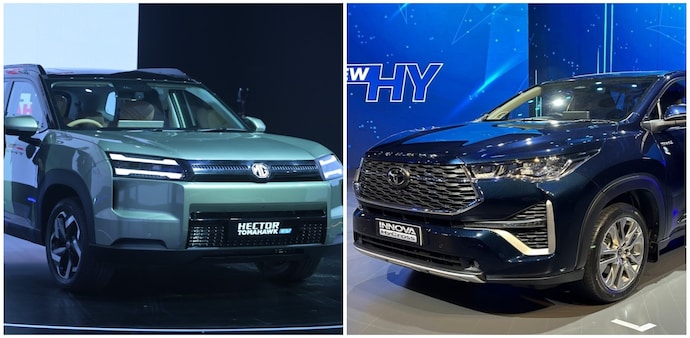
MG’s Hector Tomahawk arrives as a plug-in hybrid electric vehicle (PHEV) that can be plugged in and charged from an external power outlet. Toyota’s Hycross, on the other hand, relies on the brand's long-proven self-charging strong-hybrid mechanism.
- Aug 31, 2026,
- Updated Aug 31, 2026 11:16 AM IST
The newly-launched MG Hector Tomahawk PHEV has hit the Indian automotive market, driving headfirst into a direct showdown with the reigning segment benchmark, the Toyota Innova Hycross Hybrid ZX (O). While both three-row SUVs rely on a blend of electric and petrol power to haul families, the fundamental engineering choices driving them couldn't be more distinct.
MG’s Hector Tomahawk arrives as a plug-in hybrid electric vehicle (PHEV) that can be plugged in and charged from an external power outlet. Toyota’s Hycross, on the other hand, relies on the brand's long-proven self-charging strong-hybrid mechanism.
Price tag, dimensions & cabin tech
The financial proposition is where MG makes its initial splash. The Hector Tomahawk PHEV top 'Essence' trim enters the market priced at ₹27.79 lakh (ex-showroom). The Toyota Innova Hycross Hybrid ZX (O) carries a steeper tag of approximately ₹31.84 lakh. That positions the MG as a significant ₹4.05 lakh more affordable alternative out of the gate.
Despite the lower price point, the Innova holds the upper hand on dimensions. The Hycross stretches longer by 10mm, stands taller by 20mm, and boasts a 40mm longer wheelbase. That translates directly into luggage space — the Innova offers 239 litres of boot capacity compared to the Hector's tighter 192-litre boot.
Step inside, and the cabin experiences diverge dramatically. MG loads the Hector Tomahawk with tech firepower, featuring a massive 15.6-inch touchscreen infotainment display, an 8.8-inch digital driver cluster, a 10-speaker Infinity audio setup, 256-colour ambient lighting, and a 50W wireless charging pad.
Toyota opts for comfort over screen real estate, equipping the Hycross with a 10.1-inch central screen, a 7-inch MID, an 8-way powered driver seat, and its signature second-row powered ottoman seats.
Safety ratings & performance
On the safety front, both candidates come heavily armed. Six airbags, Level-2 ADAS, 360-degree cameras, electronic stability control, and all-wheel disc brakes come standard across both vehicles. However, Toyota holds a key credibility card with a proven 5-star Bharat NCAP rating for both adult and child occupant protection, whereas crash test ratings for the Hector Tomahawk are still awaited.
Under the hood, the powertrain specs tell a story of two different philosophies. The Hector Tomahawk combines a 1.5-litre petrol engine with a sizable 20.5 kWh battery pack, generating 198bhp of power. It supports DC fast charging, claims an impressive fuel efficiency figure of 50 km/l, and boasts a combined range exceeding 1,100 km. The Innova Hycross uses a larger 2.0-litre strong-hybrid system delivering 184bhp and a fuel efficiency rating of 22.16 km/l.
The newly-launched MG Hector Tomahawk PHEV has hit the Indian automotive market, driving headfirst into a direct showdown with the reigning segment benchmark, the Toyota Innova Hycross Hybrid ZX (O). While both three-row SUVs rely on a blend of electric and petrol power to haul families, the fundamental engineering choices driving them couldn't be more distinct.
MG’s Hector Tomahawk arrives as a plug-in hybrid electric vehicle (PHEV) that can be plugged in and charged from an external power outlet. Toyota’s Hycross, on the other hand, relies on the brand's long-proven self-charging strong-hybrid mechanism.
Price tag, dimensions & cabin tech
The financial proposition is where MG makes its initial splash. The Hector Tomahawk PHEV top 'Essence' trim enters the market priced at ₹27.79 lakh (ex-showroom). The Toyota Innova Hycross Hybrid ZX (O) carries a steeper tag of approximately ₹31.84 lakh. That positions the MG as a significant ₹4.05 lakh more affordable alternative out of the gate.
Despite the lower price point, the Innova holds the upper hand on dimensions. The Hycross stretches longer by 10mm, stands taller by 20mm, and boasts a 40mm longer wheelbase. That translates directly into luggage space — the Innova offers 239 litres of boot capacity compared to the Hector's tighter 192-litre boot.
Step inside, and the cabin experiences diverge dramatically. MG loads the Hector Tomahawk with tech firepower, featuring a massive 15.6-inch touchscreen infotainment display, an 8.8-inch digital driver cluster, a 10-speaker Infinity audio setup, 256-colour ambient lighting, and a 50W wireless charging pad.
Toyota opts for comfort over screen real estate, equipping the Hycross with a 10.1-inch central screen, a 7-inch MID, an 8-way powered driver seat, and its signature second-row powered ottoman seats.
Safety ratings & performance
On the safety front, both candidates come heavily armed. Six airbags, Level-2 ADAS, 360-degree cameras, electronic stability control, and all-wheel disc brakes come standard across both vehicles. However, Toyota holds a key credibility card with a proven 5-star Bharat NCAP rating for both adult and child occupant protection, whereas crash test ratings for the Hector Tomahawk are still awaited.
Under the hood, the powertrain specs tell a story of two different philosophies. The Hector Tomahawk combines a 1.5-litre petrol engine with a sizable 20.5 kWh battery pack, generating 198bhp of power. It supports DC fast charging, claims an impressive fuel efficiency figure of 50 km/l, and boasts a combined range exceeding 1,100 km. The Innova Hycross uses a larger 2.0-litre strong-hybrid system delivering 184bhp and a fuel efficiency rating of 22.16 km/l.