
From a lab technician's son to education entrepreneur: A ₹1 crore bet on India's young innovators
From a lab technician's son in Pilani to a technology entrepreneur, Mukesh Sharma has carved a path into education. The BITS Pilani alumnus is now backing young innovators with a ₹1 crore fund to promote practical learning and entrepreneurship.
- Nov 21, 2026,
- Updated Nov 21, 2026 1:31 PM IST
India produces millions of graduates every year, but academic qualifications do not always translate into workplace readiness. Technology entrepreneur Mukesh Sharma believes the gap between classroom learning and industry expectations highlights the need for an education system that prioritises practical skills, critical thinking and problem-solving.
India's education system has traditionally placed considerable emphasis on examinations, academic scores and formal qualifications. However, as industries increasingly demand adaptability, technical proficiency and independent thinking, questions are emerging about whether conventional classroom learning adequately prepares students for employment.
Mukesh Sharma, Chairman of Prometheus School and a BITS Pilani alumnus, encountered this challenge while building his software quality engineering company, QA InfoTech.
When academic qualifications fall short
Sharma established QA InfoTech in 2003 after working with technology companies including IBM, Quark Systems and Adobe.
During the company's early years, he identified a disconnect between academic training and the practical requirements of software testing.
Rather than relying exclusively on educational credentials, Sharma focused on training young engineers in industry-relevant skills.
According to his account, the company's engineering team expanded from nine to 75 trained professionals within a year.
The experience reinforced his belief that academic performance alone cannot adequately measure an individual's capabilities or professional potential.
Why practical skills matter
Employers increasingly look beyond degrees to assess candidates' ability to apply knowledge, solve unfamiliar problems and collaborate effectively.
In technology-related roles, practical experience with software tools, testing methodologies, communication and analytical reasoning can be as important as theoretical understanding.
An examination-focused approach may reward memorisation without necessarily developing these competencies.
However, improving employability requires more than introducing vocational courses. Schools and universities must also strengthen experiential learning, internships, project-based assessments and industry collaboration.
Can education reform begin at school?
Sharma's experience eventually influenced his decision to establish Prometheus School in Noida in 2019.
The institution offers international academic pathways, including International Baccalaureate and Cambridge programmes, with an emphasis on inquiry-based learning and independent thinking.
Its educational philosophy encourages students to approach problems creatively rather than relying solely on prescribed answers.
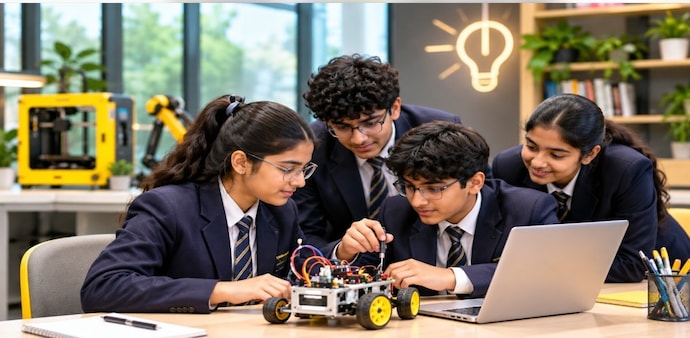
The school has also established a ₹1 crore student incubator fund intended to support entrepreneurial ideas and innovation.
Such initiatives seek to introduce students to business planning, experimentation and practical decision-making before they enter higher education.
Is changing the curriculum enough?
Experts generally distinguish between acquiring academic knowledge and developing the ability to apply it in real-world situations.
Project-based learning, internships, industry exposure and mentorship can help bridge this divide, but their effectiveness depends on implementation and accessibility.
International curricula and specialised programmes may provide opportunities, although they do not automatically guarantee stronger employment outcomes.
For Sharma, the transition from technology entrepreneurship to education reflects a broader argument: preparing students for future careers requires developing curiosity, adaptability and practical capabilities alongside academic achievement.
The larger challenge for India's education system is ensuring these opportunities extend beyond premium institutions to students across different economic backgrounds.