
'Useful life skills': NCERT Class 9 students to learn mutual funds, EMIs and taxes in new textbooks
Economist Sanjeev Sanyal says the objective is to equip students with practical financial skills
- Nov 4, 2026,
- Updated Nov 4, 2026 5:57 PM IST
NCERT has introduced chapters on personal finance and entrepreneurship in its new Class 9 Social Science textbook, bringing lessons on saving, investing, taxes and running a business into the school curriculum.
Economist and Prime Minister's Economic Advisory Council member Sanjeev Sanyal highlighted the changes on Wednesday, saying the objective was to equip students with practical financial skills.
Watch: SIP Inflows, Equity Funds & Market Trends: Anand Rathi On Samvat 2083
"The economics segment of the recently introduced NCERT textbooks for Social Science (Grade 9, Part 2) now has a chapter on personal finance. Students are taught basics about fixed deposits, mutual funds, EMI, taxes, risk-return, and so on. The idea is to provide them with useful life skills," Sanyal wrote on X.
What will Class 9 students learn?
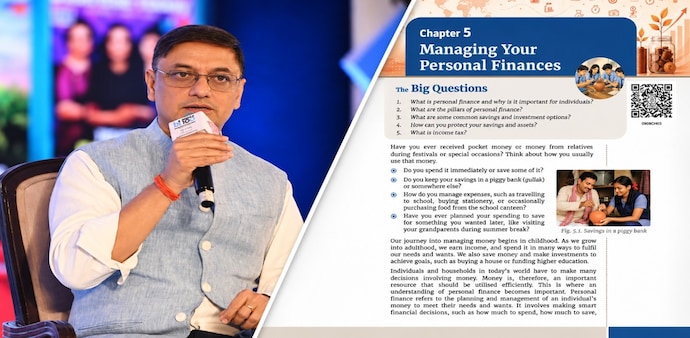
Chapter 5, titled Managing Your Personal Finances, introduces students to everyday money decisions, including spending, saving and investing.
The chapter explains how fixed deposits, mutual funds, and other investment options work. It also introduces the relationship between risk and return, explaining that lower-risk investments generally offer lower returns, while higher-risk investments may offer greater returns.
Students are taught about direct and indirect taxes, including income tax and Goods and Services Tax (GST). The textbook also introduces progressive taxation, under which higher-income individuals pay higher tax rates.
Entrepreneurship gets a separate chapter
Chapter 6, titled From Ideas to Startups, introduces students to the basics of starting and running a business.
Using the example of students setting up a lemonade stall at a school festival, the chapter explains how entrepreneurs calculate expenses, decide prices, and assess profits or losses.
It also covers business plans and four key functions of a business: management and operations, finance and accounting, human resources, and marketing and sales.
Sanyal said the new material marks a change in how business is presented to school students.
"There is also a chapter on entrepreneurship in the Grade 9 Social Science Part 2. It explains basics of profit & loss account, business plans and so. Most importantly, it presents risk-taking, innovation and business as a positive activity - quite different from how previous textbook portrayed it (with emphasis on 'hoarding' and 'black-markets')," he said.
The chapters introduce financial literacy and business concepts through everyday examples, moving beyond theoretical economic lessons to explain decisions students may face as they grow older.