
33% of India’s land is degraded: Why the soil crisis threatens farming and food security
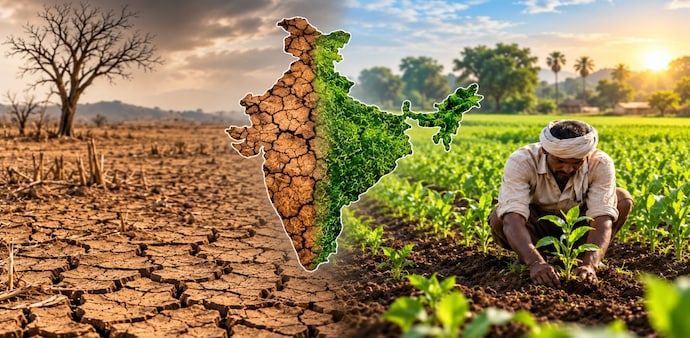
Regenerative farming can involve practices such as reduced tillage, cover cropping, crop rotation, agroforestry and livestock integration
- Sep 16, 2026,
- Updated Sep 16, 2026 2:05 AM IST
Nearly one-third of India’s soil is already degraded, raising concerns over agricultural productivity, farmer livelihoods and the country’s long-term food security, according to the report Reimagining Indian Agriculture: Unlocking the Regenerative Opportunity.
The report cites data from the Soil Physics Division of the ICAR-Indian Institute of Soil Science, which estimates that 115–120 million hectares, or around 33% of India’s total land area, had been degraded by 2024.
The scale of degradation matters because soil is the foundation of India’s farm economy. As soil quality declines, the ability of farmland to support stable and productive agriculture can weaken. The report links soil degradation with rising risks to agricultural productivity, farmer livelihoods and long-term food security. It also points to climate variability and groundwater depletion as additional pressures increasing production risks.
READ THIS: Avocado boom in India: how farmers are turning a premium fruit into a new income source
What is driving the concern?
The report argues that restoring degraded land requires a shift towards regenerative agriculture, an approach that seeks not merely to maintain farmland but to rebuild soil health, biodiversity, water resources and ecosystem functions.
Regenerative farming can involve practices such as reduced tillage, cover cropping, crop rotation, agroforestry and livestock integration. These methods are designed to increase soil organic matter, improve nutrient and water cycles and reduce dependence on synthetic inputs.
The challenge, however, is taking these practices to scale. The report identifies high transition costs, limited access to finance, underdeveloped carbon and ecosystem markets, weak monitoring systems and uncertainty over short-term farm productivity as major barriers.
ALSO READ: 90 million litres of glacier water every day: How Ladakh is reviving 1,000 acres of farmland
India already has programmes, but a policy gap remains
India has several initiatives aligned with regenerative farming. The National Mission on Natural Farming has received ₹2,481 crore and targets one crore farmers for training and adoption. The AgriSURE Fund has a corpus of ₹750 crore, while the Paramparagat Krishi Vikas Yojana provides ₹31,500 per hectare for three years for organic clusters.
Yet, the report says India lacks a nationally accepted definition and unified framework for regenerative agriculture. It recommends shifting government support from input-based subsidies towards incentives linked to measurable outcomes such as soil organic carbon, water productivity, lower input intensity, biodiversity and farmer income stability.
Nearly one-third of India’s soil is already degraded, raising concerns over agricultural productivity, farmer livelihoods and the country’s long-term food security, according to the report Reimagining Indian Agriculture: Unlocking the Regenerative Opportunity.
The report cites data from the Soil Physics Division of the ICAR-Indian Institute of Soil Science, which estimates that 115–120 million hectares, or around 33% of India’s total land area, had been degraded by 2024.
The scale of degradation matters because soil is the foundation of India’s farm economy. As soil quality declines, the ability of farmland to support stable and productive agriculture can weaken. The report links soil degradation with rising risks to agricultural productivity, farmer livelihoods and long-term food security. It also points to climate variability and groundwater depletion as additional pressures increasing production risks.
READ THIS: Avocado boom in India: how farmers are turning a premium fruit into a new income source
What is driving the concern?
The report argues that restoring degraded land requires a shift towards regenerative agriculture, an approach that seeks not merely to maintain farmland but to rebuild soil health, biodiversity, water resources and ecosystem functions.
Regenerative farming can involve practices such as reduced tillage, cover cropping, crop rotation, agroforestry and livestock integration. These methods are designed to increase soil organic matter, improve nutrient and water cycles and reduce dependence on synthetic inputs.
The challenge, however, is taking these practices to scale. The report identifies high transition costs, limited access to finance, underdeveloped carbon and ecosystem markets, weak monitoring systems and uncertainty over short-term farm productivity as major barriers.
ALSO READ: 90 million litres of glacier water every day: How Ladakh is reviving 1,000 acres of farmland
India already has programmes, but a policy gap remains
India has several initiatives aligned with regenerative farming. The National Mission on Natural Farming has received ₹2,481 crore and targets one crore farmers for training and adoption. The AgriSURE Fund has a corpus of ₹750 crore, while the Paramparagat Krishi Vikas Yojana provides ₹31,500 per hectare for three years for organic clusters.
Yet, the report says India lacks a nationally accepted definition and unified framework for regenerative agriculture. It recommends shifting government support from input-based subsidies towards incentives linked to measurable outcomes such as soil organic carbon, water productivity, lower input intensity, biodiversity and farmer income stability.