
‘A world of choke points…’: Jaishankar asks ‘middle powers’ to play a more active role
Jaishankar said countries must identify what they can bring to the table and strike partnerships based on mutual interests.
- Oct 14, 2026,
- Updated Oct 14, 2026 3:16 PM IST
The ‘middle powers’ must play a more active role in the world, said External Affairs Minister (EAM) S Jaishankar, in a world that has a tendency to weaponise its leverages. He said cooperate with one another and find partners in areas of shared interest as the global order changes and countries increasingly use economic and financial tools as strategic leverage.
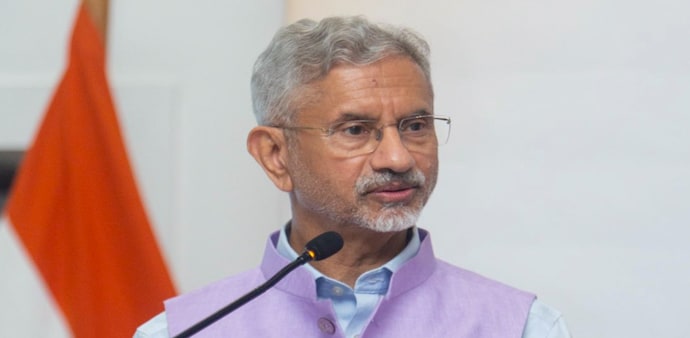
Speaking at a Bloomberg-sponsored event in Delhi, Jaishankar said India preferred the term powers in the middle, given its position as the world’s most populous country. He said countries must identify what they can bring to the table and strike partnerships based on mutual interests.
“It's not just a world of middle powers. It is also today a world of choke points. The tendency to weaponise, we tend to think of rare earths as an example. But the fact is even finance and sanctions are a choke point...We are moving to a world where the competition is going to be to who has what to bring to the table and then deals among them saying, 'You do this, I do this, let's develop this together, let's trade this for each other'... The table will exist. People will come to that in different ways, with different things to bring to the table. The behavior around the table will change. Who will talk how loudly and who will sit next to whom will also change. We should not have a pessimistic view about this process of change. This process of change was happening. It's just taken turns which we may not have anticipated."
He added that such countries need to be more active, engage with each other and find ways to advance issues of mutual interest.
DON'T MISS | 'US has deliberately become a lonelier power': EAM Jaishankar on shifting global order
Earlier this year, Canadian Prime Minister Mark Carney called on middle powers to unite amid the decline of the US-led rules-based order. This sparked debate on how countries like Canada and the UK should respond to an unpredictable superpower under President Donald Trump.
Panelists discussed proposals such as more countries joining regional trade agreements like the Comprehensive and Progressive Agreement for Trans-Pacific Partnership and the Coalition of the Willing supporting Ukraine against Russia. However, there were few signs of a comprehensive replacement for the post-Cold War security order.
Jaishankar said reliance on military power to guarantee order had been shaken, citing Russia’s invasion of Ukraine and the US attack on Iran as examples of larger countries struggling to subdue smaller ones.
MUST READ | 'US has deliberately become a lonelier power': EAM Jaishankar on shifting global order
He compared the changing global order to a corporate overhaul, with the board of directors expanding and shareholders becoming more active in debating the future of the company called Planet Earth.
Former UK prime minister Rishi Sunak said middle powers could gain leverage by becoming indispensable to others in technology and other areas. Canadian Foreign Minister Anita Anand said countries had competitive advantages but pledged that Canada would not weaponise its own.
The ‘middle powers’ must play a more active role in the world, said External Affairs Minister (EAM) S Jaishankar, in a world that has a tendency to weaponise its leverages. He said cooperate with one another and find partners in areas of shared interest as the global order changes and countries increasingly use economic and financial tools as strategic leverage.
Speaking at a Bloomberg-sponsored event in Delhi, Jaishankar said India preferred the term powers in the middle, given its position as the world’s most populous country. He said countries must identify what they can bring to the table and strike partnerships based on mutual interests.
“It's not just a world of middle powers. It is also today a world of choke points. The tendency to weaponise, we tend to think of rare earths as an example. But the fact is even finance and sanctions are a choke point...We are moving to a world where the competition is going to be to who has what to bring to the table and then deals among them saying, 'You do this, I do this, let's develop this together, let's trade this for each other'... The table will exist. People will come to that in different ways, with different things to bring to the table. The behavior around the table will change. Who will talk how loudly and who will sit next to whom will also change. We should not have a pessimistic view about this process of change. This process of change was happening. It's just taken turns which we may not have anticipated."
He added that such countries need to be more active, engage with each other and find ways to advance issues of mutual interest.
DON'T MISS | 'US has deliberately become a lonelier power': EAM Jaishankar on shifting global order
Earlier this year, Canadian Prime Minister Mark Carney called on middle powers to unite amid the decline of the US-led rules-based order. This sparked debate on how countries like Canada and the UK should respond to an unpredictable superpower under President Donald Trump.
Panelists discussed proposals such as more countries joining regional trade agreements like the Comprehensive and Progressive Agreement for Trans-Pacific Partnership and the Coalition of the Willing supporting Ukraine against Russia. However, there were few signs of a comprehensive replacement for the post-Cold War security order.
Jaishankar said reliance on military power to guarantee order had been shaken, citing Russia’s invasion of Ukraine and the US attack on Iran as examples of larger countries struggling to subdue smaller ones.
MUST READ | 'US has deliberately become a lonelier power': EAM Jaishankar on shifting global order
He compared the changing global order to a corporate overhaul, with the board of directors expanding and shareholders becoming more active in debating the future of the company called Planet Earth.
Former UK prime minister Rishi Sunak said middle powers could gain leverage by becoming indispensable to others in technology and other areas. Canadian Foreign Minister Anita Anand said countries had competitive advantages but pledged that Canada would not weaponise its own.