
After Delhi-Meerut, these 4 proposed Namo Bharat routes may cut travel time sharply
With the Delhi-Ghaziabad-Meerut Namo Bharat corridor now running, NCRTC is pushing a fresh set of western Uttar Pradesh routes. The proposed links would make Ghaziabad an interchange hub while improving access to industrial, trading and education centres.
- Aug 5, 2026,
- Updated Aug 5, 2026 1:20 PM IST
The 82-km Delhi-Ghaziabad-Meerut Namo Bharat corridor is now operational in Uttar Pradesh, with rapid rail services running on the route. In the second phase, the NCRTC may get approval for the Delhi-Shahdara-Shamli-Baraut corridor, the Ghaziabad-Bulandshahr-Khurja corridor and the Ghaziabad-Pilkhua-Hapur corridor, while the Ghaziabad-Jewar Airport route has also been placed on priority.
If these routes are taken forward, they will extend high-speed connectivity across western Uttar Pradesh, linking agricultural, trading and industrial centres such as Muzaffarnagar, Baghpat, Hapur, Bulandshahr and Shamli. The proposed network is expected to improve travel between Delhi-NCR and these towns while also strengthening links for students, traders and industries.
READ MORE: 52 extra trips announced: Namo Bharat’s big move to handle Kanwar Yatra passenger rush
Ghaziabad–Jewar Airport Namo Bharat Corridor
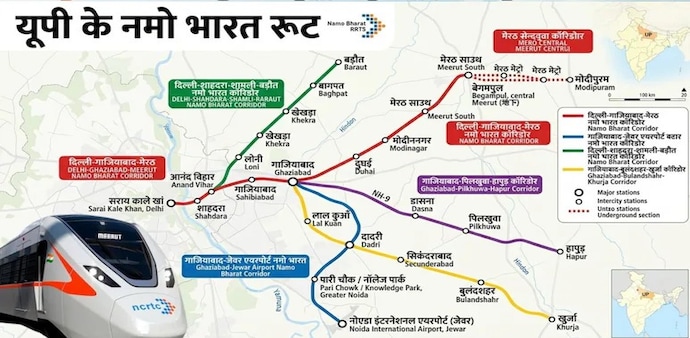
A 72-km Ghaziabad-Jewar Airport Namo Bharat corridor has been planned from the Ghaziabad RRTS station to Jewar Airport via Pari Chowk in Greater Noida. The NCRTC has already submitted its DPR for this route. Passengers coming from Meerut and Delhi will be able to change trains at Ghaziabad and travel directly to the airport. This corridor is among the priority routes.
Delhi–Shahdara–Shamli–Baraut Namo Bharat Corridor
Under the proposed Delhi-Shahdara-Shamli-Baraut corridor spanning around 55-60 kms, areas in Baghpat, Shamli and nearby towns and urban centres would get direct high-speed connectivity to Delhi. After Shahdara and Anand Vihar in Delhi, the route could extend through Loni in Ghaziabad, Khekra and Baraut in Baghpat, and further to Shamli. At present, the Delhi-Saharanpur Highway sees heavy traffic congestion, and the Namo Bharat service is expected to reduce travel time from about two hours to 30 to 40 minutes. Baghpat and Baraut are known for sugar mills, grain trade and schools and colleges, and the route is expected to make daily travel to Delhi easier for students and those linked to farming and trade.
CAN READ THIS: Delhi to Karnal, Jewar Airport by Namo Bharat? 4 proposed routes could reshape NCR travel
Ghaziabad–Bulandshahr–Khurja Corridor
The Ghaziabad-Bulandshahr-Khurja corridor is being seen as a route that could bring high-speed rail to parts of western Uttar Pradesh that are not yet connected to such a network. The proposed alignment would connect the Ghaziabad RRTS station with Lalkuan, Dadri, Sikandrabad, Bulandshahr and Khurja. The route is expected to be around 65 to 70 km long. Khurja has a ceramic industry, while Sikandrabad and Dadri have major industrial parks and depots. The route would pass near the Eastern Dedicated Freight Corridor and the Delhi-Howrah rail line and is being positioned as important for logistics and manufacturing in Delhi-NCR.
Ghaziabad–Pilkhuwa–Hapur Corridor
The Ghaziabad-Pilkhua-Hapur corridor, estimated at 30 to 35 km, would connect the Ghaziabad rapid rail station with Dasna, Pilkhua and Hapur. The area around Hapur and Pilkhua lies close to Ghaziabad, and amid space constraints in Noida and Ghaziabad, these places could develop as larger urban centres. Running parallel to NH-9, earlier known as NH-24, the corridor could also ease traffic pressure on the highway. Pilkhua is known for its handloom and textile industry as well as major engineering and medical colleges, and the route is expected to benefit thousands of students and businesspersons. Travellers between Ghaziabad and Hapur would also not have to depend on busy highway traffic for travel to Delhi.
Delhi–Ghaziabad–Meerut Namo Bharat Corridor Completed
The Delhi-Ghaziabad-Meerut Namo Bharat corridor is the country’s first Regional Rapid Transit System project and has been completed. It has reduced travel time between Delhi and Meerut to 50 to 55 minutes. The corridor runs from Sarai Kale Khan in Delhi to Modipuram in Meerut. Its Delhi stations are Sarai Kale Khan, New Ashok Nagar and Anand Vihar. In Ghaziabad, the stations are Sahibabad, Ghaziabad, Guldhar, Duhai, Duhai Depot, Murad Nagar, Modi Nagar South and Modi Nagar North. In the Meerut section, the stations are Meerut South, Partapur, Rithani, Shatabdi Nagar, Brahmpuri, Meerut Central (underground), Bhainsali (underground), Begumpul (underground), Mesville, Daurli, Modipuram and Modipuram Depot.
Extension to Haridwar–Rishikesh
There is also a proposal to extend the corridor beyond Modipuram in Meerut through Muzaffarnagar and Roorkee to Haridwar and Rishikesh in Uttarakhand. If implemented, this would provide direct high-speed connectivity from Delhi and western Uttar Pradesh to Haridwar and Rishikesh.
Ghaziabad to Become an Interchange Hub
At the same time, the Ghaziabad RRTS station is set to function as an interchange hub, allowing passengers to switch between routes for Meerut, Delhi, Jewar Airport, Hapur, Khurja and Baraut. Through Ghaziabad, it is also expected to connect with Sarai Kale Khan in Delhi and with the Delhi-Panipat-Karnal and Delhi-Alwar Namo Bharat corridors. Overall, the existing Delhi-Meerut line and the proposed new corridors are aimed at expanding high-speed connectivity across western Uttar Pradesh and strengthening links between residential, industrial and commercial centres.
The 82-km Delhi-Ghaziabad-Meerut Namo Bharat corridor is now operational in Uttar Pradesh, with rapid rail services running on the route. In the second phase, the NCRTC may get approval for the Delhi-Shahdara-Shamli-Baraut corridor, the Ghaziabad-Bulandshahr-Khurja corridor and the Ghaziabad-Pilkhua-Hapur corridor, while the Ghaziabad-Jewar Airport route has also been placed on priority.
If these routes are taken forward, they will extend high-speed connectivity across western Uttar Pradesh, linking agricultural, trading and industrial centres such as Muzaffarnagar, Baghpat, Hapur, Bulandshahr and Shamli. The proposed network is expected to improve travel between Delhi-NCR and these towns while also strengthening links for students, traders and industries.
READ MORE: 52 extra trips announced: Namo Bharat’s big move to handle Kanwar Yatra passenger rush
Ghaziabad–Jewar Airport Namo Bharat Corridor
A 72-km Ghaziabad-Jewar Airport Namo Bharat corridor has been planned from the Ghaziabad RRTS station to Jewar Airport via Pari Chowk in Greater Noida. The NCRTC has already submitted its DPR for this route. Passengers coming from Meerut and Delhi will be able to change trains at Ghaziabad and travel directly to the airport. This corridor is among the priority routes.
Delhi–Shahdara–Shamli–Baraut Namo Bharat Corridor
Under the proposed Delhi-Shahdara-Shamli-Baraut corridor spanning around 55-60 kms, areas in Baghpat, Shamli and nearby towns and urban centres would get direct high-speed connectivity to Delhi. After Shahdara and Anand Vihar in Delhi, the route could extend through Loni in Ghaziabad, Khekra and Baraut in Baghpat, and further to Shamli. At present, the Delhi-Saharanpur Highway sees heavy traffic congestion, and the Namo Bharat service is expected to reduce travel time from about two hours to 30 to 40 minutes. Baghpat and Baraut are known for sugar mills, grain trade and schools and colleges, and the route is expected to make daily travel to Delhi easier for students and those linked to farming and trade.
CAN READ THIS: Delhi to Karnal, Jewar Airport by Namo Bharat? 4 proposed routes could reshape NCR travel
Ghaziabad–Bulandshahr–Khurja Corridor
The Ghaziabad-Bulandshahr-Khurja corridor is being seen as a route that could bring high-speed rail to parts of western Uttar Pradesh that are not yet connected to such a network. The proposed alignment would connect the Ghaziabad RRTS station with Lalkuan, Dadri, Sikandrabad, Bulandshahr and Khurja. The route is expected to be around 65 to 70 km long. Khurja has a ceramic industry, while Sikandrabad and Dadri have major industrial parks and depots. The route would pass near the Eastern Dedicated Freight Corridor and the Delhi-Howrah rail line and is being positioned as important for logistics and manufacturing in Delhi-NCR.
Ghaziabad–Pilkhuwa–Hapur Corridor
The Ghaziabad-Pilkhua-Hapur corridor, estimated at 30 to 35 km, would connect the Ghaziabad rapid rail station with Dasna, Pilkhua and Hapur. The area around Hapur and Pilkhua lies close to Ghaziabad, and amid space constraints in Noida and Ghaziabad, these places could develop as larger urban centres. Running parallel to NH-9, earlier known as NH-24, the corridor could also ease traffic pressure on the highway. Pilkhua is known for its handloom and textile industry as well as major engineering and medical colleges, and the route is expected to benefit thousands of students and businesspersons. Travellers between Ghaziabad and Hapur would also not have to depend on busy highway traffic for travel to Delhi.
Delhi–Ghaziabad–Meerut Namo Bharat Corridor Completed
The Delhi-Ghaziabad-Meerut Namo Bharat corridor is the country’s first Regional Rapid Transit System project and has been completed. It has reduced travel time between Delhi and Meerut to 50 to 55 minutes. The corridor runs from Sarai Kale Khan in Delhi to Modipuram in Meerut. Its Delhi stations are Sarai Kale Khan, New Ashok Nagar and Anand Vihar. In Ghaziabad, the stations are Sahibabad, Ghaziabad, Guldhar, Duhai, Duhai Depot, Murad Nagar, Modi Nagar South and Modi Nagar North. In the Meerut section, the stations are Meerut South, Partapur, Rithani, Shatabdi Nagar, Brahmpuri, Meerut Central (underground), Bhainsali (underground), Begumpul (underground), Mesville, Daurli, Modipuram and Modipuram Depot.
Extension to Haridwar–Rishikesh
There is also a proposal to extend the corridor beyond Modipuram in Meerut through Muzaffarnagar and Roorkee to Haridwar and Rishikesh in Uttarakhand. If implemented, this would provide direct high-speed connectivity from Delhi and western Uttar Pradesh to Haridwar and Rishikesh.
Ghaziabad to Become an Interchange Hub
At the same time, the Ghaziabad RRTS station is set to function as an interchange hub, allowing passengers to switch between routes for Meerut, Delhi, Jewar Airport, Hapur, Khurja and Baraut. Through Ghaziabad, it is also expected to connect with Sarai Kale Khan in Delhi and with the Delhi-Panipat-Karnal and Delhi-Alwar Namo Bharat corridors. Overall, the existing Delhi-Meerut line and the proposed new corridors are aimed at expanding high-speed connectivity across western Uttar Pradesh and strengthening links between residential, industrial and commercial centres.