
Airport security upgrade: Why your mangalsutra or janeu won’t trigger scanner alarms anymore
The Bureau of Civil Aviation Security (BCAS) has launched trials of of full-body scanners at Bengaluru and Cochin airports to gather alarm data. a
- Oct 2, 2026,
- Updated Oct 2, 2026 2:00 PM IST
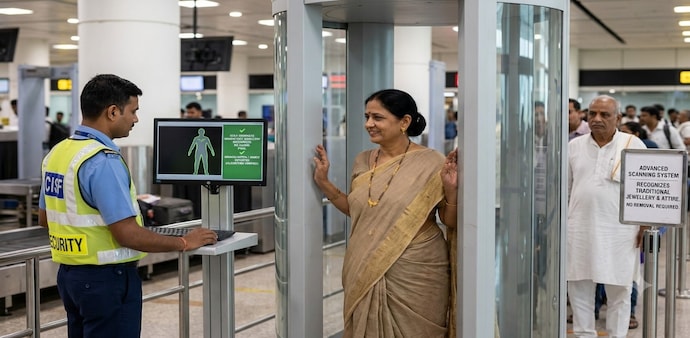
Wearing a mangalsutra or janeu will soon no longer trigger airport security alarms as the civil aviation ministry refines scanner algorithms to recognise traditional Indian attire and jewellery.
The Bureau of Civil Aviation Security (BCAS) has launched trials of of full-body scanners at Bengaluru and Cochin airports to gather alarm data. The aviation security regulator is collaborating with equipment manufacturers and vendors to update software, preventing scanners from flagging daily religious items.
“Full-body scanners have been designed for foreign countries (no trigger for other jewellery), but keeping in mind Indian requirements such as mangal sutra and even janeu, it requires refining of the algorithm. The work is in progress as we are collecting data from the ongoing trials of full body scanners,” said BCAS Director General Rajesh Nirwan.
While full-body scanners flag metallic items, foreign airports have already adapted their systems to permit standard jewellery and medical implants.
Although the government mandated full-body scanners across eight major airports, privacy concerns slowed initial rollouts.
Nirwan clarified that the upcoming scanners will feature image-agnostic displays showing generic mannequin silhouettes. “The technology will display on the screen if something suspicious is detected or where something is kept on the body and will show only that particular part,” he said.
The BCAS is implementing broader security enhancements to keep pace with rapid expansion. India currently operates 164 airports, with plans to expand the network to 350 locations by 2047.
Wearing a mangalsutra or janeu will soon no longer trigger airport security alarms as the civil aviation ministry refines scanner algorithms to recognise traditional Indian attire and jewellery.
The Bureau of Civil Aviation Security (BCAS) has launched trials of of full-body scanners at Bengaluru and Cochin airports to gather alarm data. The aviation security regulator is collaborating with equipment manufacturers and vendors to update software, preventing scanners from flagging daily religious items.
“Full-body scanners have been designed for foreign countries (no trigger for other jewellery), but keeping in mind Indian requirements such as mangal sutra and even janeu, it requires refining of the algorithm. The work is in progress as we are collecting data from the ongoing trials of full body scanners,” said BCAS Director General Rajesh Nirwan.
While full-body scanners flag metallic items, foreign airports have already adapted their systems to permit standard jewellery and medical implants.
Although the government mandated full-body scanners across eight major airports, privacy concerns slowed initial rollouts.
Nirwan clarified that the upcoming scanners will feature image-agnostic displays showing generic mannequin silhouettes. “The technology will display on the screen if something suspicious is detected or where something is kept on the body and will show only that particular part,” he said.
The BCAS is implementing broader security enhancements to keep pace with rapid expansion. India currently operates 164 airports, with plans to expand the network to 350 locations by 2047.