
'And even today, parts of India are occupied, but we did not...': S Jaishankar's sharp rebuttal to Japanese journalist on Russia-Ukraine query
External Affairs Minister S Jaishankar said that India's territory has been occupied by another nation, and despite this, there has been a global silence on the issue.
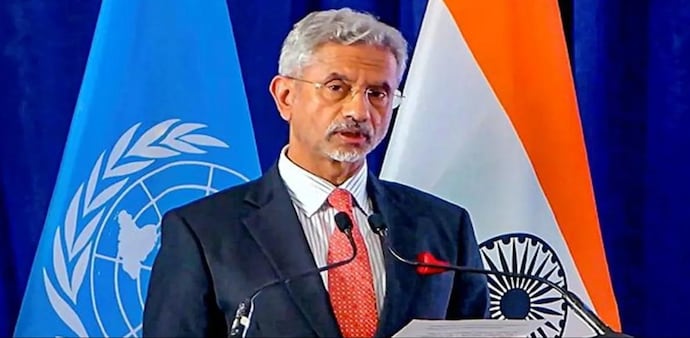
- Mar 8, 2024,
- Updated Mar 8, 2024 2:52 PM IST
In response to a question regarding India's stance on the conflict between Russia and Ukraine, External Affairs Minister S Jaishankar stated on Friday that India's territory has been occupied by another nation, and despite this, there has been a global silence on the issue.
Taking a subtle dig at Western nations, External Affairs Minister S Jaishankar remarked that people often selectively choose principles based on their convenience and overlook them when it doesn't suit their interests. Jaishankar is currently on an official visit to Japan. A Japanese journalist asked S Jaishankar if India's decision not to denounce Russia for its territorial violation of Ukraine should be interpreted as "double-standards".
S Jaishankar remarked that the world is a complex place with various important principles and beliefs. He noted that in global politics, countries tend to cherry-pick issues or principles based on their convenience. Jaishankar emphasized that India, with its history of experiencing aggression and attempts to alter its boundaries after independence, understands these dynamics well.
"My position would be that the world is a complicated place, and there are many important principles and beliefs in the world. What happens sometimes in world politics is that countries pick one issue, one situation, one principle, and they highlight it because it suits them. But if one looks at the principle itself, we in India know better than almost any other country because immediately after our independence, we experienced aggression, we experienced an effort to change our boundaries," S Jaishankar said.
Jaishankar highlighted India's ongoing territorial challenges, stating that certain parts of the country are still occupied by another nation. He expressed disappointment that the world didn't rally around India based on principles when it faced similar situations in the past. He criticized the selective application of principles, pointing out that they are often chosen or ignored based on convenience rather than consistent adherence.
"And even today, parts of India are occupied by another country. But we did not see the world response saying, oh, there's a great principle involved, and therefore, let us all go with India. Yes, today we are being told that there are principles involved. I wish I'd seen that principle in play for the last 80 years. I've seen those principles cherry-picked when it suits people and not when it doesn't suit people," he added.
In the same interview, S Jaishankar highlighted the necessity for UN Security Council reform. Jaishankar emphasised the necessity of reforming the United Nations, underscoring the significant increase in its membership from about 50 countries at its inception to nearly 200 today. He pointed out that the growth in membership requires a corresponding evolution in the leadership and decision-making processes of the organization.
"Most of us actually understand that there is a great need to reform the United Nations. When the United Nations was founded, there were roughly about 50 countries who were members. Today there are almost 200 countries that are members. So in any organization, if the membership has grown four times, the leadership and the decision-making of that organization cannot remain the same," he said. S Jaishankar, alluding to China without explicitly naming it, noted that those resistant to change have devised methods to impede the reform process.
"We are seeing today the problem when there is inadequate...If you look today at the dynamism of Asia, the demographics of Asia, I think there's a very strong case as well. So these discussions are going on. We felt that in many ways, the discussions have not progressed because those who are opposed to any change have found ways of delaying it," he said.
India has faced opposition from China, the only permanent member of the United Nations Security Council (UNSC) opposed to India's inclusion in the panel. S Jaishankar responded to a query about his potential candidacy in the upcoming Lok Sabha elections, stating that he is currently a member of the Rajya Sabha, the Upper House of the Parliament. "You make your political decision based on what the party leadership decides. So I just got re-elected to the upper house (Rajya Sabha) last year. My membership of Parliament is secure. Beyond that, that is not really a question I can answer," he said.
Jaishankar has been steadfast in defending India's decision to purchase cheaper oil from Russia, emphasizing the country's right to prioritize the well-being of its citizens. Recently, Russian Foreign Minister Sergey Lavrov praised India's stance on procuring Russian oil, even in the face of significant pressure from Western powers.
“My friend, foreign minister Subramanyam Jaishankar, was once at the UN, giving a speech. He was asked why they started buying so much oil from Russia. He advised them to mind their own business and reminded them at the same time how much oil the West had started buying and continued to buy oil from the Russian Federation. This is national dignity,” Sergey Lavrov was quoted as saying by Sputnik news agency.