
Before Ravi Varma: How Kolkata's artists brought Goddess Kali from temples into Indian homes
Long before Raja Ravi Varma's printing press popularised religious imagery, artists in 19th-century Calcutta were producing colourful prints of Goddess Kali. These affordable images helped bring the fierce yet protective goddess from temples and sacred spaces into ordinary Indian households.
- Nov 7, 2026,
- Updated Nov 7, 2026 5:30 AM IST
Every year, as Diwali approaches, Goddess Kali becomes the centre of elaborate celebrations across West Bengal and parts of eastern India. Her dark complexion, extended tongue, garland of severed heads and commanding presence over Lord Shiva form one of Hinduism's most recognisable religious images.
But the familiar pictures of Kali found in household prayer rooms have a history that stretches beyond temple worship. Their widespread circulation owes much to artists and printing workshops in 19th-century Calcutta, now Kolkata, who helped transform religious imagery into affordable, mass-produced prints.
Vaishnavi Patil, Assistant Curator of South & Southeast Asian Art at The Metropolitan Museum of Art, wrote in an article that the introduction of lithography in the 19th century transformed how Hindu gods and goddesses were depicted, reproduced and brought into ordinary households. The technology allowed religious images that were once encountered primarily in temples, sculptures and manuscripts to circulate widely through markets, picture depots and domestic shrines.
Before mass printing: Kali in temples and manuscripts
For centuries, devotees encountered Goddess Kali through temple sculptures, sacred manuscripts, paintings and religious rituals.
Her image was particularly significant in Bengal, where she has long been worshipped as a powerful manifestation of the Divine Mother.
Patil traces one of the earliest textual references to Kali to the sixth-century Devi Mahatmya, which describes her emerging as the embodied fury of Goddess Durga to destroy demonic forces.
Over time, Kali came to represent a complex combination of destruction, renewal, protection and maternal compassion.
Despite her terrifying appearance, devotees affectionately address her as Ma, or Mother.
How Calcutta became a centre for Kali prints
The arrival of chromolithography in the 1860s opened a new chapter in Bengal's religious art.
According to Patil, printing workshops in Calcutta quickly began producing images of Kali, allowing devotional pictures to reach audiences far beyond temples and traditional artistic circles.
Lithography enabled artists to draw directly onto stone, from which numerous impressions could be produced. Chromolithography added successive layers of colour, creating striking images with deep blues, reds, yellows and blacks.
These prints were inexpensive, portable and easily replaceable.
They could be purchased from markets and picture depots, displayed in domestic shrines or circulated through advertisements, postcards and magazines.
This technological shift helped carry sacred imagery into the homes of ordinary worshippers, fundamentally changing how people encountered religious art.
The forgotten artists who shaped Kali's popular image
Among the important examples documented by Patil is an early Battala print by Sri Hemchandra Das, dating to approximately 1850–70.
The image depicts Kali alongside Jagaddhatri, demonstrating how religious imagery circulated through printmaking traditions before the widespread adoption of colour lithography.
Another significant example is a print produced by G. C. Dass around 1880–85.
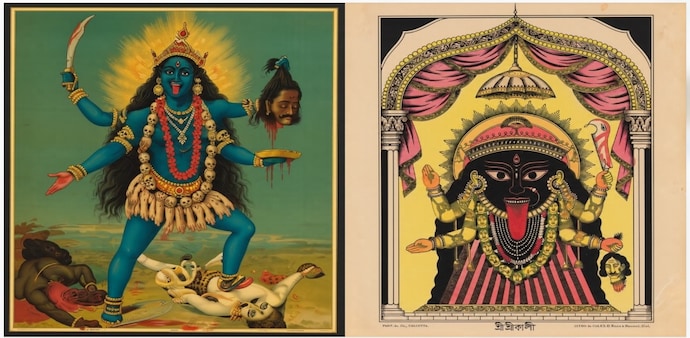
The artwork closely resembles the iconic representation of Kali worshipped at Kolkata's Kalighat Temple.
With her enlarged head, wide-set eyes and protruding tongue, the goddess appears in a form that devotees would immediately recognise.
Such prints allowed worshippers to bring a representation of the sacred Kalighat idol into their own homes.
The Calcutta Art Studio also contributed to this visual tradition. Its 1879 chromolithograph of Kali demonstrates how printing workshops combined established religious iconography with new reproduction techniques.
Why Kalighat Temple mattered
Kolkata's Kalighat Temple played an important role in shaping the goddess's popular visual identity.
The temple is regarded as one of the sacred Shakti Peethas, sites associated with the mythology of Goddess Sati.
According to tradition, Kalighat marks the place where Sati's right toes fell after Lord Vishnu divided her body to end Shiva's grief-stricken cosmic wandering.
The temple's distinctive representation of Kali became a recognisable model for artists producing devotional prints.
Through lithography, worshippers who could not regularly visit the temple could still keep a familiar representation of the goddess in their household shrines.
From Bengal's workshops to the Ravi Varma Press
By the early 20th century, devotional printing had developed into a wider industry across India.
Patil highlights Kali, the Wrathful Protector, a chromolithograph produced by the Ravi Varma Press around 1910–20 and now held by The Metropolitan Museum of Art.
The image shows Kali standing on Shiva's body, adorned with severed heads and arms and holding weapons associated with her role as a destroyer of evil.
Its dramatic colours echo earlier Bengali lithographs, illustrating how religious imagery circulated and evolved across regional printing traditions.
Although Raja Ravi Varma became widely associated with the mass production of Hindu religious pictures, Kolkata's artists and publishers had already helped establish an important tradition of affordable devotional prints.
How Kali became a household protector
The importance of these prints extended beyond their artistic or commercial value.
In domestic shrines, Kali's image represented not simply the destruction of demons but also protection against dangers confronting the household.
Her fierce appearance carried a reassuring message for devotees: destructive power could be directed against evil and threats.
Patil explains that these mass-produced images could be touched, addressed, adorned and replaced. Their religious significance was reinforced through everyday devotional use rather than rarity.
This transformation helped establish Kali as both a powerful cosmic deity and an intimate household presence.
A legacy that survives every Kali Puja
More than a century later, the visual traditions established by Bengal's early printmakers remain deeply embedded in religious life.
During Kali Puja, celebrated on the new moon night of Kartik and often coinciding with Diwali, devotees worship the goddess as a symbol of protection, transformation and spiritual liberation.
The images displayed in homes today are part of a much longer history of artistic experimentation, religious devotion and technological change.
While Raja Ravi Varma's printing press remains an important chapter in the popularisation of Hindu religious art, the earlier contribution of Kolkata's artists reveals another side of that transformation.
Their inexpensive prints helped bring Goddess Kali beyond temple walls and into the everyday lives of devotees, making the fierce Divine Mother a familiar and enduring presence in Indian homes.