
Bhargavastra trials completed: How India's new system can destroy drone swarms
Bhargavastra is a mobile, multi-layered defence system designed to destroy hostile drones, weaponised unmanned aerial vehicles (UAVs), loitering munitions and autonomous drone swarms
Manjeet Negi
- Nov 26, 2026,
- Updated Nov 26, 2026 10:10 PM IST
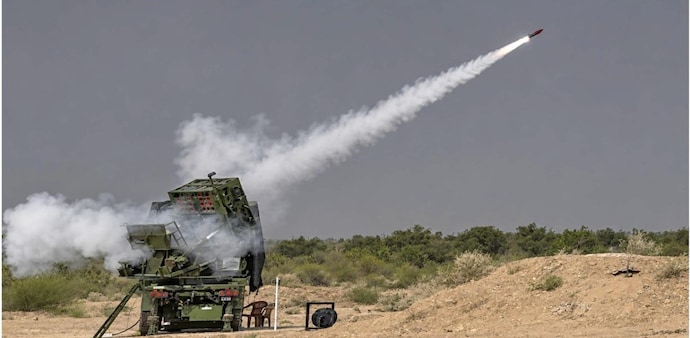
India has successfully completed development trials of Bhargavastra, the country's first indigenously designed and developed two-layer, vehicle-mounted counter-swarm drone system, at the Pokaran field firing ranges in Rajasthan. This marks a major step in strengthening India's air defence capabilities against drone attacks, an increasingly prominent threat in modern warfare.
Advertisement
Developed by Solar Defence and Aerospace Limited (SDAL), the trials were conducted from November 20 to 24. The system is designed to counter enemy drones, particularly attacks involving multiple drones flying together in coordinated swarms and has the capability to engage several aerial targets simultaneously.
READ THIS: India's Tejas is getting a major upgrade: What makes the Mk1A a more dangerous fighter?
Bhargavastra is a mobile, multi-layered defence system designed to destroy hostile drones, weaponised unmanned aerial vehicles (UAVs), loitering munitions and autonomous drone swarms. It uses a combination of indigenously developed unguided rockets and precision micro-missiles to intercept and destroy aerial threats.
Its two-layer design allows it to tackle different types of drone threats using different weapons. The system employs a hard-kill approach, meaning it physically destroys hostile drones rather than relying on electronic methods such as jamming communication signals or disrupting navigation systems. This makes it particularly relevant against autonomous drones that may continue operating even when their communication links are disrupted.
Advertisement
Mounted on vehicles, Bhargavastra can be moved and deployed according to operational requirements. It is designed to operate across different geographical conditions, including deserts, plains and high-altitude areas of up to 5,000 metres above mean sea level, making it suitable for deployment across India's varied border terrain.
How Bhargvastra detects and destroys drones
Bhargavastra's Command and Control Centre acts as the system's brain, bringing together information from multiple sensors to detect and track incoming aerial threats.
The system is equipped with radar capable of detecting drones at distances of up to 10 km, along with Electro-Optical/Infrared (EO/IR) surveillance systems and passive radio frequency (RF) sensors. These technologies help identify the presence of drones, track their movement and classify threats.
Advertisement
ALSO READ: Bullets, blasts and 28 soldiers: India's new armoured bus has a surprise under the hood
Once a drone or swarm is detected, the command-and-control system analyses the information and provides operators with a real-time picture of the aerial threat. It can then assign targets to the launcher, enabling the system to respond to incoming drones.
The ability to detect and track multiple drones is particularly important as drone swarms can overwhelm conventional air defence systems by approaching in large numbers. Bhargavastra is designed to address this challenge by providing a dedicated capability to counter such attacks. The system is also designed to integrate with the Indian Armed Forces' Command, Control, Communication and Intelligence (C4I) networks, allowing it to operate as part of a broader military surveillance and defence network.
The completion of the latest in-house development trials at Pokaran marks a further milestone in the development of Bhargavastra, an indigenous system aimed at addressing the rapidly evolving threat posed by drones and drone swarms on the battlefield.
Read more!