
'Census 2027 to be conducted in two phases, Phase 1 questions notified': Home Ministry
In a written reply to the Rajya Sabha, Rai said that the questions for the first phase of the nationwide enumeration exercise have also been notified.
- Mar 11, 2026,
- Updated Mar 11, 2026 2:52 PM IST
Minister of State for Home Ministry Nityanand Rai said on Wednesday that the nationwide census 2027 will be conducted in two phases. Houselisting and housing census will take place from April to September 2026, followed by population enumeration in February 2027.
In a written reply to the Rajya Sabha, Rai said that the questions for the first phase of the nationwide enumeration exercise have also been notified.
He said, "Information on the head of the household, amenities available, and assets possessed by the household will be collected in this phase. Three categories of sex of the head of household, viz. Male/Female/Transgender will be collected."
In the second phase, he said that population enumeration will take place and information of each individual will be collected and notified in due course. Nityanand Rai also mentioned that enumerators will undertake house-to-house field visits in the entire enumeration area to collect census data and avoid any exclusion on any ground.
"Provision of self-enumeration is an additional facility for the respondents to submit data. Further, FAQs, necessary 'Tool Tips' and validation checks for questions are provided in the self-enumeration portal itself to ensure accuracy of data," he added.
He also underscored that all field functionaries appointed for census work, including enumerators and supervisors, are being given adequate training. Validation rules are incorporated in the mobile app itself to ensure data consistency and accuracy.
Data collected by enumerators will also be monitored and checked by supervisors, he added. Towards the end of his reply, Rai mentioned, "All suitable measures have been taken for data security while collecting data on mobile, during data transmission and at the server level."
Census 2027 will mark a major shift as India transitions to a fully digital approach for its decennial headcount, replacing paper forms with electronic data collection. For the first time, residents will have the option for self-enumeration, submitting their details electronically during a 15-day window before the house-to-house phase begins. This is expected to improve data quality and reduce manual errors.
The Registrar General of India, Mrityunjay Kumar Narayan, noted that Census 2027 will make extensive use of digital technology to enhance the quality and timeliness of data collection. All data will be gathered through digital means, representing a transformative step in modernising the Census process.
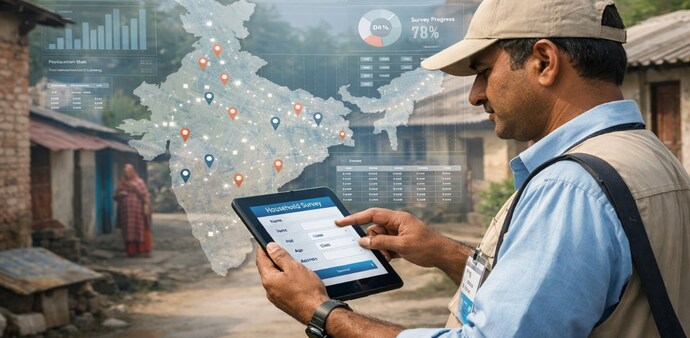
Around 3.2 million enumerators and supervisors will use handheld devices to collect data from households. These devices will transmit and validate information through the Census Monitoring and Management System (CMMS), improving speed and reducing errors.
The Census will use houselisting blocks (HLBs) and enumeration blocks (EBs) as the smallest administrative units. HLBs typically cover 700–800 people in residential areas. The demarcation and allocation of enumerators for these blocks will be managed digitally for the first time, streamlining logistics.
Digital mapping tools will enable precise boundary delineation and geo-tagging, integrating spatial data into the enumeration process. This aims to minimise overlaps and omissions, strengthening data integrity.
Minister of State for Home Ministry Nityanand Rai said on Wednesday that the nationwide census 2027 will be conducted in two phases. Houselisting and housing census will take place from April to September 2026, followed by population enumeration in February 2027.
In a written reply to the Rajya Sabha, Rai said that the questions for the first phase of the nationwide enumeration exercise have also been notified.
He said, "Information on the head of the household, amenities available, and assets possessed by the household will be collected in this phase. Three categories of sex of the head of household, viz. Male/Female/Transgender will be collected."
In the second phase, he said that population enumeration will take place and information of each individual will be collected and notified in due course. Nityanand Rai also mentioned that enumerators will undertake house-to-house field visits in the entire enumeration area to collect census data and avoid any exclusion on any ground.
"Provision of self-enumeration is an additional facility for the respondents to submit data. Further, FAQs, necessary 'Tool Tips' and validation checks for questions are provided in the self-enumeration portal itself to ensure accuracy of data," he added.
He also underscored that all field functionaries appointed for census work, including enumerators and supervisors, are being given adequate training. Validation rules are incorporated in the mobile app itself to ensure data consistency and accuracy.
Data collected by enumerators will also be monitored and checked by supervisors, he added. Towards the end of his reply, Rai mentioned, "All suitable measures have been taken for data security while collecting data on mobile, during data transmission and at the server level."
Census 2027 will mark a major shift as India transitions to a fully digital approach for its decennial headcount, replacing paper forms with electronic data collection. For the first time, residents will have the option for self-enumeration, submitting their details electronically during a 15-day window before the house-to-house phase begins. This is expected to improve data quality and reduce manual errors.
The Registrar General of India, Mrityunjay Kumar Narayan, noted that Census 2027 will make extensive use of digital technology to enhance the quality and timeliness of data collection. All data will be gathered through digital means, representing a transformative step in modernising the Census process.
Around 3.2 million enumerators and supervisors will use handheld devices to collect data from households. These devices will transmit and validate information through the Census Monitoring and Management System (CMMS), improving speed and reducing errors.
The Census will use houselisting blocks (HLBs) and enumeration blocks (EBs) as the smallest administrative units. HLBs typically cover 700–800 people in residential areas. The demarcation and allocation of enumerators for these blocks will be managed digitally for the first time, streamlining logistics.
Digital mapping tools will enable precise boundary delineation and geo-tagging, integrating spatial data into the enumeration process. This aims to minimise overlaps and omissions, strengthening data integrity.