
China is world's factory, yet graduates can't find jobs: Sridhar Vembu's warning to India
Our modern educational and economic system around the world trains young people for 'steady paycheck' jobs and those jobs are not just not growing, they are under serious challenge, says Vembu
- Nov 9, 2026,
- Updated Nov 9, 2026 3:31 PM IST
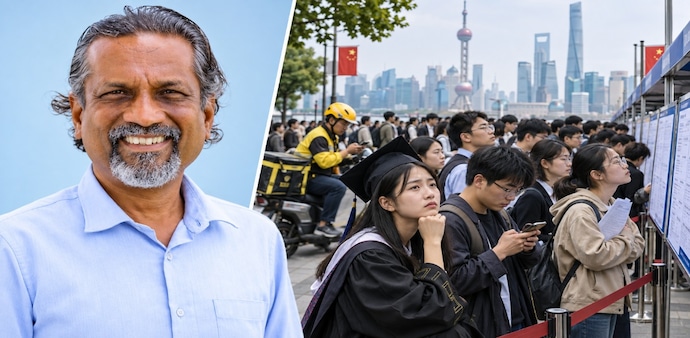
Zoho co-founder Sridhar Vembu on Monday warned Indian policymakers about the growing employment crisis among China's educated youth, saying that even the world's largest manufacturing hub was struggling to create enough jobs for college graduates. He said artificial intelligence and automation could make the problem worse.
"China is the factory of the world, has impressive technology capabilities across a vast array of sectors and runs a $1.2 trillion merchandise trade surplus and yet is not able to create jobs for a big cohort of her college-educated youth," Vembu wrote on X.
Vembu said modern education systems were designed around the expectation that young people would secure regular salaried employment after completing their studies. However, he argued, the availability of such jobs was increasingly under threat.
In Case You Missed It: 'China's economy is doing really quite badly': British author stunned by tech boom, economic slump
"Our modern educational and economic system around the world trains young people for 'steady paycheck' jobs and those jobs are not just not growing, they are under serious challenge due to automation and AI."
"This problem is about to get worse, not better," he warned.
The Zoho co-founder said governments needed to reconsider an economic model heavily dependent on large corporations providing regular employment.
"What is the solution? Dramatic gains in entrepreneurship and self-employment. That has been the foundation of prosperity even in America all the way until the mid-20th century. The rise of the big industrial and corporate 'steady paycheck' job is a relatively recent phenomenon. We have to move away from that model."
He concluded his post with a direct message: "Policymakers in India must pay heed."
China's youth unemployment at 18%
Vembu's comments came after Alex Mason, an X user, raised concerns about China's unemployment figures and the declining prospects for university graduates.
Official Chinese data showed that unemployment among urban residents aged 16 to 24, excluding students, stood at 18% in September 2026. The rate for those aged 25 to 29 was 7.4%, compared with the overall urban unemployment rate of 5.2%.
China was also expected to produce a record 12.7 million college graduates in 2026, adding pressure to an already competitive labour market.
Mason wrote: "For decades, young Chinese were promised a simple deal: Study hard. Get a good job. Become richer than your parents. That deal is breaking."
China's economic divide
British author James Crabtree, who recently spent two weeks in China, also raised concerns about employment opportunities for educated young people, including graduates from the country's leading universities.
"I was told informally that as many as half of elite Peking University graduates struggle to find work," Crabtree wrote, pointing to the difficulties facing young jobseekers even at prestigious institutions.
Crabtree also highlighted the growing dependence on gig work amid China's economic slowdown.
"The FT points out that 53m Chinese (!) now work in food delivery and ride-hailing. Roughly 200m work in the gig economy. China is clearly using the informal economy as a form of new unemployment insurance, as its economy slows," he wrote in an analysis on November 1.
He cited Chinese economist David Daokui Li's estimate that the country's actual unemployment rate could be 10.2%, compared with the official rate of just over 5%.