
Coconut shells, rice husks and more: How 4 Indian startups are giving farm waste a new life
Thenga Coco also works with local artisans, particularly rural women, who can make the products through flexible, home-based work.
- Oct 4, 2026,
- Updated Oct 4, 2026 11:50 AM IST
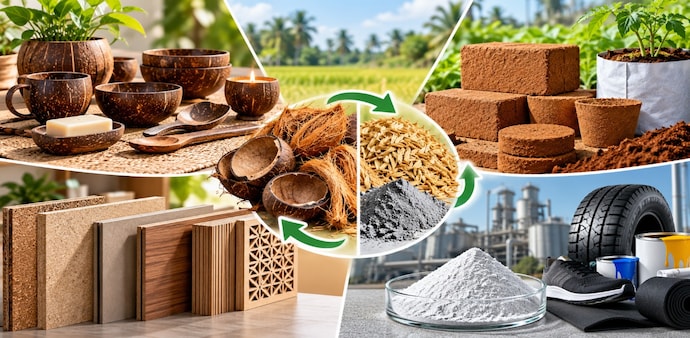
Indian startups are turning agricultural waste such as coconut shells, coconut husks and rice husks into products ranging from kitchenware and gardening supplies to furniture panels and industrial materials, The Better India reported.
Instead of being discarded or burned, these farm leftovers are being processed and reused by startups across Kerala, Tamil Nadu and Gujarat.
Kerala-based Thenga Coco, founded by Maria Kuriakose in 2019, turns discarded coconut shells into bowls, spoons, soap dishes, teacups, planters and candle holders.
The startup sources shells from local coconut oil mills and temples. The shells are polished using coconut oil instead of chemical varnishes.
Thenga Coco also works with local artisans, particularly rural women, who can make the products through flexible, home-based work.
Coconut husks help grow plants
Chennai-based Global Green Coir uses coconut husks to make cocopeat blocks, bricks, discs, grow bags and coir pots.
Don't Miss: How much do government documents cost in India? Check PAN, Passport, Aadhaar and DL fees
Founded by biotechnologist Anees Ahmed in 2014, the company processes coir pith, a material left after fibre is extracted from coconut husks.
Cocopeat is used as a soil-free growing medium in greenhouses, hydroponics, nurseries, landscaping and home gardening. The company operates manufacturing units in coconut-growing regions of Tamil Nadu and exports its products to international markets.
Rice husk becomes building material
Indowud NFC uses rice husk and other agricultural residues to make natural fibre composite panels.
The panels are made from pulverised agricultural husks, minerals and polymer binders, without harvested wood fibres. They can be used for furniture, cabinets, doors, wall panelling, decking and decorative screens.
The material is designed to be waterproof, termite-resistant and weather-resistant, and can be worked with standard carpentry tools.
Rice husk ash turns into silica
Vadodara-based Brisil Technologies, founded by Tanmay Pandya and Reshma Pandya in 2016, works with rice husk ash, which is left after rice husks are burned.
The startup has developed a process to extract high-purity silica from the ash. The material can be used in tyres, rubber products, footwear, paints and coatings.
Brisil says its process can recover up to 70% silica from rice husk ash, while its commercial-scale plants are designed to consume around 50 tonnes of biomass waste a day.
Together, these startups are finding ways to turn agricultural leftovers into products used in homes, farms and industries.
Indian startups are turning agricultural waste such as coconut shells, coconut husks and rice husks into products ranging from kitchenware and gardening supplies to furniture panels and industrial materials, The Better India reported.
Instead of being discarded or burned, these farm leftovers are being processed and reused by startups across Kerala, Tamil Nadu and Gujarat.
Kerala-based Thenga Coco, founded by Maria Kuriakose in 2019, turns discarded coconut shells into bowls, spoons, soap dishes, teacups, planters and candle holders.
The startup sources shells from local coconut oil mills and temples. The shells are polished using coconut oil instead of chemical varnishes.
Thenga Coco also works with local artisans, particularly rural women, who can make the products through flexible, home-based work.
Coconut husks help grow plants
Chennai-based Global Green Coir uses coconut husks to make cocopeat blocks, bricks, discs, grow bags and coir pots.
Don't Miss: How much do government documents cost in India? Check PAN, Passport, Aadhaar and DL fees
Founded by biotechnologist Anees Ahmed in 2014, the company processes coir pith, a material left after fibre is extracted from coconut husks.
Cocopeat is used as a soil-free growing medium in greenhouses, hydroponics, nurseries, landscaping and home gardening. The company operates manufacturing units in coconut-growing regions of Tamil Nadu and exports its products to international markets.
Rice husk becomes building material
Indowud NFC uses rice husk and other agricultural residues to make natural fibre composite panels.
The panels are made from pulverised agricultural husks, minerals and polymer binders, without harvested wood fibres. They can be used for furniture, cabinets, doors, wall panelling, decking and decorative screens.
The material is designed to be waterproof, termite-resistant and weather-resistant, and can be worked with standard carpentry tools.
Rice husk ash turns into silica
Vadodara-based Brisil Technologies, founded by Tanmay Pandya and Reshma Pandya in 2016, works with rice husk ash, which is left after rice husks are burned.
The startup has developed a process to extract high-purity silica from the ash. The material can be used in tyres, rubber products, footwear, paints and coatings.
Brisil says its process can recover up to 70% silica from rice husk ash, while its commercial-scale plants are designed to consume around 50 tonnes of biomass waste a day.
Together, these startups are finding ways to turn agricultural leftovers into products used in homes, farms and industries.