
Delhi chokes on smog: Air quality back in severe zone, IIT Delhi records season-high AQI of 488
IMD forecasts that foggy conditions will persist during the morning hours, giving way to partly cloudy skies and clearer daytime conditions later in the week. Temperatures are expected to hover with maximums reaching 28°C to 30°C and minimums dipping between 16°C and 18°C.
- Nov 13, 2026,
- Updated Nov 13, 2026 8:38 AM IST
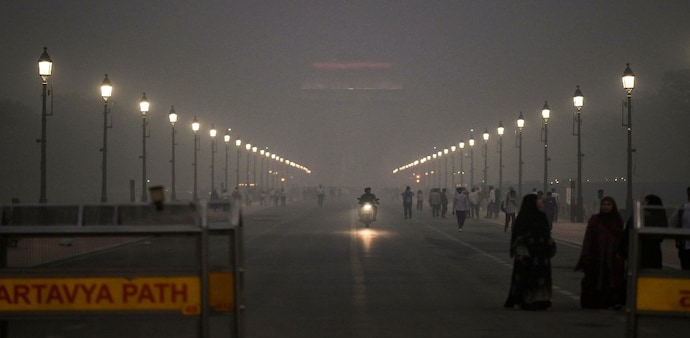
Delhi wakes up to another toxic blanket of smog as air quality slips back into the 'severe' zone, with more than half of the city's monitoring stations crossing the critical 400 mark.
Delhi's air quality has plunged back into the "severe" category, with over 30 monitoring stations across the national capital recording an Air Quality Index (AQI) exceeding 400. According to data released by the Central Pollution Control Board (CPCB), 34 out of 59 stations crossed the severe threshold, plunging millions back into hazardous conditions.
The pollution levels peaked sharply at the Indian Institute of Technology (IIT) Delhi station, which registered the highest AQI in the city at 488, driven predominantly by PM10 particles. Close behind, the historic commercial hub of Chandni Chowk recorded an AQI of 479. Other major hotspots reporting alarming figures included North Campus (Delhi University) at 478, Pusa at 469, and NSUT Jaffarpur at 459.
Under the CPCB metrics, an AQI reading between 401 and 500 is categorised as "severe," indicating a level of pollution that poses serious health risks even to healthy individuals and severely impacts those with preexisting conditions.
The India Meteorological Department (IMD) forecasts that foggy conditions will persist during the morning hours, giving way to partly cloudy skies and clearer daytime conditions later in the week. Temperatures are expected to hover with maximums reaching 28°C to 30°C and minimums dipping between 16°C and 18°C.
Authorities have not issued any special weather warnings for the capital during this current spell, leaving residents grappling with the suffocating haze as meteorological conditions offer little immediate relief.
The sharp deterioration follows a brief, one-day respite on November 12, when Delhi’s average AQI stood at 323 in the "very poor" category. Neighboring cities across the National Capital Region (NCR) fared marginally better by 5 am on November 13, though air quality remained hazardous across the belt — Ghaziabad logged an AQI of 377, Noida recorded 369, and Gurugram registered 349.
According to Central Pollution Control Board (CPCB) benchmarks, an AQI between 301 and 400 is classified as "very poor," while readings from 401 to 500 fall into the "severe" zone.
Delhi has struggled to shake off the toxic haze since Diwali, trapped by stagnant weather conditions that offer little immediate relief and ongoing farm fires in neighboring states.
Data from NASA satellites recorded 4,107 stubble burning incidents across Punjab and Haryana between October 1 and November 12 — comprising 3,729 fires in Punjab and 378 in Haryana, including 96 fresh blazes on November 12 alone. The total closely mirrors the 4,220 farm fires detected during the exact same window last season.