
Delhi pollution: Air quality turns ‘poor’ again as AQI rises to 246, NCR cities remain in grip of smog
The Air Quality Early Warning System for Delhi has forecast that pollution levels could deteriorate further in the coming days, extending the health challenge for residents.
- Nov 17, 2026,
- Updated Nov 17, 2026 8:42 AM IST
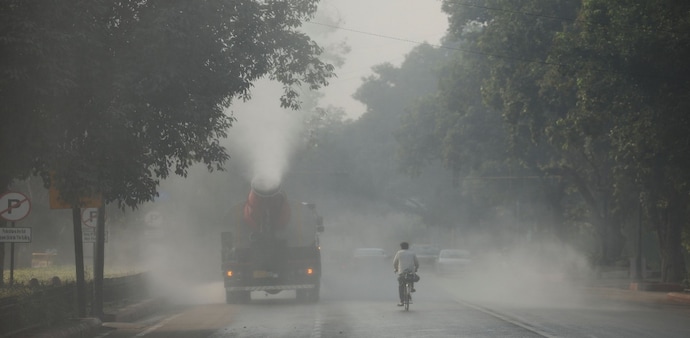
Delhi’s air quality deteriorated on Tuesday morning, with the city’s average Air Quality Index (AQI) recorded at 246 at 7 am, placing it in the “poor” category, according to data from the Central Pollution Control Board (CPCB). The reading was 30 points higher than at the same time on Monday.
Fine particulate matter, or PM2.5, was the dominant pollutant at 50 of Delhi’s 59 monitoring stations over the past 24 hours, while PM10 led at the remaining stations. PM2.5 particles are small enough to enter deep into the lungs and are associated with heightened respiratory and cardiovascular health risks.
MUST READ: Delhi's Diwali AQI worsens for third straight year: Why pollution controls are failing to deliver
It also recorded fog, a temperature of 17 degrees Celsius, humidity of 90 per cent and light winds of 3.7 km/h—conditions that can trap pollutants close to the surface.
Tuesday’s reading followed a brief improvement in the capital’s air. Delhi’s official AQI bulletin figure for November 17 stood at 246, described as the cleanest reading in 16 days, though the city had remained in the “poor” category or worse for 16 consecutive days.
On Monday morning, Delhi’s average AQI was 221, according to CPCB-based reporting. Siri Fort recorded an AQI of 354, falling in the “very poor” category, while the city’s minimum temperature was 14.8 degrees Celsius—the season’s lowest so far.
NCR Cities’ Also Affected
Air quality across Delhi-NCR remained elevated on Tuesday, with Gurugram recording an AQI of 297 and Noida’s Sector 62 at 335, both in the “poor” and “very poor” category. Ghaziabad recorded an AQI of 191, while Greater Noida stood at 174 and Faridabad at 184, placing them in the “moderate” category.
DO CHECKOUT: One Delhi, two AQI numbers. Why government and private platforms show such different pollution readings
Fine particulate matter (PM2.5) continues to be the principal pollutant across the region, which can worsen breathing difficulties, particularly for children, older adults and people with respiratory or heart conditions. The readings highlight the uneven spread of pollution across NCR cities, even as meteorological conditions and regional emissions continue to influence air quality.
Authorities on alert
The Commission for Air Quality Management had invoked Stage III of the Graded Response Action Plan (GRAP) across the National Capital Region on November 6 as air quality worsened. Authorities are expected to continue monitoring conditions closely as calm winds, fog and seasonal emissions keep pollution levels elevated.
Health advisory for residents
Health experts generally advise children, older adults, and people with asthma, heart disease or other chronic respiratory conditions to limit prolonged outdoor exertion when AQI is poor or worse. Residents stepping outside during early-morning hours, when pollution and fog often coincide, are advised to use well-fitted N95 or N99 masks where available.
DON'T MISS: 'Govt is doing AQI Data Fraud': AAP's Saurabh Bhardwaj alleges Delhi's pollution data is being shown lower
The Air Quality Early Warning System for Delhi has forecast that pollution levels could deteriorate further in the coming days, extending the health challenge for residents.