
Delhi’s Diwali air hit 3,744 as 125 pollution readings went missing from CPCB records: Here’s what the data shows
The missing readings had an impact on Delhi’s official air quality index (AQI), although the extremely high PM2.5 numbers did not push the index up by much because the AQI stops at 500.
- Nov 10, 2026,
- Updated Nov 10, 2026 9:00 AM IST
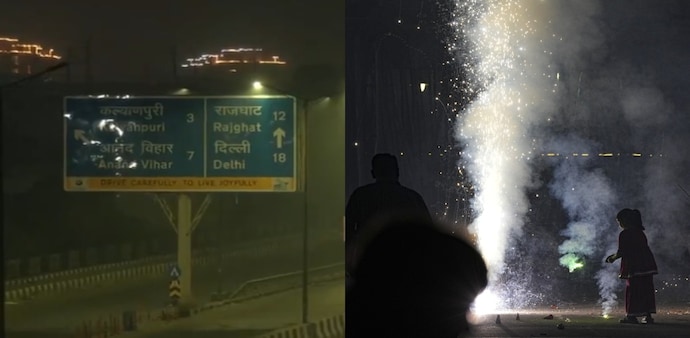
Delhi’s missing air-quality readings from Diwali night have now revealed how sharply pollution spiked, with PM2.5 levels crossing 3,700 micrograms per cubic metre at one monitoring station. The Delhi Pollution Control Committee (DPCC) released the hourly readings around 8 pm on Monday, showing that several stations recorded PM2.5 levels above 2,000 µg/m³ in the early hours of November 9, Hindustan Times reported on Tuesday.
PM2.5 refers to fine particles that can enter deep into the lungs. The national 24-hour standard for PM2.5 is 60 µg/m³.
Mundka recorded the highest PM2.5 level at 3,744 µg/m³ at 2am on November 9. JNU recorded 3,023 µg/m³ at 4am, while NSUT’s West Campus recorded 3,008 µg/m³ at 5am.
Other sharp spikes were recorded at Mandir Marg, which reached 2,908 µg/m³ at 3am, Nehru Nagar at 2,808 µg/m³ at 3am and Wazirpur at 2,721 µg/m³ at 1am.
Eleven of DPCC’s stations recorded PM2.5 levels above 2,000 µg/m³.
Every one of the 125 station-hours that were missing from the Central Pollution Control Board’s (CPCB) records was above 1,000 µg/m³ on DPCC’s website. Where both sources had a reading, the figures matched.
The highest reading anywhere in CPCB’s records for the night was 1,000 µg/m³.
Don't Miss: Global fossil CO₂ emissions to fall in 2026: Has the world finally reached peak carbon pollution?
What happened to Delhi’s missing pollution data?
PM2.5 readings at several Delhi monitoring stations went blank as the air quality worsened on the night of November 8.
At 1am, 36 of Delhi’s 59 stations had no PM2.5 reading in CPCB’s records.
A government official who asked not to be named said: “The air quality monitors are giving hourly data. There were some technical glitches, but all our 43 stations are giving data.”
Missing readings also changed the official AQI
The missing readings had an impact on Delhi’s official air quality index (AQI), although the extremely high PM2.5 numbers did not push the index up by much because the AQI stops at 500.
Counting the released readings, CPCB’s own method of calculation puts Delhi’s AQI for the 24 hours to 9am on November 9 at about 384, against the 370 CPCB published.
Must Read: Govt officially notifies E100 fuel for flex-fuel vehicles to curb crude imports and emissions
For its 4pm bulletin, the AQI works out to about 360, against the 344 published by CPCB, HT estimates show.
The index stops at 500 for any hour above about 420 µg/m³. This means readings in the thousands add little to the AQI once the level has crossed that point.
The figures are provisional. As of CPCB’s records read at 7.58pm, the released readings had not appeared there.