
‘Didn’t want asthmatic children’: Canadian man changes 3 cities over India’s worsening air pollution
He questioned why people living in India's cities should have to leave for the hills simply to breathe cleaner air. Caleb Friesen, who attracted attention for highlighting infrastructure problems in Bengaluru through awareness videos, said his decision to relocate was not about leaving India.
- Aug 21, 2026,
- Updated Aug 21, 2026 1:53 PM IST
A Canadian who chose India as his home has now moved twice in search of something as basic as clean air. Caleb Friesen, who left Delhi in 2018 because of severe winter pollution and later moved from Bengaluru to Mizoram, says he did not want to risk his children’s health by continuing to live in cities where air quality can deteriorate sharply.
Friesen, who has recently attracted attention for highlighting infrastructure problems in Bengaluru through awareness videos, said his decision to relocate was not about leaving India. In fact, he stressed that he had deliberately chosen to live in the country despite the concerns of people around him.
From Delhi to Bengaluru, then Mizoram
Friesen said air pollution was one of the major reasons he left Delhi in 2018 after experiencing what he described as PM2.5 readings of 999 or higher during winter.
He moved to Bengaluru, believing its reputation as India's "Garden City" would offer a healthier environment. But according to Friesen, the city's air quality has continued to deteriorate.
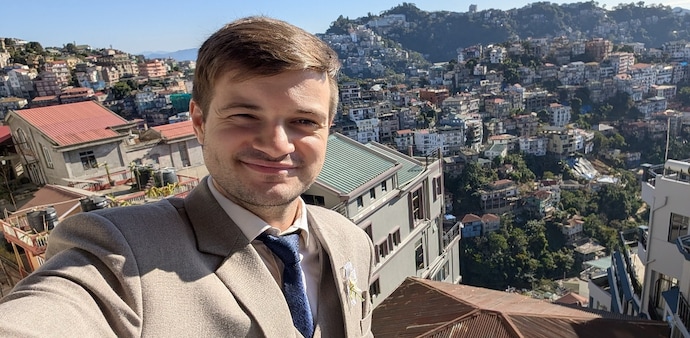
Earlier in 2026, he moved again, this time to Aizawl in Mizoram. His wife's family lives there, and with the couple raising two children, Friesen said the Northeast seemed like a better fit. "I'm glad I relocated. I didn't want to take a risk and end up with asthmatic children," he wrote in a post on X (formally twitter).
But his personal decision also came with a broader concern. Friesen questioned why people living in India's metropolitan cities should have to leave for the hills simply to breathe cleaner air.
'They shouldn't have to flee to the hills'
Friesen said he was happy to see companies working on air purification in homes, offices and factories, citing Mumbai-based Praan as an example.
He pointed to the company's filterless air-purification technology, which he said can capture particles in a collection chamber without changing their chemical composition. According to Friesen, this could also allow industrial customers to reuse captured dust as raw material.
He said the technology is already being used by several companies and expressed hope that similar solutions could eventually operate at the city level.
But technology, he argued, cannot substitute for a basic public guarantee. "I only wish this level of air quality was a guarantee for every Indian citizen today," Friesen wrote.
India's pollution problem goes beyond cities
In another post, Friesen cited IQAir data claiming that 29 of the world's 50 cities with the worst air pollution are in India.
He also drew attention to industrial pollution, claiming that while Delhi's PM2.5 can reach around 1,000 on a particularly bad day, a poorly optimised Indian steel factory could record levels approaching 100,000 on an average day.
His comparison was intended to highlight the scale of pollution inside industrial facilities, where large quantities of dust can accumulate and remain suspended in the air.
The figures cited by Friesen should be treated as claims rather than independently verified measurements. PM2.5 readings can also vary significantly depending on the monitoring equipment, location and measurement conditions.
A Canadian who chose India as his home has now moved twice in search of something as basic as clean air. Caleb Friesen, who left Delhi in 2018 because of severe winter pollution and later moved from Bengaluru to Mizoram, says he did not want to risk his children’s health by continuing to live in cities where air quality can deteriorate sharply.
Friesen, who has recently attracted attention for highlighting infrastructure problems in Bengaluru through awareness videos, said his decision to relocate was not about leaving India. In fact, he stressed that he had deliberately chosen to live in the country despite the concerns of people around him.
From Delhi to Bengaluru, then Mizoram
Friesen said air pollution was one of the major reasons he left Delhi in 2018 after experiencing what he described as PM2.5 readings of 999 or higher during winter.
He moved to Bengaluru, believing its reputation as India's "Garden City" would offer a healthier environment. But according to Friesen, the city's air quality has continued to deteriorate.
Earlier in 2026, he moved again, this time to Aizawl in Mizoram. His wife's family lives there, and with the couple raising two children, Friesen said the Northeast seemed like a better fit. "I'm glad I relocated. I didn't want to take a risk and end up with asthmatic children," he wrote in a post on X (formally twitter).
But his personal decision also came with a broader concern. Friesen questioned why people living in India's metropolitan cities should have to leave for the hills simply to breathe cleaner air.
'They shouldn't have to flee to the hills'
Friesen said he was happy to see companies working on air purification in homes, offices and factories, citing Mumbai-based Praan as an example.
He pointed to the company's filterless air-purification technology, which he said can capture particles in a collection chamber without changing their chemical composition. According to Friesen, this could also allow industrial customers to reuse captured dust as raw material.
He said the technology is already being used by several companies and expressed hope that similar solutions could eventually operate at the city level.
But technology, he argued, cannot substitute for a basic public guarantee. "I only wish this level of air quality was a guarantee for every Indian citizen today," Friesen wrote.
India's pollution problem goes beyond cities
In another post, Friesen cited IQAir data claiming that 29 of the world's 50 cities with the worst air pollution are in India.
He also drew attention to industrial pollution, claiming that while Delhi's PM2.5 can reach around 1,000 on a particularly bad day, a poorly optimised Indian steel factory could record levels approaching 100,000 on an average day.
His comparison was intended to highlight the scale of pollution inside industrial facilities, where large quantities of dust can accumulate and remain suspended in the air.
The figures cited by Friesen should be treated as claims rather than independently verified measurements. PM2.5 readings can also vary significantly depending on the monitoring equipment, location and measurement conditions.