
From Mokobara bags to steel dabbas: How the CJP protest brought different Indians together
Hours after protesters marched towards Parliament on Monday, the entrance to Jantar Mantar still carried traces of tear gas mixed with the smell of fresh rain.
- Jul 22, 2026,
- Updated Jul 22, 2026 6:57 PM IST
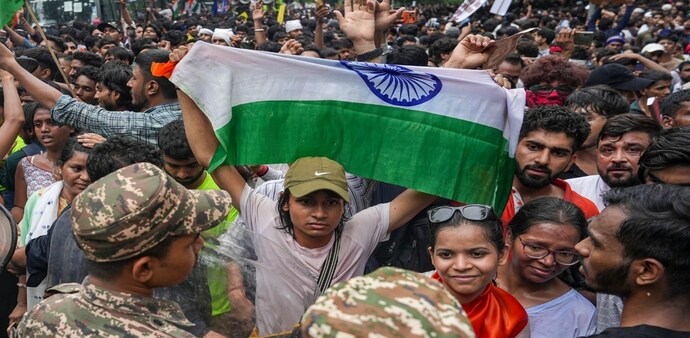
As thousands gathered in Delhi for the Cockroach Janta Party's (CJP) Chalo Sansad march, one aspect of the protest stood out beyond the clashes, detentions and political messaging — the visible presence of students and young people from affluent backgrounds, a demographic that is rarely seen in large numbers at street protests.
From school students headed to universities abroad to college-goers carrying the latest iPhones and premium luggage, many who would not be directly affected by the issues being raised still chose to spend hours at Jantar Mantar, standing alongside seasoned activists and student organisations.
A protest site marked by contrasts
Hours after protesters marched towards Parliament on Monday, the entrance to Jantar Mantar still carried traces of tear gas mixed with the smell of fresh rain.
The stage where activist Sonam Wangchuk had begun his indefinite hunger strike had been dismantled, leaving behind a site strewn with garbage, stones, broken glass and sludge.
Don't Miss: Sonam Wangchuk now has only one condition to end fast: 'No legal action against protesters'
While student groups such as NSUI, AISF and AISA provided much of the organisational backbone of the protest, many participants said the crowd composition reflected something unusual.
As several protesters put it, "It's so bad that even the privileged are here."
Costly journey to the protest
Reaching the protest site itself became a challenge.
Metro services near the area remained suspended, private vehicles risked damage and internet restrictions across central Delhi left many relying on patchy Edge connectivity. App-based cab bookings became difficult, allowing drivers to charge steep fares.
Even short rides reportedly cost between ₹300 and ₹500.
Despite the inconvenience, many young people who typically engage with politics online chose to attend in person, documenting developments through videos and social media posts.
Why the presence of the elite stood out
The participation of affluent sections at a mass protest is relatively uncommon in Delhi and has often been compared to the public mobilisation seen after the December 16, 2012 gang rape and murder case.
Activist and journalist Aakar Patel notes in his book The Anarchist Cookbook that India's upper class — roughly the 3% that pays income tax — interacts with the State differently from most citizens.
With access to private healthcare, education and transport, many among the elite rarely depend on government-run systems such as public schools, anganwadis or the public distribution system. As a result, governance failures often remain distant from their daily lives.
At Jantar Mantar, however, that pattern appeared to shift.
Young voices join the protest
Among those present was Arjun Sharma, a Class 12 student from a South Delhi school.
"I am here because what is happening affects the future we will inherit," said Arjun Sharma. "We read about rights in our textbooks. But when you see policies that ignore people's voices, you realise silence is not an option. My parents were worried, but I told them this is our time to learn how to speak up."
Priya Mehra, an 18-year-old studying at a Delhi University college, said, "My family has resources. But if we, who have the privilege of voice and safety, do not stand here, then who will? I came with friends. We are here to push back."
Different backgrounds, same ground
The economic differences within the crowd were evident.
Some Delhi University students carried steel lunch boxes packed with peanuts and pickle wrapped in gamchhas, while others arrived with Mokobara bags. Yet both groups remained at the site despite heavy rain.
An activist-lawyer familiar with street protests, speaking on condition of anonymity, shared a photograph of a friend with a forehead injury caused by a stone that had "dropped from the sky".
By around 9.30 pm, roads around Jantar Mantar, including Ashoka Road, Raisina Road and Akbar Road, had largely been cleaned despite witnessing nearly 30,000 protesters earlier in the day. The protest site itself, however, still bore visible signs of the day's events.
Gen Z learns the language of protest
For many young participants, the demonstration was also a lesson in civic engagement.
Rachit Kumar, a journalism student at IMS Noida, said he joined after seeing messages on his college group.
"If we are going to become journalists tomorrow, we cannot learn reporting from a classroom alone... If ordinary people are on the streets raising their voices, we have to be there to understand what is happening firsthand," he told India Today Digital.
Another student, Hardik, said the issue extended beyond class divisions.
"For most middle-class families, education and healthcare are the biggest expenses. If almost everything a family earns goes towards those two things, people have every right to question the system. We shouldn't reduce every protest to a class. We are Indians first, and when people come together for a public cause, that is what should matter," the student said.
More than just a protest
The presence of affluent students and young professionals does not erase the broader inequalities that continue to shape Indian society. Many still have access to private alternatives and support systems unavailable to most citizens.
Yet their participation added a new dimension to the gathering at Jantar Mantar.
For many at the protest, the message was simple: when people who are usually distant from street politics decide to show up, it signals that concerns have spread beyond the groups traditionally associated with activism.
As thousands gathered in Delhi for the Cockroach Janta Party's (CJP) Chalo Sansad march, one aspect of the protest stood out beyond the clashes, detentions and political messaging — the visible presence of students and young people from affluent backgrounds, a demographic that is rarely seen in large numbers at street protests.
From school students headed to universities abroad to college-goers carrying the latest iPhones and premium luggage, many who would not be directly affected by the issues being raised still chose to spend hours at Jantar Mantar, standing alongside seasoned activists and student organisations.
A protest site marked by contrasts
Hours after protesters marched towards Parliament on Monday, the entrance to Jantar Mantar still carried traces of tear gas mixed with the smell of fresh rain.
The stage where activist Sonam Wangchuk had begun his indefinite hunger strike had been dismantled, leaving behind a site strewn with garbage, stones, broken glass and sludge.
Don't Miss: Sonam Wangchuk now has only one condition to end fast: 'No legal action against protesters'
While student groups such as NSUI, AISF and AISA provided much of the organisational backbone of the protest, many participants said the crowd composition reflected something unusual.
As several protesters put it, "It's so bad that even the privileged are here."
Costly journey to the protest
Reaching the protest site itself became a challenge.
Metro services near the area remained suspended, private vehicles risked damage and internet restrictions across central Delhi left many relying on patchy Edge connectivity. App-based cab bookings became difficult, allowing drivers to charge steep fares.
Even short rides reportedly cost between ₹300 and ₹500.
Despite the inconvenience, many young people who typically engage with politics online chose to attend in person, documenting developments through videos and social media posts.
Why the presence of the elite stood out
The participation of affluent sections at a mass protest is relatively uncommon in Delhi and has often been compared to the public mobilisation seen after the December 16, 2012 gang rape and murder case.
Activist and journalist Aakar Patel notes in his book The Anarchist Cookbook that India's upper class — roughly the 3% that pays income tax — interacts with the State differently from most citizens.
With access to private healthcare, education and transport, many among the elite rarely depend on government-run systems such as public schools, anganwadis or the public distribution system. As a result, governance failures often remain distant from their daily lives.
At Jantar Mantar, however, that pattern appeared to shift.
Young voices join the protest
Among those present was Arjun Sharma, a Class 12 student from a South Delhi school.
"I am here because what is happening affects the future we will inherit," said Arjun Sharma. "We read about rights in our textbooks. But when you see policies that ignore people's voices, you realise silence is not an option. My parents were worried, but I told them this is our time to learn how to speak up."
Priya Mehra, an 18-year-old studying at a Delhi University college, said, "My family has resources. But if we, who have the privilege of voice and safety, do not stand here, then who will? I came with friends. We are here to push back."
Different backgrounds, same ground
The economic differences within the crowd were evident.
Some Delhi University students carried steel lunch boxes packed with peanuts and pickle wrapped in gamchhas, while others arrived with Mokobara bags. Yet both groups remained at the site despite heavy rain.
An activist-lawyer familiar with street protests, speaking on condition of anonymity, shared a photograph of a friend with a forehead injury caused by a stone that had "dropped from the sky".
By around 9.30 pm, roads around Jantar Mantar, including Ashoka Road, Raisina Road and Akbar Road, had largely been cleaned despite witnessing nearly 30,000 protesters earlier in the day. The protest site itself, however, still bore visible signs of the day's events.
Gen Z learns the language of protest
For many young participants, the demonstration was also a lesson in civic engagement.
Rachit Kumar, a journalism student at IMS Noida, said he joined after seeing messages on his college group.
"If we are going to become journalists tomorrow, we cannot learn reporting from a classroom alone... If ordinary people are on the streets raising their voices, we have to be there to understand what is happening firsthand," he told India Today Digital.
Another student, Hardik, said the issue extended beyond class divisions.
"For most middle-class families, education and healthcare are the biggest expenses. If almost everything a family earns goes towards those two things, people have every right to question the system. We shouldn't reduce every protest to a class. We are Indians first, and when people come together for a public cause, that is what should matter," the student said.
More than just a protest
The presence of affluent students and young professionals does not erase the broader inequalities that continue to shape Indian society. Many still have access to private alternatives and support systems unavailable to most citizens.
Yet their participation added a new dimension to the gathering at Jantar Mantar.
For many at the protest, the message was simple: when people who are usually distant from street politics decide to show up, it signals that concerns have spread beyond the groups traditionally associated with activism.