
From school charts to couture: India's favourite ‘Adarsh Balak’ steals Lovebirds' London Fashion Week debut
Indian label Lovebirds, Founders Amrita Khanna and Gursi Singh described the collection, titled India: IYKYK, as a nostalgic yet razor-sharp love letter to the India of the ’60s, ’70s and ’80s.
- Sep 24, 2026,
- Updated Sep 24, 2026 12:03 PM IST
In a nostalgic yet razor-sharply contemporary turn, the iconic “Adarsh Balak” (Ideal Boy) imagery from 1970s Indian school charts walked the London Fashion Week (LFW) runway as part of Delhi-based label Lovebirds’ Spring/Summer 2027 showcase.
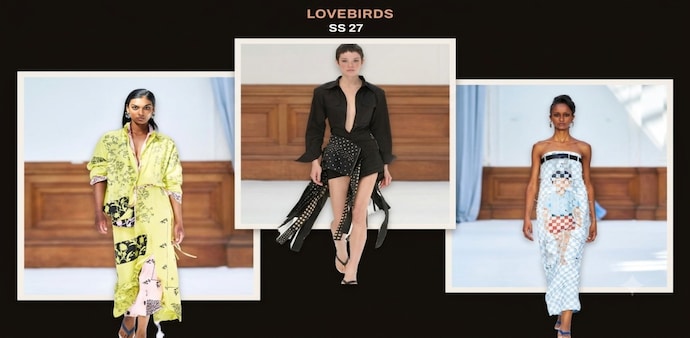
The motif began as a satirical comic-style poster about the qualities of an “ideal middle-class Indian boy”. It was later turned into graphic prints for deconstructed eveningwear. One standout look featured a strapless gown in blue checks, cinched with a black obi belt, with the Adarsh Balak illustration taking centre stage on the bodice.
“Adarsh Balak” was part of a wider visual language drawn from pre-digital India—hand-painted advertisements, studio portrait backdrops, and even the popular Bata chappal, which was transformed into sculptural kitten heels.
Craft Meets Collective Memory
Indian label Lovebirds, Founders Amrita Khanna and Gursi Singh described the collection, titled India: IYKYK, as a nostalgic yet razor-sharp love letter to the India of the ’60s, ’70s and ’80s. The fabrics—chintz, dupion, tussar, and Banarasi brocade—were handcrafted in collaboration with artisans from Kutch, Gujarat, and Varanasi, Uttar Pradesh.
The duo said they began with visual codes that require no explanation among those who grew up around them, including hand-painted signs, studio backdrops and schoolbook drawings, before translating these into garments through embroidery, fraying and reconstruction.
The references were specific enough to feel instantly familiar to an Indian audience while appearing unexpected to viewers encountering them for the first time, the designers noted backstage at Lindley Hall.
Why vintage Indian pop culture is trending
Lovebirds’ LFW debut signals a growing global appetite for Indian pop-culture nostalgia rendered through high craftsmanship. By elevating everyday visual codes—school posters, matchbox art, street signs—into luxury garments, the label challenges Western-centric fashion narratives while celebrating indigenous textile traditions.
Shakira shines in Banarasi brocade
Indian couture is also making waves beyond the runway, with pop superstar Shakira wearing a custom Gaurav Gupta ensemble during her Las Mujeres Ya No Lloran World Tour in Madrid, which began on September 18.
Styled by Nicolas Bru, the singer performed in a hand-sculpted brass breastplate paired with a handwoven Banarasi silk brocade skirt, shaped to resemble ocean waves. On September 21, Gupta shared that the gold-toned look took 500 hours to craft with a team of 10 artisans and features a she-wolf motif—a recurring symbol in Shakira's artistry representing instinct, resilience and feminine power.
DO CHECKOUT: 5,000 years in gold: Sabyasachi raids The Met's history for a dazzling new collection
In a nostalgic yet razor-sharply contemporary turn, the iconic “Adarsh Balak” (Ideal Boy) imagery from 1970s Indian school charts walked the London Fashion Week (LFW) runway as part of Delhi-based label Lovebirds’ Spring/Summer 2027 showcase.
The motif began as a satirical comic-style poster about the qualities of an “ideal middle-class Indian boy”. It was later turned into graphic prints for deconstructed eveningwear. One standout look featured a strapless gown in blue checks, cinched with a black obi belt, with the Adarsh Balak illustration taking centre stage on the bodice.
“Adarsh Balak” was part of a wider visual language drawn from pre-digital India—hand-painted advertisements, studio portrait backdrops, and even the popular Bata chappal, which was transformed into sculptural kitten heels.
Craft Meets Collective Memory
Indian label Lovebirds, Founders Amrita Khanna and Gursi Singh described the collection, titled India: IYKYK, as a nostalgic yet razor-sharp love letter to the India of the ’60s, ’70s and ’80s. The fabrics—chintz, dupion, tussar, and Banarasi brocade—were handcrafted in collaboration with artisans from Kutch, Gujarat, and Varanasi, Uttar Pradesh.
The duo said they began with visual codes that require no explanation among those who grew up around them, including hand-painted signs, studio backdrops and schoolbook drawings, before translating these into garments through embroidery, fraying and reconstruction.
The references were specific enough to feel instantly familiar to an Indian audience while appearing unexpected to viewers encountering them for the first time, the designers noted backstage at Lindley Hall.
Why vintage Indian pop culture is trending
Lovebirds’ LFW debut signals a growing global appetite for Indian pop-culture nostalgia rendered through high craftsmanship. By elevating everyday visual codes—school posters, matchbox art, street signs—into luxury garments, the label challenges Western-centric fashion narratives while celebrating indigenous textile traditions.
Shakira shines in Banarasi brocade
Indian couture is also making waves beyond the runway, with pop superstar Shakira wearing a custom Gaurav Gupta ensemble during her Las Mujeres Ya No Lloran World Tour in Madrid, which began on September 18.
Styled by Nicolas Bru, the singer performed in a hand-sculpted brass breastplate paired with a handwoven Banarasi silk brocade skirt, shaped to resemble ocean waves. On September 21, Gupta shared that the gold-toned look took 500 hours to craft with a team of 10 artisans and features a she-wolf motif—a recurring symbol in Shakira's artistry representing instinct, resilience and feminine power.
DO CHECKOUT: 5,000 years in gold: Sabyasachi raids The Met's history for a dazzling new collection