
GST Fitment Committee recommends no rate cut on air, water purifiers despite calls for relief
The panel had flagged the contradiction between government efforts to address air pollution and the 18% tax imposed on devices used by citizens for protection against it.
- Oct 6, 2026,
- Updated Oct 6, 2026 1:46 PM IST
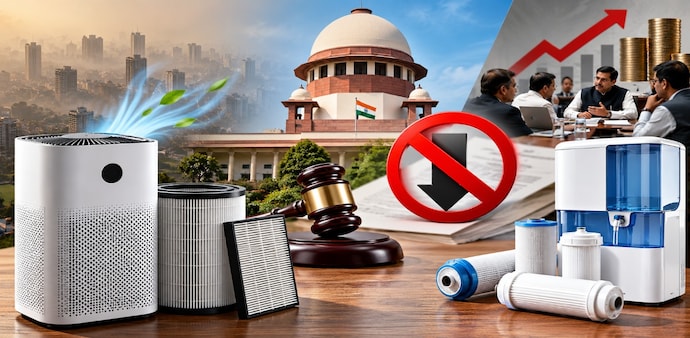
The GST Fitment Committee has recommended no change in the existing 18% GST rate on air purifiers and their parts, including HEPA filters, despite calls from a parliamentary panel and observations by the Delhi High Court for a reduction in the tax on such products.
Air purifiers currently attract 18% GST . The proposal before the committee sought a reduction in the rate to either 5% or nil.
The issue comes amid growing concerns over air pollution and the increasing use of air purification devices, particularly in cities facing severe pollution levels.
The Delhi High Court, while hearing a public interest litigation seeking classification of HEPA-equipped purifiers as medical devices in Kapil Madan vs Union of India, observed that GST on air purifiers should be reduced.
Separately, the Department-related Parliamentary Standing Committee on Science and Technology, Environment, Forests and Climate Change, in its 401st report, recommended reduction or abolition of GST on air purifiers and HEPA filters.
The panel had flagged the contradiction between government efforts to address air pollution and the 18% tax imposed on devices used by citizens for protection against it.
However, the Fitment Committee has cited concerns around the tax structure and domestic manufacturing. A reduction to 5% could create an inverted duty structure, as manufacturers would continue to pay 18% GST on most inputs while collecting only 5% on their output. A nil rate, meanwhile, would prevent manufacturers from claiming input tax credit, resulting in input taxes being embedded in the ex-factory price.
The committee also noted that HEPA filters are used beyond household air purifiers, including in HVAC systems, clean rooms, laboratories, hospitals and industrial premises. Restricting a lower rate to domestic use could therefore create classification and compliance issues.
It further flagged the possibility that cheaper imports could gain an advantage over domestically manufactured air purifiers if the GST rate were reduced.
The Fitment Committee has similarly recommended no change in the 18% GST rate on water purifiers and their consumable parts, including RO membranes, filter cartridges and filter housings.
A proposal to reduce GST on household water purifiers from 18% to 12% had also been considered at the 45th GST Council meeting but was not accepted.
The GST Fitment Committee has recommended no change in the existing 18% GST rate on air purifiers and their parts, including HEPA filters, despite calls from a parliamentary panel and observations by the Delhi High Court for a reduction in the tax on such products.
Air purifiers currently attract 18% GST . The proposal before the committee sought a reduction in the rate to either 5% or nil.
The issue comes amid growing concerns over air pollution and the increasing use of air purification devices, particularly in cities facing severe pollution levels.
The Delhi High Court, while hearing a public interest litigation seeking classification of HEPA-equipped purifiers as medical devices in Kapil Madan vs Union of India, observed that GST on air purifiers should be reduced.
Separately, the Department-related Parliamentary Standing Committee on Science and Technology, Environment, Forests and Climate Change, in its 401st report, recommended reduction or abolition of GST on air purifiers and HEPA filters.
The panel had flagged the contradiction between government efforts to address air pollution and the 18% tax imposed on devices used by citizens for protection against it.
However, the Fitment Committee has cited concerns around the tax structure and domestic manufacturing. A reduction to 5% could create an inverted duty structure, as manufacturers would continue to pay 18% GST on most inputs while collecting only 5% on their output. A nil rate, meanwhile, would prevent manufacturers from claiming input tax credit, resulting in input taxes being embedded in the ex-factory price.
The committee also noted that HEPA filters are used beyond household air purifiers, including in HVAC systems, clean rooms, laboratories, hospitals and industrial premises. Restricting a lower rate to domestic use could therefore create classification and compliance issues.
It further flagged the possibility that cheaper imports could gain an advantage over domestically manufactured air purifiers if the GST rate were reduced.
The Fitment Committee has similarly recommended no change in the 18% GST rate on water purifiers and their consumable parts, including RO membranes, filter cartridges and filter housings.
A proposal to reduce GST on household water purifiers from 18% to 12% had also been considered at the 45th GST Council meeting but was not accepted.