
India countering tariffs & sanctions through strategic trade ties: PM's top advisor PK Mishra
Speaking at the Kautilya Economic Conclave under the theme 'A World Priced for Risk', Principal Secretary to the Prime Minister PK Mishra outlined a stark picture of modern global commerce. He warned that traditional trade mechanisms are increasingly being repurposed as geopolitical leverage.
- Oct 4, 2026,
- Updated Oct 4, 2026 8:59 AM IST
In an era where physical distance was once thought rendered obsolete by technological leaps, geography has returned to the center of global trade with a vengeance—bringing with it an unprecedented weaponisation of economic policy.
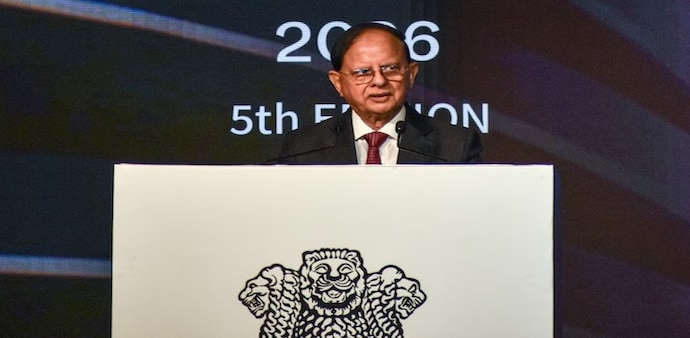
Speaking at the Kautilya Economic Conclave under the theme 'A World Priced for Risk', Principal Secretary to the Prime Minister PK Mishra outlined a stark picture of modern global commerce. He warned that traditional trade mechanisms are increasingly being repurposed as geopolitical leverage.
"Export restrictions, sanctions, and tariffs have become standard policy instruments, and at times, they are explicitly weaponised," Mishra said.
Navigating a landscape marked by rising global friction, the top official emphasised that supply chain disruptions and choke points along critical maritime corridors mean that geography has re-emerged as an essential economic variable.
"A disruption in a major shipping route can affect the price of crude oil thousands of kilometres away," he noted. "Geography, we thought, technology has made it irrelevant. But it has returned to the centre of the table and it is not only oil."
To insulate itself against extreme volatility without retreating into isolationism, India’s strategic posture focuses on building multi-layered economic buffers.
"Resilience cannot be insulation from the world," Mishra said. "It has to mean the ability to remain open to the world without becoming excessively vulnerable to it."
He highlighted India’s active push toward supply chain and energy diversification. On energy security, New Delhi expanded its crude oil suppliers from 27 to 43 countries to prevent concentrated vulnerabilities. Simultaneously, the National Critical Mineral Mission is driving domestic exploration, processing, and recycling, backed by international alliances with partners such as the United States, France, Germany, and the Netherlands.
Addressing external trade policy, Mishra pointed out that India is actively expanding its broader network of agreements. Pacts with partners like the UAE, Australia, the UK, Oman, New Zealand, and the European Union ensure that integration into the global economy does not lead to single-point dependencies.
"An open economy will always depend on other economies. The objective is not to eliminate that dependence, but to avoid excessive concentration," he said.
Mishra concluded with a vision for navigating future global uncertainties. "I believe that the world in the near future will belong to those who can be steady without being closed, careful without being fearful, and ambitious without being naive — and India intends to be such a country."
In an era where physical distance was once thought rendered obsolete by technological leaps, geography has returned to the center of global trade with a vengeance—bringing with it an unprecedented weaponisation of economic policy.
Speaking at the Kautilya Economic Conclave under the theme 'A World Priced for Risk', Principal Secretary to the Prime Minister PK Mishra outlined a stark picture of modern global commerce. He warned that traditional trade mechanisms are increasingly being repurposed as geopolitical leverage.
"Export restrictions, sanctions, and tariffs have become standard policy instruments, and at times, they are explicitly weaponised," Mishra said.
Navigating a landscape marked by rising global friction, the top official emphasised that supply chain disruptions and choke points along critical maritime corridors mean that geography has re-emerged as an essential economic variable.
"A disruption in a major shipping route can affect the price of crude oil thousands of kilometres away," he noted. "Geography, we thought, technology has made it irrelevant. But it has returned to the centre of the table and it is not only oil."
To insulate itself against extreme volatility without retreating into isolationism, India’s strategic posture focuses on building multi-layered economic buffers.
"Resilience cannot be insulation from the world," Mishra said. "It has to mean the ability to remain open to the world without becoming excessively vulnerable to it."
He highlighted India’s active push toward supply chain and energy diversification. On energy security, New Delhi expanded its crude oil suppliers from 27 to 43 countries to prevent concentrated vulnerabilities. Simultaneously, the National Critical Mineral Mission is driving domestic exploration, processing, and recycling, backed by international alliances with partners such as the United States, France, Germany, and the Netherlands.
Addressing external trade policy, Mishra pointed out that India is actively expanding its broader network of agreements. Pacts with partners like the UAE, Australia, the UK, Oman, New Zealand, and the European Union ensure that integration into the global economy does not lead to single-point dependencies.
"An open economy will always depend on other economies. The objective is not to eliminate that dependence, but to avoid excessive concentration," he said.
Mishra concluded with a vision for navigating future global uncertainties. "I believe that the world in the near future will belong to those who can be steady without being closed, careful without being fearful, and ambitious without being naive — and India intends to be such a country."