
India’s drone didis + China tech: Chinese envoy shares blueprint for an agricultural revolution
In China, agricultural drones have rapidly transitioned from high-tech novelties to mainstream farming equipment. With over 250,000 agricultural drones actively operating across the country, the machines handle a vast array of tasks that traditionally required manual labour.
- May 25, 2026,
- Updated May 25, 2026 4:44 PM IST
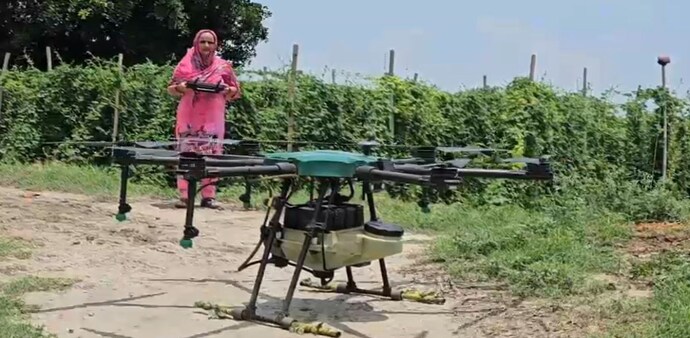
Highlighting what could be a potential India+China partnership, which could revolutionise and empower women in drone tech, Yu Jing, Spokesperson of the Chinese Embassy in India, highlighted Prime Minister Narendra Modi's Namo Drone Didi initiative as a shining template for cross-border synergy.
Taking to X (formerly Twitter), Jing detailed how an alliance focusing on unmanned aerial vehicle (UAV) technology could reshape the agrarian landscapes of both Asian giants, while placing women at the centre of the transformation.
"In China, drones are already revolutionising farming — from seeding to harvesting! Combine this with PM Modi’s #NamoDroneDidi initiative empowering women in drone tech — the impact will be 1+1 > 2!" Jing wrote.
China's 'flying tractors'
In China, agricultural drones have rapidly transitioned from high-tech novelties to mainstream farming equipment. With over 250,000 agricultural drones actively operating across the country, the machines handle a vast array of tasks that traditionally required manual labour:
- Precision seeding: Drones are utilised to distribute seeds evenly across massive plots, particularly in hard-to-reach terrains or flooded rice paddies.
- Granular spreading: Automated systems dispense fertilizers with surgical accuracy, cutting operational waste by nearly 30%.
- Turnkey harvesting logistics: From mapping field topography to monitoring crop ripeness via multispectral imagery, the technology manages the field ecosystem from planting to yield.
India's grassroots flight path
India’s ₹1,261-crore Namo Drone Didi central sector scheme takes a distinctly human-centric approach by putting this technology directly into the hands of rural women through Self-Help Groups (SHGs).
"The choice of China is due to the fact that about 70 percent of the global market for unmanned aerial vehicles and innovative technologies currently belongs to China. With the help of these drones, a service system will be established for land users," noted Sardor Gulomov, a regional UAV operations expert tracking global drone diffusion.
By merging China’s massive hardware manufacturing ecosystem with India's mobilized network of certified rural female pilots, the proposed "1+1 > 2" formula could provide a scalable blueprint for sustainable intensification across the developing world.
Highlighting what could be a potential India+China partnership, which could revolutionise and empower women in drone tech, Yu Jing, Spokesperson of the Chinese Embassy in India, highlighted Prime Minister Narendra Modi's Namo Drone Didi initiative as a shining template for cross-border synergy.
Taking to X (formerly Twitter), Jing detailed how an alliance focusing on unmanned aerial vehicle (UAV) technology could reshape the agrarian landscapes of both Asian giants, while placing women at the centre of the transformation.
"In China, drones are already revolutionising farming — from seeding to harvesting! Combine this with PM Modi’s #NamoDroneDidi initiative empowering women in drone tech — the impact will be 1+1 > 2!" Jing wrote.
China's 'flying tractors'
In China, agricultural drones have rapidly transitioned from high-tech novelties to mainstream farming equipment. With over 250,000 agricultural drones actively operating across the country, the machines handle a vast array of tasks that traditionally required manual labour:
- Precision seeding: Drones are utilised to distribute seeds evenly across massive plots, particularly in hard-to-reach terrains or flooded rice paddies.
- Granular spreading: Automated systems dispense fertilizers with surgical accuracy, cutting operational waste by nearly 30%.
- Turnkey harvesting logistics: From mapping field topography to monitoring crop ripeness via multispectral imagery, the technology manages the field ecosystem from planting to yield.
India's grassroots flight path
India’s ₹1,261-crore Namo Drone Didi central sector scheme takes a distinctly human-centric approach by putting this technology directly into the hands of rural women through Self-Help Groups (SHGs).
"The choice of China is due to the fact that about 70 percent of the global market for unmanned aerial vehicles and innovative technologies currently belongs to China. With the help of these drones, a service system will be established for land users," noted Sardor Gulomov, a regional UAV operations expert tracking global drone diffusion.
By merging China’s massive hardware manufacturing ecosystem with India's mobilized network of certified rural female pilots, the proposed "1+1 > 2" formula could provide a scalable blueprint for sustainable intensification across the developing world.