
India's E20 rollout backed by scientific studies and real-world trials: Government
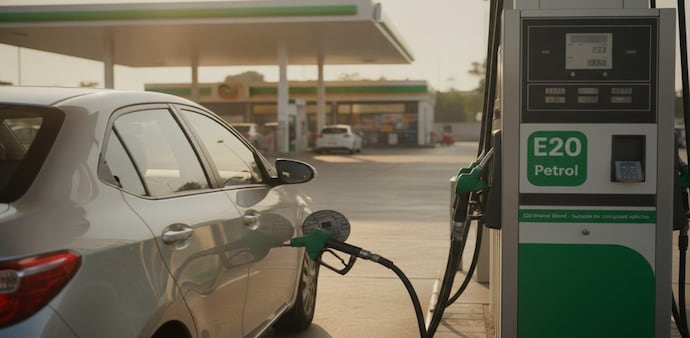
Across more than 20 crore two-wheelers and over 3 crore petrol cars currently running on these blends, service networks have registered no verified instances of widespread engine failure or vehicle breakdown linked to ethanol.
- Jul 30, 2026,
- Updated Jul 30, 2026 5:49 PM IST
Concerns surrounding vehicle performance and engine longevity under India’s ethanol blending program lack empirical grounding, the Ministry of Petroleum and Natural Gas informed the Lok Sabha today.
Responding in a written reply, Minister of State Shri Suresh Gopi highlighted that the rollout of E20 petrol rests on rigorous scientific validation, extensive field testing, and multi-stakeholder consultations.
The Ethanol Blended Petrol (EBP) Programme was structured through a consultative framework featuring NITI Aayog, automobile manufacturers, Oil Marketing Companies (OMCs), the Automotive Research Association of India (ARAI), the Society of Indian Automobile Manufacturers (SIAM), and the Indian Institute of Petroleum (IIP). Exhaustive laboratory research and field trials evaluated parameters ranging from engine durability, startability, and drivability to material compatibility, corrosion resistance, and fuel efficiency.
Real-world tracking across India's vast vehicle fleet further reinforces laboratory findings. With roughly 8 crore vehicles — about 80% of them petrol-driven — visiting fuel stations daily, higher ethanol blends have been integrated into routine usage. E15+ petrol has seen active deployment for over three-and-a-half years, while E19-E20 blends have been widely distributed for over two-and-a-half years.
Across more than 20 crore two-wheelers and over 3 crore petrol cars currently running on these blends, service networks have registered no verified instances of widespread engine failure or vehicle breakdown linked to ethanol. Legacy vehicles, including those non-certified for E20, have shown no abnormal wear and tear or operational variation.
Industry service records present concrete proof:
- A leading original equipment manufacturer (OEM) serviced 2.84 crore vehicles during FY 2025-26 — including nearly 1.5 crore non-E20 certified models — reporting zero E20-induced corrosion, accelerated component wear, or lifespan reduction.
- Tracking data from another major OEM covering 1.4 crore vehicles operated on E20 over an extended period similarly confirmed no ethanol-related damage.
- Leading two-wheeler manufacturers reported matching field observations.
- Automobile manufacturers continue to honor full warranty obligations for vehicles utilising E20 fuel.
Beyond mechanical compatibility, scientific assessments by SIAM and ARAI indicate tangible operational gains. Ethanol's higher octane rating supports modern high-compression engines, while its higher heat of vaporisation enhances combustion efficiency — improving overall acceleration and ride quality while lowering carbon emissions.
Concerns surrounding vehicle performance and engine longevity under India’s ethanol blending program lack empirical grounding, the Ministry of Petroleum and Natural Gas informed the Lok Sabha today.
Responding in a written reply, Minister of State Shri Suresh Gopi highlighted that the rollout of E20 petrol rests on rigorous scientific validation, extensive field testing, and multi-stakeholder consultations.
The Ethanol Blended Petrol (EBP) Programme was structured through a consultative framework featuring NITI Aayog, automobile manufacturers, Oil Marketing Companies (OMCs), the Automotive Research Association of India (ARAI), the Society of Indian Automobile Manufacturers (SIAM), and the Indian Institute of Petroleum (IIP). Exhaustive laboratory research and field trials evaluated parameters ranging from engine durability, startability, and drivability to material compatibility, corrosion resistance, and fuel efficiency.
Real-world tracking across India's vast vehicle fleet further reinforces laboratory findings. With roughly 8 crore vehicles — about 80% of them petrol-driven — visiting fuel stations daily, higher ethanol blends have been integrated into routine usage. E15+ petrol has seen active deployment for over three-and-a-half years, while E19-E20 blends have been widely distributed for over two-and-a-half years.
Across more than 20 crore two-wheelers and over 3 crore petrol cars currently running on these blends, service networks have registered no verified instances of widespread engine failure or vehicle breakdown linked to ethanol. Legacy vehicles, including those non-certified for E20, have shown no abnormal wear and tear or operational variation.
Industry service records present concrete proof:
- A leading original equipment manufacturer (OEM) serviced 2.84 crore vehicles during FY 2025-26 — including nearly 1.5 crore non-E20 certified models — reporting zero E20-induced corrosion, accelerated component wear, or lifespan reduction.
- Tracking data from another major OEM covering 1.4 crore vehicles operated on E20 over an extended period similarly confirmed no ethanol-related damage.
- Leading two-wheeler manufacturers reported matching field observations.
- Automobile manufacturers continue to honor full warranty obligations for vehicles utilising E20 fuel.
Beyond mechanical compatibility, scientific assessments by SIAM and ARAI indicate tangible operational gains. Ethanol's higher octane rating supports modern high-compression engines, while its higher heat of vaporisation enhances combustion efficiency — improving overall acceleration and ride quality while lowering carbon emissions.