
'It's a fallacy': China and Pakistan are not India's only adversaries, warns army veteran
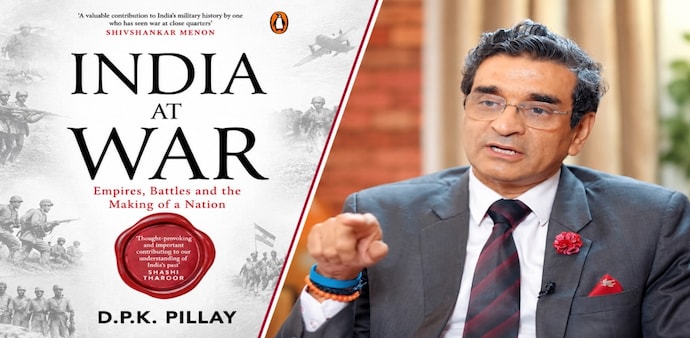
Pakistan has always been a piece of real estate that external powers needed and used in Afghanistan, against Iran, and to balance India, says military veteran DPK Pillay, author of 'India at War'
- Sep 16, 2026,
- Updated Sep 16, 2026 4:01 PM IST
India's biggest security challenge is not just China and Pakistan, according to former army officer DPK Pillay, author of 'India at War'. He argues that bigger powers have also been involved in India's conflicts, from the 1947–48 war with Pakistan to the 1971 war and the Kargil conflict.
"This is a fallacy to think that it is only Pakistan and China that are our enemies," Pillay says in an interview with Business Today Digital. "There are bigger powers that are also our adversaries."
Pillay, who has written extensively about India's military history, says external powers have repeatedly used Pakistan to pursue their strategic interests in the region, and technology has often been used to constrain India during conflicts. He argues that this makes self-reliance in defence, semiconductors, space, cyber capabilities, and autonomous weapons central to India's future security.
Edited Excerpts
Q - There has been a lot of writing on Indian history. What did you feel was missing that made you write this book, 'India At War'? And what is the central argument?
DPK: I started my education in convent and Anglo-Indian schools before joining military school in Bangalore in 1979. We followed the Cambridge syllabus, and as a child, I knew more about Greek and Roman history than I knew about the history of my own country.
We learnt about Romulus and Remus, the Roman Empire, the Greeks, and Alexander defeating Porus. We learnt about the Mughals, but very little about the Ahoms, Vijayanagara, the Pallavas, Cholas and Cheras, the Mahajanapadas, or India's extraordinary achievements in architecture, science, metallurgy, and military thought.
If I can use a metaphor, imagine that India's history is a ten-volume book. We were taught Mohenjo-daro and Harappa, which would be Volume One, and then we seemed to jump almost straight to the age of conquest and the Islamic invasions. What happened to the history in between? Volumes Two to Eight were effectively compressed into a few pages - as if those centuries did not matter.
But that was precisely where so much of India's history was: the Mahajanapadas, the great empires and kingdoms, the Ahoms, Vijayanagara, the Pallavas, Cholas and Cheras, and India's extraordinary achievements in science, technology, architecture, metallurgy and military thought.
That was the history I discovered later in life.
I came from Trivandrum, in the old kingdom of Travancore, and we have the memorial at Colachel commemorating Marthanda Varma's defeat of the Dutch East India Company in 1751. Then I travelled to Cambodia, Vietnam, and other parts of Southeast Asia - and saw the enormous influence of Indian civilisation there. I began asking myself: Where was this part of our history? Why had we not been taught it?
We are often told that India was a defeated civilisation. But if we had been completely defeated, how did our civilisation survive - our languages, traditions, temples, literature, science, and culture? That's when I realised that some pages of our history were missing. And India at War is my attempt to put some of those pages back.
And the whole idea came together when I was working in the National Security Council and was tasked with curating an exhibition marking 70 years of J&K's accession, before the abrogation of Article 370. In that process, I also helped uncover the extraordinary story of heroism of Indian soldiers at the Battle of Haifa, which ultimately resulted in Prime Minister Narendra Modi's visit to Haifa in July 2017.
In Case You Missed It: 'No good deed in govt goes unpunished': Ex-Telecom Secretary's memoir makes rare revelations on BSNL, 2G
Q - The book begins with Teen Murti and Haifa Chowk. For those who may not know, what was the Battle of Haifa, and why should Indians remember it?
DPK: Haifa was a major port, and it remains one of Israel's principal ports today. During the First World War, the campaign in Palestine was a major struggle between the British Empire and the Ottoman Empire, and Haifa was strategically important to that campaign. The Battle of Haifa in September 1918 was a defining moment because the Indian cavalry played a decisive role in capturing the city. The Jodhpur and Mysore Lancers, supported by other Indian Imperial Service troops, carried out an extraordinary cavalry charge against strongly defended Ottoman positions.
But there is another part of the story that is not remembered enough.
There was a holy man called Abdu'l-Baha, the son of Baha'u'llah, the founder of the Baha'i Faith. He was living in Haifa, and the Ottoman authorities had threatened to crucify him and his family on Mount Carmel. British intelligence had received this information, and instructions were given that his safety was to be ensured.
The Indian horsed cavalry of Jodhpur and Mysore lancers charged up the slopes of Mount Carmel in broad daylight and captured Haifa on 23 September 1918. They thus ensured Abdu'l-Baha's safety and liberated Haifa.
Till then, the British had kept telling us that Indians were good soldiers but could not lead men on their own. They said we were not leaders and could not plan or conduct campaigns.
That entire theory fell flat at Haifa. Indian officers and soldiers demonstrated extraordinary courage, initiative, and tactical ability in one of the most remarkable cavalry actions of the First World War.
That is why Haifa has to be remembered-not merely as a British victory in Palestine, but as a victory in which Indian soldiers played a decisive role, secured a strategically vital port, and ensured the safety of a holy man.
Must Read: 'BRICS remains a useful hedging instrument': Expert explains what G2, G3 would mean for India
Q - You have questioned several decisions by the government during the war with Pakistan. Are there any lessons from 1947–48 that remain relevant today?
DPK: We made major mistakes in 1947, 1962, 1971, and even later, and we don't seem to learn from them. The larger problem is that we don't seem to have a strategic bent of mind proportionate to India's weight and security requirements. We don't think in terms of the kind of influence a country of India's size and civilisational depth should be able to exert.
The lessons of 1947–48 are particularly powerful because we were clearly on the ascendancy. We had reversed the initial tide of the battle. We were recapturing territory, and the military balance was increasingly in our favour. Yet, under international pressure, we called a ceasefire and abandoned the attempt to recapture the remaining parts of Jammu and Kashmir held by Pakistan. There was no military necessity to stop at that point. We then became hostage to global opinion, which was already skewed against us and, in many ways, in favour of Pakistan. Taking the Kashmir issue to the UN under Article 35 of the UN Charter was another blunder because it internationalised what was essentially an aggression against India and gave Pakistan an equal standing in the dispute.
The other lesson is that military advice matters. Competent military commanders must be listened to. That lesson was not properly absorbed, and we repeated the mistake in 1962. In 1962, the PM relied too heavily on foreign advice and did not sufficiently use the professional military advice available to him in India. Competent commanders such as General SPP Thorat were ignored and humiliated, while decisions were taken without adequately considering the realities of war-fighting.
A country of India's size, civilisational depth, and strategic weight should be able to exert influence far beyond its boundaries. And yet, even the good that we do seems to be lost.
Look at Minsar, near Mount Kailash. Under the 1684 Treaty of Tingmosgang, the ruler of Ladakh retained Minsar as an enclave, and the revenue from it was traditionally associated with maintaining the pilgrimage to Mount Kailash and the holy lakes of Mansarovar and Rakas Tal. After Ladakh became part of the Jammu and Kashmir State, these rights were inherited by the Kashmir Government. Yet, in the early 1950s, India quietly relinquished these rights. Nehru was prepared to give up India's rights over Minsar as a gesture of goodwill towards China, in the hope of building a better relationship and facilitating a larger understanding with China. You cannot secure national interests by not standing up for your rights, giving away your land in the hope that the other side will appreciate your goodwill.
Goodwill has its place in diplomacy, but it cannot substitute for strategy. It didn't work when we sent back 93,000 prisoners in 1971, it didn't work when we gave 550 million rupees to Pakistan in 1947, and it didn't work when we gave away a bulk of the river water rights to Pakistan, along with 62 million pounds to Pakistan in 1960 as part of the Indus Treaty.
Q - The Indus Waters Treaty is favourable to Pakistan. But you also point out that India paid £60 million to Pakistan to help finance the construction of replacement irrigation works. Was there any serious pushback within the Indian government? Because this is a remarkably generous settlement.
DPK: Yes, we paid 60 million pounds. You know, why did Mao Zedong capture Tibet? It was not because he wanted to become a Buddhist. It is because the water table - 12 rivers flow out of Tibet. Mekong, Brahmaputra, and everything comes out of Tibet. Similarly, in this part, the entire thing becomes viable because of the Kashmir River Valley and the Indus water. That's why they (Pakistan) wanted to capture it. The moment they lost the battle in 1948, only then did they go into negotiations for the Indus Water Treaty.
Q - India has put the treaty now in abeyance. What do you think New Delhi should do after this? Should we revoke it or keep it in abeyance mode only?
DPK: Hold it in abeyance only. You don't have to abrogate it. Link it to terror and link it to their performance. They are supposed to renegotiate it for a better peace. We thought we would be able to buy peace from them, but they are not ceasing any of their activities. It is a one-sided treaty that never benefited us in any way. They completely held up all our projects, like the Kishenganga hydroelectric project, by taking them to the Court of Arbitration.
So, what has the treaty given us? Did it give us peace? No. Nowhere else in the world, in any period of history, has a treaty been signed like this.
Q- You also write about the Indian Army's contribution in the Battle of Kohima and Imphal. General Slim's 14th Army fought at Imphal and Kohima, and Churchill described it as the 'forgotten army that saved Asia'. Why have some of these episodes disappeared from our memory?
DPK: This happened because of people who came after independence. Instead of reviving the history, they perpetuated what the British wanted us to believe.
The British wanted it so they would be seen as a superior force. They told us that they inherited the mantle from the Mughals, but the Mughal Empire had died in 1707. The Battles of Chillianwala, Gujarat, Laswari, and Deeg were all against Jats, Sikhs, Rajputs, and Marathas. It was not against the Mughals at all.
The 1757 war was against Siraj-ud-Daulah, the vassal of the Mughals. It was not against the Mughal Empire, but they said that they inherited it from the Mughals.
The grandeur of the Mughals, the Peacock Throne, became famous all over the world. Everyone knew about the Mughal Empire, Red Fort, and Taj Mahal. So, when the British came here, they said we have taken over from them. So they became the new Sarkar.
They created the Aryan invasion theory. The British had a version of history which, for many reasons, we allowed to be perpetuated. Maybe it was good in terms of continuity. We didn't want a break from the past. But knowing that history is very important.
Q - Is there any move in that direction now?
DPK: Our textbooks are not touching the real issues. I don't see any real concerted and academically driven effort. It has to be a very clear exercise. We should get international scholars. Some people say India didn't have a written history. Tell me, where is the written history of the Roman Empire? Show me that. There are buildings, monuments, and records. We too have it.
At that time, it was memorised and passed down. We know what was recited 5,000 years ago. Ditto is recited even today. And then we have inscriptions in temples. What more do you need? That bit has to be asserted.
Our beautiful monuments, like the temples in South India, the Kailash temple, and the Ellora caves in Sambhaji Nagar, are all real wonders of the world. We don't even talk about them. These are the things that encourage people to understand history and celebrate our victories. That part of our history should be very academic. Rejuvenation should take place.
If you go to Japan and Korea, you will find the temples there always have Varuna, Garuda, Hanuman, Narayana, and Indra. Then Buddha is there in the pantheon, like the topmost. There are three Buddhas: the old Buddha, the current Buddha, and the future Buddha. All of them are there. It's all in the pantheon.
But in India, they say, Buddhism is a different religion. That kind of narrative is there, and no one is there to contest it. What happened was that the universities that used to produce them - Nalanda and Udantapuri, and Takshila - were all destroyed by them.
Look at the precision with which the temples were built in South India. Look at the Padmanabhaswamy Temple. On the equinox day, the sun goes exactly through the temple arches. Now, you had to have the precision of knowing the path of the sun on that particular day.
In Kolhapur, there's a temple in which the sun comes to the goddess's feet on a particular day. You have to know the path of the solar system and the sun. It's an amazing thing. That has to be revived.
Q - You say Chittagong was 98% Buddhist, yet it was given to Pakistan because Britain wanted a maritime presence in the Bay of Bengal. In March 2025, Tripura's Pradyot Deb Barma said India should support indigenous groups or take over parts up to the Chittagong Hill Tracts. Sadhguru once said that we have to make Chicken's neck now Elephant's neck.
DPK: Yes, we have to. Tell me, in which part of the world has the status quo ever been maintained?
Q - Is that possible in today's world?
DPK: It's possible. If they are threatening you, anything is possible, and it should be done. Why bother about the world? Did the world help when Bangladeshis were being massacred in 1971? It was the Indian Army that helped. Whenever there is a provocation next, I don't think we should be constrained by decency. It is not set in stone like the Ten Commandments that it can't be altered.
Q - To alter anything in today's world, we need the capability to sustain it. We are seeing two wars in which two major powers are involved. But there is no decisive victory for any of them despite advanced tech and strong defence manufacturing capacity.
DPK: What did Afghanistan have in terms of technology? The US entered Afghanistan in 2001. Twenty years later, it came out the same way. Look at Vietnam. North Vietnam overwhelmed the US completely. So, I don't agree that we need to get technology first. Technology is the people's will. It doesn't really matter.
Q - India is now working on the Great Nicobar project. There has been some criticism, but that project is strategically very important. How do you see this project?
DPK: Absolutely. Why wasn't it done earlier? The Andaman and Nicobar Islands are like a permanent aircraft carrier for us. Look at the shipping that is taking place. The Chinese are gaining access to all key strategic points in the sea lanes. Nicobar Island sits on one of the busiest sea lanes. The Malacca Strait is among the busiest lanes. And there's no way shipping will stop.
Why are the critics not raising a voice about what's happening in Tibet? Look at what happened in Tibet and Nepal. So, that is the real fragile ecosystem. Have they stopped sending spacecraft even though there are already millions of pieces of debris in space?
India has a security risk, and this project is needed.
Also, India is the only country in the whole world that has protected its tribes. Show me any other country in the Amazon that has a law saying you can't touch tribals. We don't even touch the Sentinelese. We have laws to protect them. Could anyone be more environmentally conscious than this?
Q - India is facing two immediate adversaries - China and Pakistan. As the security environment is changing due to the arrival of drones and autonomous weapons, how should the Indian Army prepare for a future crisis?
DPK: Firstly, it is a fallacy to think that it is only Pakistan and China that are our enemies. There are bigger powers that are also our adversaries.
That should be very clear. Look at our history. The 1947–48 war - was it an India-Pakistan war? It was an Anglo-Pakistani war. In 1971, when the US Seventh Fleet moved into the Bay of Bengal toward Chittagong, what was that? It was sent to aid and protect Pakistan while it was committing an outright genocide against its own citizens in East Pakistan. In the 1999 Kargil War, when our soldiers were fighting on the icy peaks, GPS data was deliberately denied and spoofed to handicap India.
Pakistan has always been a piece of real estate that external powers needed and used in Afghanistan, against Iran, and to balance India. Billions of dollars in aid, F-16s, and advanced armor were never meant for mountain counter-insurgency or fighting terrorism. Is Pakistan using F-16s to fight terror? They were provided to equip Pakistan against us. Billions of dollars have been given in aid. They were not for making camps in the mountains. They were given to equip Pakistan with hardware and tanks. Tanks are not used against insurgents. So, it is clear that we have bigger enemies.
From 1971 to Kargil, external powers controlled critical technology and denied it to us whenever the pressure mounted. We have always been overwhelmed by technology. We should be abreast with the latest technology, and we are doing well in this area. The government has actually invested a lot in Atmanirbhar Bharat. We have made progress in space technology. Space, cyber, semiconductors, and autonomous weapons - these are the new frontiers, and we are doing very well nowadays.
However, future readiness cannot be an isolated military pursuit; it demands a total and all-of-nation mobilisation. Atmanirbhar Bharat cannot settle for bolting together foreign parts. Complete self-reliance requires our civil industry, academia, and military working as one to build domestic semiconductors, sovereign NavIC navigation, and indigenous autonomous code.
Also, hostile algorithms and electronic warfare will blind sensors, crash swarms, and disable formations long before a physical bullet is fired. We must command the electromagnetic spectrum and algorithmic speed. The era of being constrained by foreign technology is ending. Deterrence tomorrow belongs to whoever commands the software, the spectrum, the swarm, and the narrative.
India's biggest security challenge is not just China and Pakistan, according to former army officer DPK Pillay, author of 'India at War'. He argues that bigger powers have also been involved in India's conflicts, from the 1947–48 war with Pakistan to the 1971 war and the Kargil conflict.
"This is a fallacy to think that it is only Pakistan and China that are our enemies," Pillay says in an interview with Business Today Digital. "There are bigger powers that are also our adversaries."
Pillay, who has written extensively about India's military history, says external powers have repeatedly used Pakistan to pursue their strategic interests in the region, and technology has often been used to constrain India during conflicts. He argues that this makes self-reliance in defence, semiconductors, space, cyber capabilities, and autonomous weapons central to India's future security.
Edited Excerpts
Q - There has been a lot of writing on Indian history. What did you feel was missing that made you write this book, 'India At War'? And what is the central argument?
DPK: I started my education in convent and Anglo-Indian schools before joining military school in Bangalore in 1979. We followed the Cambridge syllabus, and as a child, I knew more about Greek and Roman history than I knew about the history of my own country.
We learnt about Romulus and Remus, the Roman Empire, the Greeks, and Alexander defeating Porus. We learnt about the Mughals, but very little about the Ahoms, Vijayanagara, the Pallavas, Cholas and Cheras, the Mahajanapadas, or India's extraordinary achievements in architecture, science, metallurgy, and military thought.
If I can use a metaphor, imagine that India's history is a ten-volume book. We were taught Mohenjo-daro and Harappa, which would be Volume One, and then we seemed to jump almost straight to the age of conquest and the Islamic invasions. What happened to the history in between? Volumes Two to Eight were effectively compressed into a few pages - as if those centuries did not matter.
But that was precisely where so much of India's history was: the Mahajanapadas, the great empires and kingdoms, the Ahoms, Vijayanagara, the Pallavas, Cholas and Cheras, and India's extraordinary achievements in science, technology, architecture, metallurgy and military thought.
That was the history I discovered later in life.
I came from Trivandrum, in the old kingdom of Travancore, and we have the memorial at Colachel commemorating Marthanda Varma's defeat of the Dutch East India Company in 1751. Then I travelled to Cambodia, Vietnam, and other parts of Southeast Asia - and saw the enormous influence of Indian civilisation there. I began asking myself: Where was this part of our history? Why had we not been taught it?
We are often told that India was a defeated civilisation. But if we had been completely defeated, how did our civilisation survive - our languages, traditions, temples, literature, science, and culture? That's when I realised that some pages of our history were missing. And India at War is my attempt to put some of those pages back.
And the whole idea came together when I was working in the National Security Council and was tasked with curating an exhibition marking 70 years of J&K's accession, before the abrogation of Article 370. In that process, I also helped uncover the extraordinary story of heroism of Indian soldiers at the Battle of Haifa, which ultimately resulted in Prime Minister Narendra Modi's visit to Haifa in July 2017.
In Case You Missed It: 'No good deed in govt goes unpunished': Ex-Telecom Secretary's memoir makes rare revelations on BSNL, 2G
Q - The book begins with Teen Murti and Haifa Chowk. For those who may not know, what was the Battle of Haifa, and why should Indians remember it?
DPK: Haifa was a major port, and it remains one of Israel's principal ports today. During the First World War, the campaign in Palestine was a major struggle between the British Empire and the Ottoman Empire, and Haifa was strategically important to that campaign. The Battle of Haifa in September 1918 was a defining moment because the Indian cavalry played a decisive role in capturing the city. The Jodhpur and Mysore Lancers, supported by other Indian Imperial Service troops, carried out an extraordinary cavalry charge against strongly defended Ottoman positions.
But there is another part of the story that is not remembered enough.
There was a holy man called Abdu'l-Baha, the son of Baha'u'llah, the founder of the Baha'i Faith. He was living in Haifa, and the Ottoman authorities had threatened to crucify him and his family on Mount Carmel. British intelligence had received this information, and instructions were given that his safety was to be ensured.
The Indian horsed cavalry of Jodhpur and Mysore lancers charged up the slopes of Mount Carmel in broad daylight and captured Haifa on 23 September 1918. They thus ensured Abdu'l-Baha's safety and liberated Haifa.
Till then, the British had kept telling us that Indians were good soldiers but could not lead men on their own. They said we were not leaders and could not plan or conduct campaigns.
That entire theory fell flat at Haifa. Indian officers and soldiers demonstrated extraordinary courage, initiative, and tactical ability in one of the most remarkable cavalry actions of the First World War.
That is why Haifa has to be remembered-not merely as a British victory in Palestine, but as a victory in which Indian soldiers played a decisive role, secured a strategically vital port, and ensured the safety of a holy man.
Must Read: 'BRICS remains a useful hedging instrument': Expert explains what G2, G3 would mean for India
Q - You have questioned several decisions by the government during the war with Pakistan. Are there any lessons from 1947–48 that remain relevant today?
DPK: We made major mistakes in 1947, 1962, 1971, and even later, and we don't seem to learn from them. The larger problem is that we don't seem to have a strategic bent of mind proportionate to India's weight and security requirements. We don't think in terms of the kind of influence a country of India's size and civilisational depth should be able to exert.
The lessons of 1947–48 are particularly powerful because we were clearly on the ascendancy. We had reversed the initial tide of the battle. We were recapturing territory, and the military balance was increasingly in our favour. Yet, under international pressure, we called a ceasefire and abandoned the attempt to recapture the remaining parts of Jammu and Kashmir held by Pakistan. There was no military necessity to stop at that point. We then became hostage to global opinion, which was already skewed against us and, in many ways, in favour of Pakistan. Taking the Kashmir issue to the UN under Article 35 of the UN Charter was another blunder because it internationalised what was essentially an aggression against India and gave Pakistan an equal standing in the dispute.
The other lesson is that military advice matters. Competent military commanders must be listened to. That lesson was not properly absorbed, and we repeated the mistake in 1962. In 1962, the PM relied too heavily on foreign advice and did not sufficiently use the professional military advice available to him in India. Competent commanders such as General SPP Thorat were ignored and humiliated, while decisions were taken without adequately considering the realities of war-fighting.
A country of India's size, civilisational depth, and strategic weight should be able to exert influence far beyond its boundaries. And yet, even the good that we do seems to be lost.
Look at Minsar, near Mount Kailash. Under the 1684 Treaty of Tingmosgang, the ruler of Ladakh retained Minsar as an enclave, and the revenue from it was traditionally associated with maintaining the pilgrimage to Mount Kailash and the holy lakes of Mansarovar and Rakas Tal. After Ladakh became part of the Jammu and Kashmir State, these rights were inherited by the Kashmir Government. Yet, in the early 1950s, India quietly relinquished these rights. Nehru was prepared to give up India's rights over Minsar as a gesture of goodwill towards China, in the hope of building a better relationship and facilitating a larger understanding with China. You cannot secure national interests by not standing up for your rights, giving away your land in the hope that the other side will appreciate your goodwill.
Goodwill has its place in diplomacy, but it cannot substitute for strategy. It didn't work when we sent back 93,000 prisoners in 1971, it didn't work when we gave 550 million rupees to Pakistan in 1947, and it didn't work when we gave away a bulk of the river water rights to Pakistan, along with 62 million pounds to Pakistan in 1960 as part of the Indus Treaty.
Q - The Indus Waters Treaty is favourable to Pakistan. But you also point out that India paid £60 million to Pakistan to help finance the construction of replacement irrigation works. Was there any serious pushback within the Indian government? Because this is a remarkably generous settlement.
DPK: Yes, we paid 60 million pounds. You know, why did Mao Zedong capture Tibet? It was not because he wanted to become a Buddhist. It is because the water table - 12 rivers flow out of Tibet. Mekong, Brahmaputra, and everything comes out of Tibet. Similarly, in this part, the entire thing becomes viable because of the Kashmir River Valley and the Indus water. That's why they (Pakistan) wanted to capture it. The moment they lost the battle in 1948, only then did they go into negotiations for the Indus Water Treaty.
Q - India has put the treaty now in abeyance. What do you think New Delhi should do after this? Should we revoke it or keep it in abeyance mode only?
DPK: Hold it in abeyance only. You don't have to abrogate it. Link it to terror and link it to their performance. They are supposed to renegotiate it for a better peace. We thought we would be able to buy peace from them, but they are not ceasing any of their activities. It is a one-sided treaty that never benefited us in any way. They completely held up all our projects, like the Kishenganga hydroelectric project, by taking them to the Court of Arbitration.
So, what has the treaty given us? Did it give us peace? No. Nowhere else in the world, in any period of history, has a treaty been signed like this.
Q- You also write about the Indian Army's contribution in the Battle of Kohima and Imphal. General Slim's 14th Army fought at Imphal and Kohima, and Churchill described it as the 'forgotten army that saved Asia'. Why have some of these episodes disappeared from our memory?
DPK: This happened because of people who came after independence. Instead of reviving the history, they perpetuated what the British wanted us to believe.
The British wanted it so they would be seen as a superior force. They told us that they inherited the mantle from the Mughals, but the Mughal Empire had died in 1707. The Battles of Chillianwala, Gujarat, Laswari, and Deeg were all against Jats, Sikhs, Rajputs, and Marathas. It was not against the Mughals at all.
The 1757 war was against Siraj-ud-Daulah, the vassal of the Mughals. It was not against the Mughal Empire, but they said that they inherited it from the Mughals.
The grandeur of the Mughals, the Peacock Throne, became famous all over the world. Everyone knew about the Mughal Empire, Red Fort, and Taj Mahal. So, when the British came here, they said we have taken over from them. So they became the new Sarkar.
They created the Aryan invasion theory. The British had a version of history which, for many reasons, we allowed to be perpetuated. Maybe it was good in terms of continuity. We didn't want a break from the past. But knowing that history is very important.
Q - Is there any move in that direction now?
DPK: Our textbooks are not touching the real issues. I don't see any real concerted and academically driven effort. It has to be a very clear exercise. We should get international scholars. Some people say India didn't have a written history. Tell me, where is the written history of the Roman Empire? Show me that. There are buildings, monuments, and records. We too have it.
At that time, it was memorised and passed down. We know what was recited 5,000 years ago. Ditto is recited even today. And then we have inscriptions in temples. What more do you need? That bit has to be asserted.
Our beautiful monuments, like the temples in South India, the Kailash temple, and the Ellora caves in Sambhaji Nagar, are all real wonders of the world. We don't even talk about them. These are the things that encourage people to understand history and celebrate our victories. That part of our history should be very academic. Rejuvenation should take place.
If you go to Japan and Korea, you will find the temples there always have Varuna, Garuda, Hanuman, Narayana, and Indra. Then Buddha is there in the pantheon, like the topmost. There are three Buddhas: the old Buddha, the current Buddha, and the future Buddha. All of them are there. It's all in the pantheon.
But in India, they say, Buddhism is a different religion. That kind of narrative is there, and no one is there to contest it. What happened was that the universities that used to produce them - Nalanda and Udantapuri, and Takshila - were all destroyed by them.
Look at the precision with which the temples were built in South India. Look at the Padmanabhaswamy Temple. On the equinox day, the sun goes exactly through the temple arches. Now, you had to have the precision of knowing the path of the sun on that particular day.
In Kolhapur, there's a temple in which the sun comes to the goddess's feet on a particular day. You have to know the path of the solar system and the sun. It's an amazing thing. That has to be revived.
Q - You say Chittagong was 98% Buddhist, yet it was given to Pakistan because Britain wanted a maritime presence in the Bay of Bengal. In March 2025, Tripura's Pradyot Deb Barma said India should support indigenous groups or take over parts up to the Chittagong Hill Tracts. Sadhguru once said that we have to make Chicken's neck now Elephant's neck.
DPK: Yes, we have to. Tell me, in which part of the world has the status quo ever been maintained?
Q - Is that possible in today's world?
DPK: It's possible. If they are threatening you, anything is possible, and it should be done. Why bother about the world? Did the world help when Bangladeshis were being massacred in 1971? It was the Indian Army that helped. Whenever there is a provocation next, I don't think we should be constrained by decency. It is not set in stone like the Ten Commandments that it can't be altered.
Q - To alter anything in today's world, we need the capability to sustain it. We are seeing two wars in which two major powers are involved. But there is no decisive victory for any of them despite advanced tech and strong defence manufacturing capacity.
DPK: What did Afghanistan have in terms of technology? The US entered Afghanistan in 2001. Twenty years later, it came out the same way. Look at Vietnam. North Vietnam overwhelmed the US completely. So, I don't agree that we need to get technology first. Technology is the people's will. It doesn't really matter.
Q - India is now working on the Great Nicobar project. There has been some criticism, but that project is strategically very important. How do you see this project?
DPK: Absolutely. Why wasn't it done earlier? The Andaman and Nicobar Islands are like a permanent aircraft carrier for us. Look at the shipping that is taking place. The Chinese are gaining access to all key strategic points in the sea lanes. Nicobar Island sits on one of the busiest sea lanes. The Malacca Strait is among the busiest lanes. And there's no way shipping will stop.
Why are the critics not raising a voice about what's happening in Tibet? Look at what happened in Tibet and Nepal. So, that is the real fragile ecosystem. Have they stopped sending spacecraft even though there are already millions of pieces of debris in space?
India has a security risk, and this project is needed.
Also, India is the only country in the whole world that has protected its tribes. Show me any other country in the Amazon that has a law saying you can't touch tribals. We don't even touch the Sentinelese. We have laws to protect them. Could anyone be more environmentally conscious than this?
Q - India is facing two immediate adversaries - China and Pakistan. As the security environment is changing due to the arrival of drones and autonomous weapons, how should the Indian Army prepare for a future crisis?
DPK: Firstly, it is a fallacy to think that it is only Pakistan and China that are our enemies. There are bigger powers that are also our adversaries.
That should be very clear. Look at our history. The 1947–48 war - was it an India-Pakistan war? It was an Anglo-Pakistani war. In 1971, when the US Seventh Fleet moved into the Bay of Bengal toward Chittagong, what was that? It was sent to aid and protect Pakistan while it was committing an outright genocide against its own citizens in East Pakistan. In the 1999 Kargil War, when our soldiers were fighting on the icy peaks, GPS data was deliberately denied and spoofed to handicap India.
Pakistan has always been a piece of real estate that external powers needed and used in Afghanistan, against Iran, and to balance India. Billions of dollars in aid, F-16s, and advanced armor were never meant for mountain counter-insurgency or fighting terrorism. Is Pakistan using F-16s to fight terror? They were provided to equip Pakistan against us. Billions of dollars have been given in aid. They were not for making camps in the mountains. They were given to equip Pakistan with hardware and tanks. Tanks are not used against insurgents. So, it is clear that we have bigger enemies.
From 1971 to Kargil, external powers controlled critical technology and denied it to us whenever the pressure mounted. We have always been overwhelmed by technology. We should be abreast with the latest technology, and we are doing well in this area. The government has actually invested a lot in Atmanirbhar Bharat. We have made progress in space technology. Space, cyber, semiconductors, and autonomous weapons - these are the new frontiers, and we are doing very well nowadays.
However, future readiness cannot be an isolated military pursuit; it demands a total and all-of-nation mobilisation. Atmanirbhar Bharat cannot settle for bolting together foreign parts. Complete self-reliance requires our civil industry, academia, and military working as one to build domestic semiconductors, sovereign NavIC navigation, and indigenous autonomous code.
Also, hostile algorithms and electronic warfare will blind sensors, crash swarms, and disable formations long before a physical bullet is fired. We must command the electromagnetic spectrum and algorithmic speed. The era of being constrained by foreign technology is ending. Deterrence tomorrow belongs to whoever commands the software, the spectrum, the swarm, and the narrative.