
No more soup, sandwiches! IRCTC cuts food items on Vande Bharat Sleeper menu, here's what passengers will get
The Indian Railway Catering and Tourism Corporation (IRCTC) introduced the compact menu on November 1 after repeated complaints about cold, stale and unhygienic food on long-distance trains.
- Nov 26, 2026,
- Updated Nov 26, 2026 11:19 AM IST
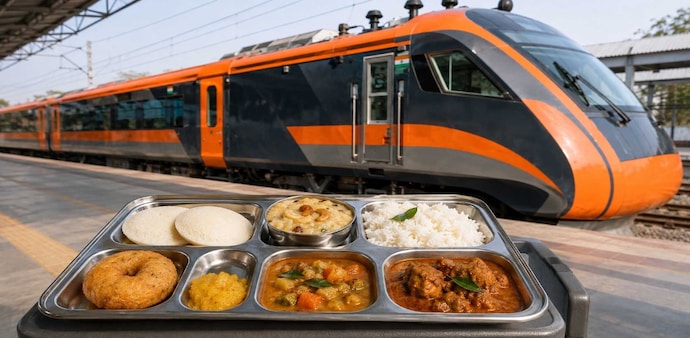
Indian Railways has reduced the food menu on Vande Bharat Sleeper trains as part of a pilot project aimed at improving meal quality, freshness and hygiene. The compact, airline-style menu is now being tested on three long-distance routes: Mumbai–Bengaluru, New Delhi–Varanasi and Howrah–Kamakhya.
What passengers will get?
The number of items in a meal has been cut from roughly eight to 10 to just four. On the Mumbai–Bengaluru service, breakfast options include idli and vada with sambhar and chutney, poha, or upma, Under the revised arrangement cited by the Hindustan Times reported.
For lunch and dinner, passengers will receive chapati, rice, dal and one main dish, with a choice between chicken and a vegetarian preparation.
Items removed from the earlier menu include soup, omelette, sandwiches, buttermilk and chocolate at breakfast, as well as dry vegetables, curd, salad, pickle and sweets at lunch and dinner.
Why the menu was cut
The Indian Railway Catering and Tourism Corporation (IRCTC) introduced the compact menu on November 1 after repeated complaints about cold, stale and unhygienic food on long-distance trains. Officials said preparing a large number of dishes in limited pantry space, with limited staff and preparation time, had created operational challenges.
“Following complaints about the food, we are offering a compact menu just like airlines do. This will help us monitor the quality of each item, rather than managing a variety of dishes,” an IRCTC official told Hindustan Times.
The official added that meals are now being prepared by cloud kitchens that also supply airlines and hotels, where food is produced, packaged and served under more controlled conditions.
Smaller meals, same portions
Although the overall meal weight has fallen from about 700–750 grams to 450–500 grams, IRCTC has clarified that the portion size of individual dishes has not been reduced. The reduction reflects the removal of additional accompaniments rather than smaller servings.
IRCTC has partnered with Mayfair Group for the Kamakhya route, TajSATS for Howrah and Sarovar Portico Group for the other two Vande Bharat sleeper trains.
Early feedback
The catering body has reported a 10 per cent decline in complaints in its West Zone since cloud kitchens began supplying meals. “Passenger satisfaction remains IRCTC’s foremost priority,” said Gaurav Jha, group general manager, IRCTC West Zone, Mumbai.
IRCTC is currently assessing passenger feedback and may extend the shorter-menu model to more long-distance trains if the response remains positive.
For passengers, the change means fewer choices on the tray—but railway officials hope it will translate into fresher, more consistent meals on India’s premium overnight services.