
North India gasps: Delhi air improves slightly; NCR, UP remain in toxic grip
The CPCB classifies AQI between 301 and 400 as “very poor", meaning prolonged exposure can cause respiratory illness even among healthy people.
- Nov 10, 2026,
- Updated Nov 10, 2026 11:33 AM IST
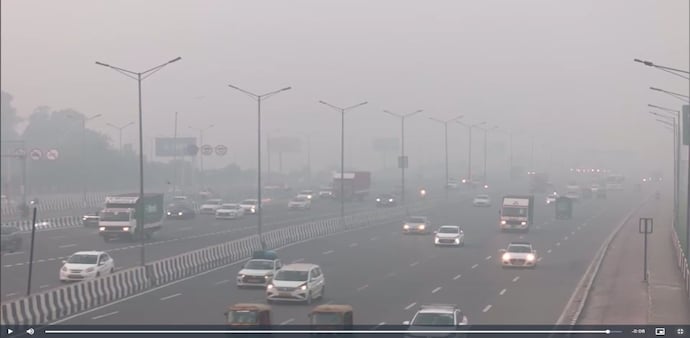
Delhi woke up to a marginally clearer sky on Tuesday, but relief is still far away. The national capital’s Air Quality Index (AQI) improved slightly, yet the air remained firmly in the “poor” category, leaving millions across Delhi-NCR and much of northern India to contend with a persistent blanket of toxic smog.
The CPCB classifies AQI between 301 and 400 as “very poor,” meaning prolonged exposure can cause respiratory illness even among healthy people.
NCR cities under haze
Neighbouring NCR cities continued to breathe polluted air. Ghaziabad recorded an AQI of 252 at 9 am, while Noida stood at 306, according to CPCB figures. Gurugram and Ambala each recorded an AQI of 321 and 269, placing them in the “poor”and “very poor” category respectively.
The pollution build-up follows on Diwali, when Noida recorded an average AQI of 341, Ghaziabad 357, Gurugram 328 and Faridabad 342, according to CPCB data. Those readings placed all four cities in the “very poor” category, which corresponds to an AQI between 301 and 400.
DO CHECKOUT: Delhi’s Diwali air hit 3,744 as 125 pollution readings went missing from CPCB records: Here’s what the data shows
The region's pollution has been aggravated by low wind speeds, winter inversion and limited rainfall, with forecasters expecting little immediate relief despite an approaching Western disturbance.
Punjab and Haryana affected
The smog also spread across Punjab and Haryana. Jalandhar and Mandi Gobindgarh topped Punjab’s pollution chart with an AQI 261 and 309 respectively, while Ludhiana recorded 281, Amritsar 260 and Patiala 200, according to CPCB figures.
Chandigarh’s air quality was reported in the “poor” category, with readings ranging from 127 to 193 across monitoring stations on Tuesday.
UP cities among pollution
Air quality was equally alarming in parts of Uttar Pradesh. On Monday morning, AQI levels in Prayagraj, Gorakhpur and Lucknow crossed 500, according to CPCB-based figures.
But on Tuesday, there’s a moderate improvement. Prayagraj's real-time AQI was reported at 176, while Lucknow stood at 191 and Kanpur at 206.
Ten Uttar Pradesh cities, including Noida, Ghaziabad, Kanpur and Varanasi, recorded hazardous air quality on Monday, but with a moderate improvement underscoring that the crisis will go down in coming days beyond the capital region.
Emergency curbs continue
The Commission for Air Quality Management (CAQM) invoked Stage III of the Graded Response Action Plan (GRAP) across Delhi-NCR on November 6, after the capital’s average AQI reached 382, placing it in the “very poor” category.
Under Stage III, authorities have tightened restrictions on construction and demolition activity, vehicle movement and industrial operations. Schools have been asked to conduct classes up to Class 5 in hybrid mode, allowing children to attend physically or learn online where facilities are available.
CAQM has directed agencies in Delhi and adjoining districts of Haryana, Uttar Pradesh and Rajasthan to intensify enforcement and pollution-control measures to prevent air quality from slipping into the “severe” category.
Health advisory
Doctors and pollution experts advise residents—particularly children, older adults and people with asthma, heart disease or other respiratory conditions—to limit outdoor exertion during early mornings and late evenings.
With no significant rain expected immediately, officials say the priority is strict enforcement of GRAP-III measures, reduced vehicular and construction dust, and public cooperation in avoiding open waste burning.