
‘Not targeted at India…’: Marco Rubio says US is simply trying to fix its tariff and visa systems
Marco Rubio said on one hand the US wants to pressure the warring parties to the table to negotiate an outcome and on the other hand putting other important relationships under stress.
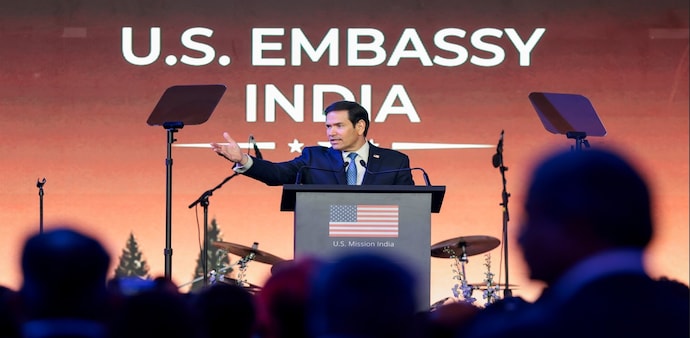
- Oct 21, 2026,
- Updated Oct 21, 2026 8:10 AM IST
US’ tariffs and its restrictions on visas are not targeted at India, said Secretary of State Marco Rubio, who is on his second visit to the country in five months. He acknowledged that balancing foreign policy is a difficult act.
In an interview with The Indian Express, Rubio said that “there is no doubt” that the sanctions on purchase of Russian oil, which have been waived off, can be imposed again at some point. “And that is why it has to be managed very carefully, and the relationship we have is so critical… None of these tariffs are meant to punish or harm India,” he said.
Rubio said the tariffs are part of a broader foreign policy that involves a war going on between Russia and Ukraine that the US would like to see come to an end. The Secretary of State said one of the reasons Donald Trump did not impose the restrictions is because “he understands that it would have a very detrimental impact on a very important relationship with India”.
He said it is part of the balancing act, where on one hand the US wants to pressure the warring parties to the table to negotiate an outcome and on the other hand putting other important relationships under stress. “I think the President is trying very hard to balance that… but it will be a challenge,” he said to the daily.
Rubio also spoke about the restrictions on visas and on concerns that the anti-immigrant rhetoric is seen as antagonistic to Indians, some of the biggest beneficiaries of the H-1B. He said that every country has immigration laws and without them no country is sovereign. Rubio claimed that people entered the US unlawfully, “especially under the four years of President Joe Biden”.
“And, this is not about India, this applies globally…It is not unique to Indians or India. We have seen a rise in birth tourism, that has nothing to do with India but with other countries. Things of this nature. So we are trying to fix 20 years of neglect of an immigration system, and that is not targeted towards India,” he said in the interview.
Rubio acknowledged that “certain categories of visas” see a large number of Indian applicants but added that the US is simply trying to fix its immigration system so that it can welcome immigrants into the country.
“We want people to visit the United States. We want people to study in the United States. There are certain people that we want, that want to come work for a time in the United States. We want people to invest in the United States, and we are always going to have people immigrate to the United States. But we want it done through a system of laws that are complied with,” said Rubio.
He said that mass migration is the biggest threat to legal immigration. Rubio said he understands that from the perspective in India, it might seem targeted at India but it is not. “There is virtually no country on Earth that I visit where I don’t get a complaint about some visa or process, because we are fixing it globally,” he said.