
Ocean sentinels: India inks ₹1,943-crore lease for two MQ-9B Sea Guardian drones
The high-altitude uncrewed systems will provide persistent Intelligence, Surveillance, and Reconnaissance (ISR) coverage across vast stretches of the maritime domain, expanding the Indian Navy’s tactical readiness and rapid-response capabilities across the Indian Ocean Region.
- Aug 17, 2026,
- Updated Aug 17, 2026 5:56 PM IST
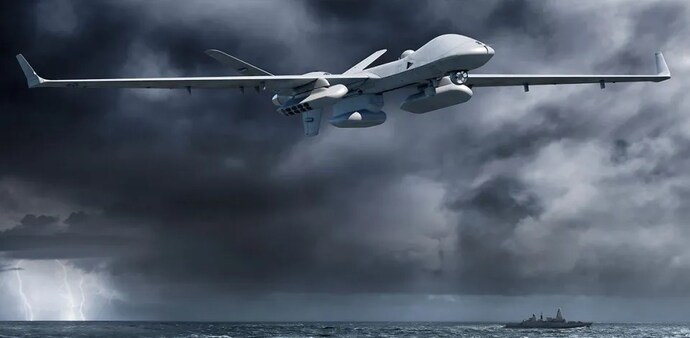
In a direct push to fortify its surveillance coverage over critical sea lanes, the Ministry of Defence signed a contract on August 17, 2026, with US defense major General Atomics Aeronautical Systems, Inc. (GA-ASI) to lease two MQ-9B Sea Guardian High-Altitude Long-Endurance (HALE) Remotely Piloted Aircraft Systems (RPAS) for the Indian Navy.
The contract, valued at approximately ₹1,943 crore, establishes a 30-month lease framework designed to deliver uninterrupted airborne intelligence. The pact was signed in New Delhi at Kartavya Bhawan-2 in the presence of Shri A. Anbarasu, Additional Secretary & Director General (Acquisition), Department of Defence.
Equipped with high-definition optical payloads, advanced maritime radar, and long-range sensors, the incoming MQ-9B Sea Guardians are slated to immediately boost India’s Maritime Domain Awareness (MDA).
The high-altitude uncrewed systems will provide persistent Intelligence, Surveillance, and Reconnaissance (ISR) coverage across vast stretches of the maritime domain, expanding the Indian Navy’s tactical readiness and rapid-response capabilities across the Indian Ocean Region.
What is the MQ-9B Sea Guardian?
Developed by General Atomics Aeronautical Systems, Inc. (GA-ASI), the MQ-9B Sea Guardian is the maritime-focused variant of the SkyGuardian High-Altitude Long-Endurance (HALE) aircraft family.
Unlike standard land-based surveillance drones, the Sea Guardian is specifically engineered for all-weather maritime operations and blue-water security.
- Endurance & Altitude: Capable of remaining airborne for over 30 to 40 hours per mission at altitudes above 40,000 feet.
- Sensor Capabilities: Features a 360-degree surface-search radar (such as the Lynx Multi-Mode Radar), Automatic Identification System (AIS) receiver, High-Definition Electro-Optical/Infrared (EO/IR) cameras, and anti-submarine warfare (ASW) suit options, including sonobuoy dispensers.
- Primary Missions: Anti-surface warfare targeting, maritime domain awareness, search and rescue (SAR), anti-piracy patrols, coastal surveillance, and environmental monitoring.
Global operators & Users
The MQ-9B platform family (comprising the SkyGuardian and SeaGuardian) has seen rapid adoption among NATO allies and strategic partner nations:
- United States: Operates across military branches, with the US Navy, US Air Force, and Coast Guard utilising Predator/Reaper/SeaGuardian variants.
- United Kingdom: The Royal Air Force operates the MQ-9B variant under the designation Protector RG Mk1.
- Japan: The Japan Coast Guard (JCG) and Japan Maritime Self-Defense Force (JMSDF) operate MQ-9B Sea Guardians for maritime security, Exclusive Economic Zone (EEZ) surveillance, and disaster response.
- Canada: Selected the MQ-9B SkyGuardian to modernize its airborne long-range intelligence capability.
- Belgium: Purchased MQ-9B SkyGuardians to fulfill NATO defense commitments.
- Taiwan: Procurement approved for MQ-9B variants to enhance regional reconnaissance and coastal defense capabilities.
In a direct push to fortify its surveillance coverage over critical sea lanes, the Ministry of Defence signed a contract on August 17, 2026, with US defense major General Atomics Aeronautical Systems, Inc. (GA-ASI) to lease two MQ-9B Sea Guardian High-Altitude Long-Endurance (HALE) Remotely Piloted Aircraft Systems (RPAS) for the Indian Navy.
The contract, valued at approximately ₹1,943 crore, establishes a 30-month lease framework designed to deliver uninterrupted airborne intelligence. The pact was signed in New Delhi at Kartavya Bhawan-2 in the presence of Shri A. Anbarasu, Additional Secretary & Director General (Acquisition), Department of Defence.
Equipped with high-definition optical payloads, advanced maritime radar, and long-range sensors, the incoming MQ-9B Sea Guardians are slated to immediately boost India’s Maritime Domain Awareness (MDA).
The high-altitude uncrewed systems will provide persistent Intelligence, Surveillance, and Reconnaissance (ISR) coverage across vast stretches of the maritime domain, expanding the Indian Navy’s tactical readiness and rapid-response capabilities across the Indian Ocean Region.
What is the MQ-9B Sea Guardian?
Developed by General Atomics Aeronautical Systems, Inc. (GA-ASI), the MQ-9B Sea Guardian is the maritime-focused variant of the SkyGuardian High-Altitude Long-Endurance (HALE) aircraft family.
Unlike standard land-based surveillance drones, the Sea Guardian is specifically engineered for all-weather maritime operations and blue-water security.
- Endurance & Altitude: Capable of remaining airborne for over 30 to 40 hours per mission at altitudes above 40,000 feet.
- Sensor Capabilities: Features a 360-degree surface-search radar (such as the Lynx Multi-Mode Radar), Automatic Identification System (AIS) receiver, High-Definition Electro-Optical/Infrared (EO/IR) cameras, and anti-submarine warfare (ASW) suit options, including sonobuoy dispensers.
- Primary Missions: Anti-surface warfare targeting, maritime domain awareness, search and rescue (SAR), anti-piracy patrols, coastal surveillance, and environmental monitoring.
Global operators & Users
The MQ-9B platform family (comprising the SkyGuardian and SeaGuardian) has seen rapid adoption among NATO allies and strategic partner nations:
- United States: Operates across military branches, with the US Navy, US Air Force, and Coast Guard utilising Predator/Reaper/SeaGuardian variants.
- United Kingdom: The Royal Air Force operates the MQ-9B variant under the designation Protector RG Mk1.
- Japan: The Japan Coast Guard (JCG) and Japan Maritime Self-Defense Force (JMSDF) operate MQ-9B Sea Guardians for maritime security, Exclusive Economic Zone (EEZ) surveillance, and disaster response.
- Canada: Selected the MQ-9B SkyGuardian to modernize its airborne long-range intelligence capability.
- Belgium: Purchased MQ-9B SkyGuardians to fulfill NATO defense commitments.
- Taiwan: Procurement approved for MQ-9B variants to enhance regional reconnaissance and coastal defense capabilities.