
One Delhi, two AQI numbers. Why government and private platforms show such different pollution readings
The AQI is not a direct reading from a pollution monitor. It is an index calculated from the concentration of pollutants such as PM2.5 and PM10.
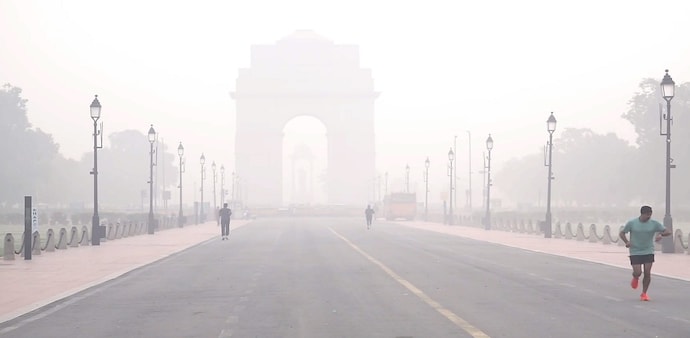
- Nov 9, 2026,
- Updated Nov 9, 2026 1:05 PM IST
Delhi's air quality has thrown up two very different sets of numbers after Diwali. While the official monitoring system put the city's average AQI at 376 on November 8, readings from independent air-quality platforms showed much higher levels in parts of the capital. AAP leader Saurabh Bhardwaj cited some of these readings on Monday, claiming that the AQI had crossed 3,000 and accusing the BJP-led Delhi government of fudging pollution data.
The difference has raised questions about which number reflects the air Delhi residents were actually breathing. But the gap is also linked to how public and private platforms collect, process and report pollution data.
The AQI is not a direct reading from a pollution monitor. It is an index calculated from the concentration of pollutants such as PM2.5 and PM10. Different AQI systems can therefore turn the same pollution concentration into different numbers.
India and private platforms may use different AQI scales
The official AQI reported by the Central Pollution Control Board (CPCB) follows India's National Air Quality Index. The Indian scale runs from 0 to 500, with 401-500 classified as "Severe".
Private platforms may use a different system. IQAir, one of the widely used global air-quality platforms, uses the US AQI methodology for its AQI readings.
The US system has different pollutant breakpoints from India's system and can continue beyond 500 for extremely high pollution. This means a private platform can show an AQI above 500 even when India's official AQI has already entered its highest category.
So a reading of 1,000 on a private platform cannot simply be compared with an official Indian AQI of 1,000 because the Indian system does not report AQI in the same way.
Don't Miss: Post-Diwali pollution grips north India: NCR cities' air turn ‘very poor’; Lucknow, Kanpur record high AQI
This difference becomes particularly important when extreme pollution is being reported.
The time of the reading also matters
The other major difference is the period over which the pollution is measured.
India's AQI methodology uses prescribed averaging periods. PM2.5 and PM10, for instance, are calculated using 24-hour average concentrations for the AQI calculation.
Private platforms can provide hourly readings.
IQAir says its station data are aggregated into hourly averages before the platform calculates its air-quality information.
That can produce a very different picture during a sudden pollution spike.
For example, if pollution rises sharply after midnight because of firecrackers, an hourly monitor can reflect that increase quickly. A longer averaging period will also include pollution from earlier hours when levels may have been lower.
This is one reason a private platform can show a very high number at a particular point in time while the official citywide AQI remains considerably lower.
Delhi's pollution is not the same everywhere
Location is another major factor.
The official Delhi AQI is a citywide figure based on readings from multiple monitoring stations. Individual stations can record much higher or lower pollution depending on where they are located.
Traffic-heavy roads, construction sites, industrial areas and places affected by local burning can have much higher particulate levels than other parts of the city.
Delhi's official monitoring data itself shows these differences.
On November 8, several stations were in the Severe category even though the city's average AQI was 376.
That means a resident standing near one of the most polluted monitoring locations could be experiencing considerably worse air than the number displayed as Delhi's citywide AQI suggests.
It also means a station-level reading should not automatically be compared with a citywide average.
Government and private platforms may not use the same monitors
The source of the data is another difference.
The Delhi government's AQI system uses data from continuous ambient air-quality monitoring stations operated by CPCB and the Delhi Pollution Control Committee.
Private platforms can combine data from government stations with privately operated monitors.
IQAir says its network includes government reference stations as well as low-cost sensors and AirVisual monitors.
As a result, two platforms can have access to different sets of readings from the same city.
Even if they use some of the same stations, they can process those readings differently.
The Delhi government says its city AQI is calculated by averaging the AQI values reported by the stations reporting at that time.
Private platforms can use different methods to produce a city-level figure. IQAir, for instance, says its city data uses the median of hourly aggregated concentration data from stations within the city area.
That difference in calculation can itself change the final number.'
Sensors can also produce different readings
There is another layer to the difference: the equipment measuring the pollution.
Government reference stations are designed for continuous regulatory monitoring. Private networks can also use lower-cost sensors, which make it possible to install more monitors across a city.
These sensors can be useful for showing pollution at a much more local level, but their measurements can be affected by factors such as humidity and can have different levels of uncertainty from reference-grade instruments.
IQAir says it applies correction methods to low-cost sensor data and monitors stations for unusual readings.
So a private sensor reading should not automatically be dismissed, but it also needs to be understood in the context of the equipment and methodology behind it.
PM2.5 can give a clearer picture
For people trying to compare air-quality readings, the underlying PM2.5 concentration can be more useful than the headline AQI.
PM2.5 is measured in micrograms per cubic metre and represents the concentration of fine particulate matter in the air.
AQI, on the other hand, converts pollutant concentrations into a score based on a particular country's or platform's methodology.
So when two platforms show very different AQIs, readers should check the PM2.5 concentration, timestamp and monitoring location before deciding that the numbers contradict each other.
So which AQI should Delhi residents follow?
For the official Indian AQI, CPCB and the Delhi government's monitoring system remain the relevant reference.
Private platforms can provide additional information, particularly about real-time and neighbourhood-level changes in pollution.
But the two should not be treated as interchangeable dashboards.
A citywide official AQI, a reading from one polluted neighbourhood, an hourly sensor reading and an AQI calculated using the US system can all produce very different numbers.
That is why Delhi can simultaneously have an official AQI in the 300s and private readings running into four figures.
The difference is not just about the air. It is also about which monitor measured it, when it was measured, how the data was averaged and which AQI formula was used to turn that measurement into a number.