
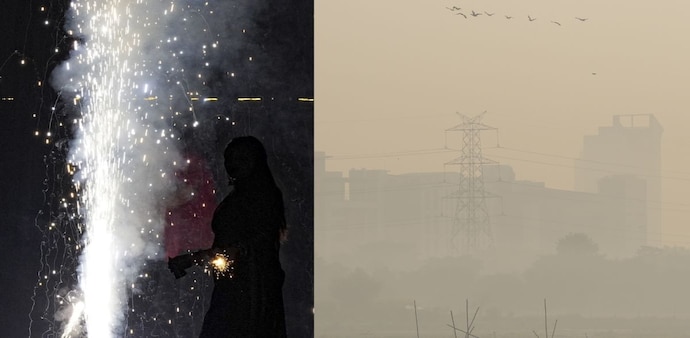
Post-Diwali pollution grips north India: NCR cities' air turn ‘very poor’; Lucknow, Kanpur record high AQI
Delhi may be grabbing headlines after Diwali celebrations, but its NCR neighbours are quietly gasping for clean air as AQI levels surge past 340.
- Nov 9, 2026,
- Updated Nov 9, 2026 11:33 AM IST
Air quality across Delhi-NCR and several major cities in northern India deteriorated sharply on Monday, with multiple locations slipping into the ‘very poor’ and ‘severe’ categories in the aftermath of Diwali.
Noida, Ghaziabad, Gurugram and Faridabad were among the worst affected, while cities such as Lucknow, Kanpur and Jaipur also reported elevated pollution levels, raising concerns over worsening respiratory risks as stagnant weather conditions continue to trap pollutants close to the ground.
Under the CPCB classification, an AQI of 0-50 is “good,” 51-100 “satisfactory,” 101-200 “moderate,” 201-300 “poor,” 301-400 “very poor,” and 401-500 “severe.”
Noida in ‘very poor’ zone
CPCB figures showed Noida’s average AQI at 341, firmly in the “very poor” category, which covers readings between 301 and 400. Greater Noida recorded an AQI of 287, remaining in the “poor” category but close to the threshold for very poor air.
The deterioration follows a rapid decline earlier in the week. On November 2, Noida’s average AQI had jumped to 248 from 106 the previous day, according to CPCB data.
Ghaziabad among worst hit
Ghaziabad’s AQI of 357 was among the highest readings in Uttar Pradesh on Monday, according to CPCB data. The city’s Loni area had already recorded an AQI of 373 on November 2, just 27 points below the “severe” threshold of 401.
Monitoring stations in Noida’s Sector 39 and Sector 62 -- areas with heavy traffic -- had also crossed the 300 mark earlier in the week.
Gurugram and Faridabad also choke
The pollution crisis was not confined to Noida and Ghaziabad. Gurugram recorded an AQI of 328, while Faridabad stood at 342, according to CPCB data, placing both Haryana cities in the “very poor” category.
Faridabad’s Sector 11 monitoring station recorded an AQI of 412 -- within the “severe” category -- while Gurugram’s TERI Gram station registered 408, according to the CPCB data. With PM2.5 and PM10 identified as prominent pollutants, authorities and health experts have advised residents, particularly children, the elderly and those with respiratory or cardiac conditions, to minimise outdoor exposure.
Bahadurgarh and Manesar
Bahadurgarh recorded the highest AQI among the neighbouring cities in the CPCB dataset, at 389, placing it close to the “severe” threshold of 401. The Haryana town shared the 389 reading with Mandi Gobindgarh in Punjab.
Manesar’s AQI stood at 338, according to CPCB data, placing the industrial town in the “very poor” category alongside Noida and Faridabad. The reading reflects the broader deterioration across the Delhi-NCR airshed, where calm conditions and festival-related emissions have trapped pollutants close to the surface.
Beyond the capital region
The pollution crisis was not limited to the NCR. Jaipur recorded an AQI of 313, while Lucknow and Kanpur recorded readings around 385, reflecting pollution levels across northern and central India.
Weather may worsen situation
The India Meteorological Department (IMD) has forecast dry weather across parts of Uttar Pradesh, with shallow to moderate fog likely in some areas during the morning. The absence of significant rainfall and cooler temperatures reduce atmospheric mixing, allowing pollutants to accumulate near the surface.
The recent improvement followed unseasonal rain that acted as a “natural scrubber", but clear skies, falling night temperatures and weak winds allowed particulate matter to build up again.
DON'T MISS: Your air purifier's running cost could be ₹2,810 to ₹10,210 a year
Health advisory issued
Health experts warn that prolonged exposure to “very poor” air can cause respiratory illness even among healthy people, while those with asthma, lung disease or heart conditions face greater breathing discomfort.
Children, senior citizens and people with pre-existing respiratory or cardiac conditions have been advised to limit outdoor activity, especially during morning and late-evening hours when pollution levels tend to remain elevated.
With no major weather system expected to bring immediate relief, officials and air-quality experts have urged residents to avoid open burning, use public transport where possible, and keep windows closed during peak pollution hours. Forecasts indicate that air quality may deteriorate further unless northwesterly winds disrupt the stagnant weather pattern.