
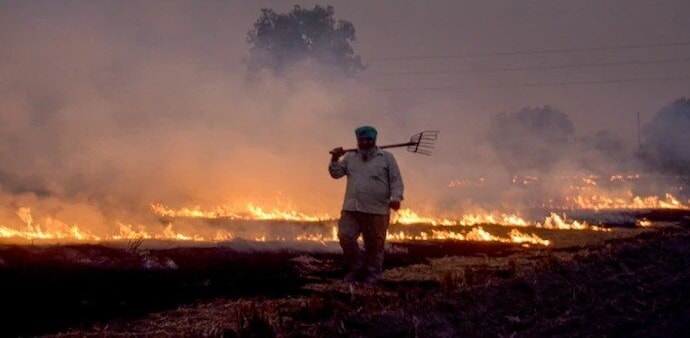
Punjab's Barnala chokes as AQI hits 1,104; farm fire incidents surge past 2,100
The alarming spike in pollution levels has brought crop residue burning back into the national spotlight. Delhi Environment Minister Manjinder Singh Sirsa launched a scathing attack on the Punjab government, holding farm fires in the state directly responsible for choking Delhi-NCR.
- Nov 6, 2026,
- Updated Nov 6, 2026 9:36 AM IST
Toxic smog has once again transformed northern India into a massive health hazard, with Punjab's Barnala recording a staggering Air Quality Index (AQI) of 1,104, even as a fierce political confrontation erupted between the BJP and the AAP over the worsening air.
The alarming spike in pollution levels has brought crop residue burning back into the national spotlight. Delhi Environment Minister Manjinder Singh Sirsa launched a scathing attack on the Punjab government, holding farm fires in the state directly responsible for choking the national capital and neighboring regions.
Sirsa highlighted that Delhi’s AQI deteriorated sharply from a comfortable 60 on October 30 to 377 by November 4, mirroring a sudden surge in stubble-burning incidents across Punjab.
According to data cited during the political slugfest, Punjab's cumulative farm-fire tally crossed 2,100 incidents, led heavily by districts like Tarn Taran, Ferozepur, and Amritsar. Highlighting extreme localised pollution, Sirsa pointed out that hazardous readings extended deep into Punjab, with towns like Bathinda and Talwandi Sabo crossing the grim 1,000-mark.
The war of words deepened over the utilisation of financial resources. Critics and central authorities pointed out that massive allocations — including a substantial chunk of roughly Rs 5,000 crore earmarked nationally under crop residue management schemes over recent years — have largely gone underutilized or failed to make ground-level impacts, leaving mandated stubble-management machinery sitting idle or ineffective.
The Aam Aadmi Party swiftly fired back, dismissing the accusations as a political smokescreen. AAP leaders accused the BJP of manufacturing falsehoods to deflect attention away from administrative shortcomings in managing local urban and industrial emission sources within the capital.
Alarmed by an unchecked surge in stubble burning across Punjab, the Commission for Air Quality Management (CAQM) on November 4 summoned top district bureaucrats and police chiefs from 12 key regions to enforce an immediate visual crackdown on farm fires.
With cumulative stubble fire incidents reaching 2,196 as of November 3, the anti-pollution watchdog mandated an intensified monitoring and enforcement sweep on the ground. District administration leaders were instructed to hold designated nodal officers strictly accountable for monitoring failures or dereliction of duty, with explicit warnings that any operational laxity would invite immediate disciplinary action.
Regional data underlines the severity of the challenge, showing that Tarn Taran alone accounts for the single highest concentration of agricultural blazes, recording 545 incidents to top the state's tally.
National capital under 'severe' air grip
Delhi woke up to a thick shroud of smog on the morning of Dhanteras (November 6) as the overall air quality in the national capital was 'very poor', with air quality index at 389 as of 8 am, up from 369 on November 5.
Around 28 monitoring stations across the national capital already registered severe air quality, according to the Central Pollution Control Board (CPCB). Pollution levels have been steadily going up through the week, with To make matters worse for Delhiites, experts have made a grim prediction for Diwali and the day after the festivities are over.