
₹5,000 lifeline: This IIT-Delhi device can cut emissions of old buses & trucks to BS-VI levels
Union minister Nitin Gadkari noted that similar emission-reduction equipment is already operational in diesel generator sets, and the ministry now intends to scale the application across the country’s heavy road transport sector.
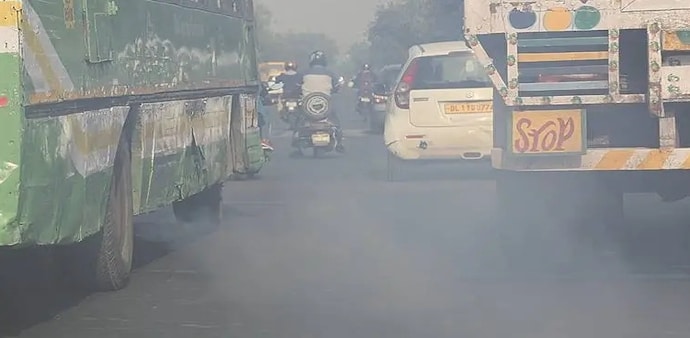
- Sep 6, 2026,
- Updated Sep 6, 2026 10:51 AM IST
In a significant policy move aimed at tackling commercial vehicle pollution, Union Road Transport Minister Nitin Gadkari announced that owners of older diesel trucks and buses will be allowed to fit a low-cost, domestically developed emission-control device to drastically reduce tailpipe pollution.
Speaking at an event organized by the Society of Indian Automobile Manufacturers (SIAM), Gadkari revealed that the retrofit emission-control device (RECD) — developed from an innovation at IIT-Delhi — has successfully passed testing phase and is now ready for commercial deployment on BS-III, BS-IV, and other legacy diesel vehicles.
Priced between ₹4,000 and ₹5,000, the device is designed to cut particulate matter emissions by up to 90 percent and nitrogen oxide emissions by 60 percent. The technology offers commercial fleet owners an affordable pathway to bring their aging diesel vehicles close to the far stringent BS-VI emission benchmarks without forcing an immediate, capital-intensive vehicle replacement.
The Union minister noted that similar emission-reduction equipment is already operational in diesel generator sets, and the ministry now intends to scale the application across the country’s heavy road transport sector.
To standardise the rollout, the Ministry of Road Transport and Highways is preparing to notify Automotive Industry Standard 228 (AIS-228), which will outline the technical specifications and performance benchmarks required for commercial installation.
The new policy will run alongside the government’s existing vehicle scrappage framework, giving owners of heavy vehicles that are not yet due for scrapping a viable method to lower their environmental footprint while keeping their vehicles compliant on Indian roads.
Beyond the emission device, Gadkari outlined several broader mobility and safety initiatives during his address at the SIAM conference:
- Public Transport Shortage: Highlighting India's current density of just two buses per 1,000 people — well below the global benchmark of eight — the minister urged the adoption of innovative public transport models in smaller cities where capital-intensive metro systems are impractical.
- Driver Penalties and Rewards: The transport ministry plans to introduce a negative points system for traffic violations. Under the framework, accumulated penalty points could result in license suspension or cancellation, while drivers maintaining clean records could receive financial incentives from insurance providers.
- Expanded Vehicle Safety: An updated Bharat NCAP program will roll out from October 2027, evaluating vehicle safety across the "entire safety chain." Citing India's annual toll of five lakh road accidents and 1.80 lakh fatalities — predominantly affecting individuals aged 18 to 36 — Gadkari emphasized the need for comprehensive safety assessments.
In a significant policy move aimed at tackling commercial vehicle pollution, Union Road Transport Minister Nitin Gadkari announced that owners of older diesel trucks and buses will be allowed to fit a low-cost, domestically developed emission-control device to drastically reduce tailpipe pollution.
Speaking at an event organized by the Society of Indian Automobile Manufacturers (SIAM), Gadkari revealed that the retrofit emission-control device (RECD) — developed from an innovation at IIT-Delhi — has successfully passed testing phase and is now ready for commercial deployment on BS-III, BS-IV, and other legacy diesel vehicles.
Priced between ₹4,000 and ₹5,000, the device is designed to cut particulate matter emissions by up to 90 percent and nitrogen oxide emissions by 60 percent. The technology offers commercial fleet owners an affordable pathway to bring their aging diesel vehicles close to the far stringent BS-VI emission benchmarks without forcing an immediate, capital-intensive vehicle replacement.
The Union minister noted that similar emission-reduction equipment is already operational in diesel generator sets, and the ministry now intends to scale the application across the country’s heavy road transport sector.
To standardise the rollout, the Ministry of Road Transport and Highways is preparing to notify Automotive Industry Standard 228 (AIS-228), which will outline the technical specifications and performance benchmarks required for commercial installation.
The new policy will run alongside the government’s existing vehicle scrappage framework, giving owners of heavy vehicles that are not yet due for scrapping a viable method to lower their environmental footprint while keeping their vehicles compliant on Indian roads.
Beyond the emission device, Gadkari outlined several broader mobility and safety initiatives during his address at the SIAM conference:
- Public Transport Shortage: Highlighting India's current density of just two buses per 1,000 people — well below the global benchmark of eight — the minister urged the adoption of innovative public transport models in smaller cities where capital-intensive metro systems are impractical.
- Driver Penalties and Rewards: The transport ministry plans to introduce a negative points system for traffic violations. Under the framework, accumulated penalty points could result in license suspension or cancellation, while drivers maintaining clean records could receive financial incentives from insurance providers.
- Expanded Vehicle Safety: An updated Bharat NCAP program will roll out from October 2027, evaluating vehicle safety across the "entire safety chain." Citing India's annual toll of five lakh road accidents and 1.80 lakh fatalities — predominantly affecting individuals aged 18 to 36 — Gadkari emphasized the need for comprehensive safety assessments.