
Sergio Gor outlines sharp vision for US-India ties, unveils TRUST Fellowship in Bengaluru
Under the fellowship, researchers will target core strategic domains aligned with the TRUST initiative, including Artificial Intelligence, Quantum Computing, Semiconductors, Defence and Space, Biotechnology, and Energy.
- Sep 7, 2026,
- Updated Sep 7, 2026 8:21 AM IST
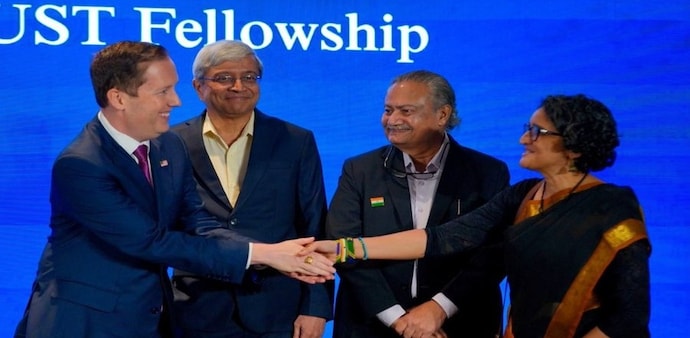
Up to 20 American postdoctoral researchers will soon head to premier Indian institutes for cutting-edge collaborative research as part of a new bilateral strategic technology push. Announced by US Ambassador to India and Special Envoy to South and Central Asia Sergio Gor, the US-India TRUST Fellowship marks a major milestone in deepening high-impact academic and scientific ties between the two nations.
Writing on X, Ambassador Gor expressed his enthusiasm for the initiative: "Thrilled to launch the new US-India TRUST Fellowship! With private funding from @kris_sg and @KiranShaw, up to 20 postdoctoral researchers from US will conduct collaborative R&D with @IITMadras, @iiscbangalore, and @MAHE_Manipal - advancing critical technologies and high-impact partnerships between leading US and Indian institutions."
Gor outlined a sharper, results-focused vision for the bilateral relationship, emphasising that the primary objective of the partnership is to deliver "real results" for citizens in both nations. Speaking in Bengaluru, Ambassador Gor highlighted how targeted scientific and economic collaboration will serve as the cornerstone for deeper engagement moving forward.
Public-Private coalition for high-impact R&D
The initiative aligns directly with the joint commitment of US President Donald Trump and Indian Prime Minister Narendra Modi to advance strategic technology cooperation under the broader TRUST framework. Implemented as a public-private partnership, the programme aims to accelerate innovation, build a robust collaborative research ecosystem, and deliver tangible outcomes, including joint publications, patents, and commercial applications.
The 12-month programme is jointly supported by the US Consulate General in Chennai, the Indian Institute of Science (IISc) Bengaluru, the Indian Institute of Technology Madras (IIT Madras), and the Manipal Academy of Higher Education (MAHE). Founding private sponsors include Kris Gopalakrishnan’s Pratiksha Trust and Kiran Mazumdar-Shaw’s Mazumdar Shaw Philanthropy (MSP).
Focus areas & key benefits
Under the fellowship, researchers will target core strategic domains aligned with the TRUST initiative, including Artificial Intelligence, Quantum Computing, Semiconductors, Defence and Space, Biotechnology, and Energy.
Selected fellows will receive a monthly stipend of $1,650 (approximately ₹1.56 lakh), along with complimentary on-campus housing and meals, health insurance, visa and logistical assistance, and one round-trip economy airfare ticket between their US home city and India.
The fellowship is tailored for postdoctoral researchers and early-career faculty members from leading US institutions working in these focus areas, with preference given to US citizens who have little to no prior research experience in India.
Eligible candidates can apply by submitting an academic CV highlighting their top publications, a two-to-three-page research proposal, and an optional host faculty consent letter via email.
Up to 20 American postdoctoral researchers will soon head to premier Indian institutes for cutting-edge collaborative research as part of a new bilateral strategic technology push. Announced by US Ambassador to India and Special Envoy to South and Central Asia Sergio Gor, the US-India TRUST Fellowship marks a major milestone in deepening high-impact academic and scientific ties between the two nations.
Writing on X, Ambassador Gor expressed his enthusiasm for the initiative: "Thrilled to launch the new US-India TRUST Fellowship! With private funding from @kris_sg and @KiranShaw, up to 20 postdoctoral researchers from US will conduct collaborative R&D with @IITMadras, @iiscbangalore, and @MAHE_Manipal - advancing critical technologies and high-impact partnerships between leading US and Indian institutions."
Gor outlined a sharper, results-focused vision for the bilateral relationship, emphasising that the primary objective of the partnership is to deliver "real results" for citizens in both nations. Speaking in Bengaluru, Ambassador Gor highlighted how targeted scientific and economic collaboration will serve as the cornerstone for deeper engagement moving forward.
Public-Private coalition for high-impact R&D
The initiative aligns directly with the joint commitment of US President Donald Trump and Indian Prime Minister Narendra Modi to advance strategic technology cooperation under the broader TRUST framework. Implemented as a public-private partnership, the programme aims to accelerate innovation, build a robust collaborative research ecosystem, and deliver tangible outcomes, including joint publications, patents, and commercial applications.
The 12-month programme is jointly supported by the US Consulate General in Chennai, the Indian Institute of Science (IISc) Bengaluru, the Indian Institute of Technology Madras (IIT Madras), and the Manipal Academy of Higher Education (MAHE). Founding private sponsors include Kris Gopalakrishnan’s Pratiksha Trust and Kiran Mazumdar-Shaw’s Mazumdar Shaw Philanthropy (MSP).
Focus areas & key benefits
Under the fellowship, researchers will target core strategic domains aligned with the TRUST initiative, including Artificial Intelligence, Quantum Computing, Semiconductors, Defence and Space, Biotechnology, and Energy.
Selected fellows will receive a monthly stipend of $1,650 (approximately ₹1.56 lakh), along with complimentary on-campus housing and meals, health insurance, visa and logistical assistance, and one round-trip economy airfare ticket between their US home city and India.
The fellowship is tailored for postdoctoral researchers and early-career faculty members from leading US institutions working in these focus areas, with preference given to US citizens who have little to no prior research experience in India.
Eligible candidates can apply by submitting an academic CV highlighting their top publications, a two-to-three-page research proposal, and an optional host faculty consent letter via email.