
Sixth phase of elections sees 59.06 per cent voter turnout, Bengal's Jangal Mahal region logs 78.19 per cent
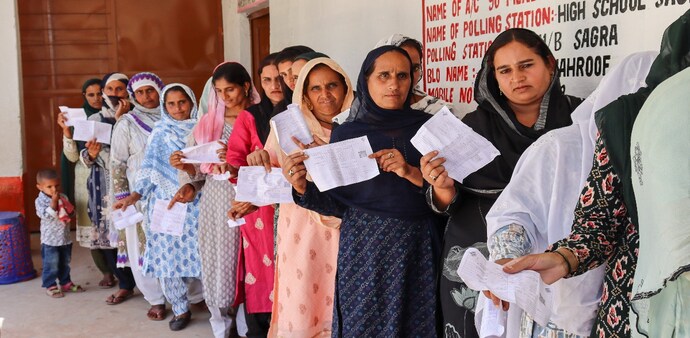
The EC highlighted the Anantnag-Rajouri seat in Jammu and Kashmir for witnessing its highest voter turnout in decades.
- May 25, 2024,
- Updated May 25, 2024 9:53 PM IST
India concluded the sixth phase of its Lok Sabha elections on Saturday, witnessing an overall voter turnout of 59.06% across 58 constituencies spread over six states and two Union territories. The Election Commission (EC) reported a particularly high turnout in West Bengal's Jangal Mahal region, reaching 78.19%.
Polling was generally peaceful, with a few isolated incidents of minor clashes and protests reported in West Bengal. Some instances of EVM malfunctioning were also reported, including in Delhi.
Jharkhand registered a voter turnout of 62.74%, while Uttar Pradesh saw 54.03% of eligible voters exercising their franchise. Bihar recorded a 53.30% turnout, Jammu and Kashmir 52.28%, Haryana 58.37%, Odisha 60.07%, and Delhi 54.48%, according to EC data released at 7:45 PM.
The EC highlighted the Anantnag-Rajouri seat in Jammu and Kashmir for witnessing its highest voter turnout in decades.
With the completion of this phase, polling has now concluded in 486 out of 543 Lok Sabha constituencies across 28 states and Union territories. The final phase of voting is slated for June 1st, with the highly anticipated vote counting scheduled for June 4th.
This phase saw over 11.13 crore eligible voters, including 5.84 crore male voters, 5.29 crore female voters, and 5,120 third-gender voters. The EC deployed approximately 11.4 lakh polling officials across 1.14 lakh polling stations to ensure a smooth and fair election process.
Several measures were implemented to counter the ongoing heatwave affecting large parts of India. Polling stations were equipped with cold water, coolers, fans, and tents. Wheelchairs were also made available for elderly voters.
Prominent figures who cast their votes in this phase included President Droupadi Murmu, Union Ministers S Jaishankar and Hardeep Singh Puri, Delhi Chief Minister Arvind Kejriwal, and Congress leaders Sonia Gandhi and Rahul Gandhi.
The high-stakes electoral battle for the Jangal Mahal region in West Bengal, known for its history of identity politics, saw minor clashes between supporters of the ruling TMC and the BJP. This region, which sends eight representatives to the Lok Sabha, witnessed the BJP securing five seats and the TMC three in the 2019 elections.
In Uttar Pradesh, polling was held for 14 constituencies, while Jharkhand saw voting taking place in four constituencies. Bihar held elections for eight constituencies, with authorities reporting the arrest or detention of 107 individuals for attempting to disrupt the electoral process.
Prime Minister Narendra Modi, Delhi Chief Minister Arvind Kejriwal, and Congress President Mallikarjun Kharge urged citizens to participate actively in this penultimate phase of the Lok Sabha elections. As India gears up for the final phase of voting, all eyes are on the outcome that will determine the composition of the next government.
India concluded the sixth phase of its Lok Sabha elections on Saturday, witnessing an overall voter turnout of 59.06% across 58 constituencies spread over six states and two Union territories. The Election Commission (EC) reported a particularly high turnout in West Bengal's Jangal Mahal region, reaching 78.19%.
Polling was generally peaceful, with a few isolated incidents of minor clashes and protests reported in West Bengal. Some instances of EVM malfunctioning were also reported, including in Delhi.
Jharkhand registered a voter turnout of 62.74%, while Uttar Pradesh saw 54.03% of eligible voters exercising their franchise. Bihar recorded a 53.30% turnout, Jammu and Kashmir 52.28%, Haryana 58.37%, Odisha 60.07%, and Delhi 54.48%, according to EC data released at 7:45 PM.
The EC highlighted the Anantnag-Rajouri seat in Jammu and Kashmir for witnessing its highest voter turnout in decades.
With the completion of this phase, polling has now concluded in 486 out of 543 Lok Sabha constituencies across 28 states and Union territories. The final phase of voting is slated for June 1st, with the highly anticipated vote counting scheduled for June 4th.
This phase saw over 11.13 crore eligible voters, including 5.84 crore male voters, 5.29 crore female voters, and 5,120 third-gender voters. The EC deployed approximately 11.4 lakh polling officials across 1.14 lakh polling stations to ensure a smooth and fair election process.
Several measures were implemented to counter the ongoing heatwave affecting large parts of India. Polling stations were equipped with cold water, coolers, fans, and tents. Wheelchairs were also made available for elderly voters.
Prominent figures who cast their votes in this phase included President Droupadi Murmu, Union Ministers S Jaishankar and Hardeep Singh Puri, Delhi Chief Minister Arvind Kejriwal, and Congress leaders Sonia Gandhi and Rahul Gandhi.
The high-stakes electoral battle for the Jangal Mahal region in West Bengal, known for its history of identity politics, saw minor clashes between supporters of the ruling TMC and the BJP. This region, which sends eight representatives to the Lok Sabha, witnessed the BJP securing five seats and the TMC three in the 2019 elections.
In Uttar Pradesh, polling was held for 14 constituencies, while Jharkhand saw voting taking place in four constituencies. Bihar held elections for eight constituencies, with authorities reporting the arrest or detention of 107 individuals for attempting to disrupt the electoral process.
Prime Minister Narendra Modi, Delhi Chief Minister Arvind Kejriwal, and Congress President Mallikarjun Kharge urged citizens to participate actively in this penultimate phase of the Lok Sabha elections. As India gears up for the final phase of voting, all eyes are on the outcome that will determine the composition of the next government.