
‘Some more jobs gone’: Machine applying intricate mehendi designs gets Harsh Goenka’s attention
For many Indians, mehendi is closely tied to weddings, festivals and other celebrations.
- Sep 14, 2026,
- Updated Sep 14, 2026 2:36 PM IST
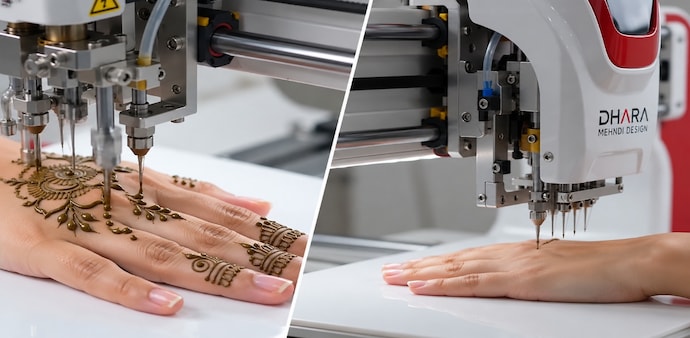
A machine applying intricate mehendi designs on a woman’s hand has sparked a debate over automation, traditional skills and the value of human touch after industrialist Harsh Goenka shared a video of the process.
“Some more jobs gone,” Goenka wrote while sharing the video on X.
The clip shows a woman placing her hand inside a machine, which then appears to apply a detailed mehendi design with little visible human involvement. The video has since prompted a wider conversation about whether automation could eventually take over jobs that depend on human skill and creativity.
Why mehendi is more than a beauty service
For many Indians, mehendi is closely tied to weddings, festivals and other celebrations. It is particularly associated with bridal ceremonies, where elaborate designs are applied as part of wedding festivities.
The tradition also features prominently in festivals. During Teej, women traditionally adorn themselves with intricate mehendi designs as part of the celebrations. Government tourism material describes the practice as part of the festival's cultural traditions.
Don't Miss: 'It is my vehicle, I was at work': Gurugram car owner says friend was driving during woman biker crash
Mehendi is also associated with Karva Chauth. In Uttar Pradesh, for instance, women traditionally apply mehendi to their hands as part of the festival's celebrations and dress in traditional attire before the evening rituals.
That cultural connection is also part of why the machine shown in the video has attracted a reaction beyond questions about technology. For many people, getting mehendi applied is itself an experience, involving the artist's design choices, conversations and the personal touch that comes with a handmade pattern.
One user said, “It doesn't have to be. I still prefer the touch of a human being and prefer thr human connection. I would still let humans have that job. Those who want machines can use machines. I rather still turn to human beings.”
Another questioned the growing preference for speed and convenience, writing, “I really don't know where as a human being we are heading. Why do we want everything so fast and quick.. why we just don't enjoy the time, people around us and the WORK which takes it own time. Why do we want fast life??”
Must Read: ‘Hit with iron rod twice...’: Kargil war veteran assaulted by parking staff in Gurugram
A third user was more concerned about the machine itself, saying, “I for one don't have it in me to allow such robots to apply Mehendi because it takes guts to keep my hand under all those needle like application robots. I prefer humans with a cone in their hand”
The reactions point to a broader question around automation. While machines can potentially make some tasks faster and more consistent, the appeal of certain services lies not only in the final product but also in the human interaction and craftsmanship involved in creating it.
The debate over the mehendi machine therefore goes beyond whether a design can be produced by a machine. It raises a more familiar question as automation moves into everyday services: what happens to the human experience when the work itself can be done by a machine?
A machine applying intricate mehendi designs on a woman’s hand has sparked a debate over automation, traditional skills and the value of human touch after industrialist Harsh Goenka shared a video of the process.
“Some more jobs gone,” Goenka wrote while sharing the video on X.
The clip shows a woman placing her hand inside a machine, which then appears to apply a detailed mehendi design with little visible human involvement. The video has since prompted a wider conversation about whether automation could eventually take over jobs that depend on human skill and creativity.
Why mehendi is more than a beauty service
For many Indians, mehendi is closely tied to weddings, festivals and other celebrations. It is particularly associated with bridal ceremonies, where elaborate designs are applied as part of wedding festivities.
The tradition also features prominently in festivals. During Teej, women traditionally adorn themselves with intricate mehendi designs as part of the celebrations. Government tourism material describes the practice as part of the festival's cultural traditions.
Don't Miss: 'It is my vehicle, I was at work': Gurugram car owner says friend was driving during woman biker crash
Mehendi is also associated with Karva Chauth. In Uttar Pradesh, for instance, women traditionally apply mehendi to their hands as part of the festival's celebrations and dress in traditional attire before the evening rituals.
That cultural connection is also part of why the machine shown in the video has attracted a reaction beyond questions about technology. For many people, getting mehendi applied is itself an experience, involving the artist's design choices, conversations and the personal touch that comes with a handmade pattern.
One user said, “It doesn't have to be. I still prefer the touch of a human being and prefer thr human connection. I would still let humans have that job. Those who want machines can use machines. I rather still turn to human beings.”
Another questioned the growing preference for speed and convenience, writing, “I really don't know where as a human being we are heading. Why do we want everything so fast and quick.. why we just don't enjoy the time, people around us and the WORK which takes it own time. Why do we want fast life??”
Must Read: ‘Hit with iron rod twice...’: Kargil war veteran assaulted by parking staff in Gurugram
A third user was more concerned about the machine itself, saying, “I for one don't have it in me to allow such robots to apply Mehendi because it takes guts to keep my hand under all those needle like application robots. I prefer humans with a cone in their hand”
The reactions point to a broader question around automation. While machines can potentially make some tasks faster and more consistent, the appeal of certain services lies not only in the final product but also in the human interaction and craftsmanship involved in creating it.
The debate over the mehendi machine therefore goes beyond whether a design can be produced by a machine. It raises a more familiar question as automation moves into everyday services: what happens to the human experience when the work itself can be done by a machine?