
Tata Sons chairman N Chandrasekaran suggests university to blend Hindu Shastras with modern sciences
The scholars that we have in our Hindu Sanatana Dharma, in all these subjects, are extraordinary. They are not recognised on par with some of those scholars in the modern subjects, says Chandrasekaran
- Sep 28, 2026,
- Updated Sep 28, 2026 6:58 PM IST
Tata Sons chairman N Chandrasekaran has suggested setting up a university under the chancellorship of the Sringeri Acharya to take the study of Hindu Shastras to a wider audience while combining them with modern disciplines such as computer science and artificial intelligence.
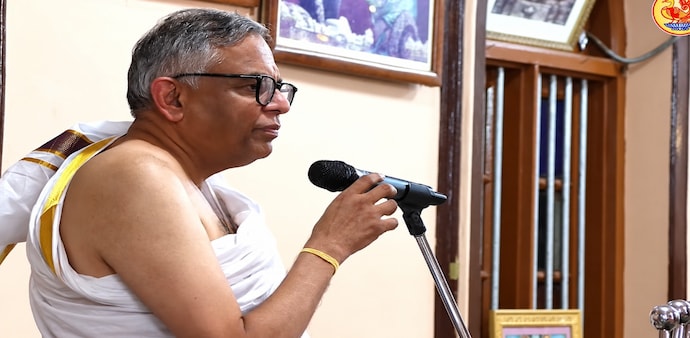
Speaking at the valedictory programme of the Sri Mahaganapati Vakyartha Vidwat Sabha at Sringeri, Chandrasekaran said the traditional knowledge systems had much to offer but needed to be made more accessible and viable for younger people.
"Maybe a huge university should be set up under the chancellorship of Sri Acharya. It's easier said than done. There are lots of issues. We also don't want to use all these texts like normal reels. These are precious. So how do we preserve the sanctity? But at the same time, how do we scale? How do we have million youths?" he said.
Read More: Tata Sons AGM: Why holding the board meeting is critical amid the boardroom tussle
Chandrasekaran said the traditional system had deep bodies of knowledge in areas such as ethics, along with methods of enquiry and debate embedded in subjects including Vyakarana, Tarkam, and Meenamsa.
He suggested creating innovative curricula that combine these traditions with modern fields.
"We have a much deeper body of knowledge in Ethics. So how do we create a curriculum where we are able to take our body of knowledge from Shastras and use the techniques, like our Vyakarana, like our Tarkam and other things, and mix it with modern sciences, Computer Science. So we create a holistic program," he said.
The 63-year-old corporate leader said interdisciplinary learning was increasingly important because breakthroughs could emerge when different fields came together. "Today, the world is about what they call it as interdisciplinary learning. Breakthroughs are coming because two different subjects merge," he said.
He cited the example of a Nobel Prize in Chemistry that, he said, went to a professor in computer science and artificial intelligence because AI was used to process formulations in chemistry.
Must Read: Tata Sons boardroom dispute: Why Tata Trusts and the group are at odds
Chandrasekaran said more young people were showing interest in Hindu Shastras, at least at a basic level, but many did not fully understand the broader body of knowledge.
"Today, more and more younger people are wanting to learn our Hindu Shastras, at the very minimum, some shlokas. But they don't fully comprehend the whole body of knowledge and whole body of work," he said.
The top executive further said many people now recite shlokas because they find them calming. "It gives them solace, it gives them shanti. So you can see very common people, at least playing Rudra Chandi or some other shlokas. It has become common now because they feel that it gives them some mental peace," he said.
Chandrasekaran said the aim should not be to make everyone an expert in every subject, but to take their understanding several levels deeper.
"It is today very common to go to a Brahmin household. Most people, at least, will recite Vishnu Sahasranama. How do we take them from there, five levels above? They may not become expert in everything. But we can take them five, six levels," he said.
Need to recognise scholars
Chandrasekaran also said scholars of Hindu Sanatana Dharma and its various subjects needed greater recognition. "The scholars that we have in our Hindu Sanatana Dharma, in all these subjects, are extraordinary. They are not recognised on par with some of those scholars in the modern subjects, maybe science, literature, ethics in the western world," he said.
He said their knowledge and experience also needed to reach a broader audience, particularly in India.
"It is fair to say the depth of knowledge, the level of adhyayanam practice of our scholars is much higher on a much more difficult subject. Second, their knowledge and their experience have to reach broadly, definitely in India. And for that to happen in life, we need to make it viable," he said.
'Modern world is defined as lack of continuous attention’
The Tata Sons chairman compared the traditional approach to learning with what he described as the fragmented attention of the modern world.
"The modern world is defined as lack of continuous attention. You cannot concentrate on anything. It is a world of partial attention continuously. Before you read a line, there is music going on. Before that, there is a YouTube going on. Before that, there is a reel going on. And this is the way the modern-day learning goes," he said.
He said the traditional knowledge system placed greater emphasis on questioning and understanding the purpose of learning. Our knowledge system, he added, has this "beautiful process of answering questions of why am I learning, what am I learning, what am I understanding, what am I getting out of this, and if I do this, what happens, if I don't do this, what happens. That is the true process of learning."
The top Tata executive added that no person could master every subject in a lifetime, making the process of deep enquiry important for whatever one chooses to study.
"Any subject can be learned by putting in the effort, but the subjects are too many. No one in this world in their lifetime can master everything. But whatever they learn, they have to go through this process of deep enquiry, which will give a sense of further evolution for every individual," he said.
Tata Sons chairman N Chandrasekaran has suggested setting up a university under the chancellorship of the Sringeri Acharya to take the study of Hindu Shastras to a wider audience while combining them with modern disciplines such as computer science and artificial intelligence.
Speaking at the valedictory programme of the Sri Mahaganapati Vakyartha Vidwat Sabha at Sringeri, Chandrasekaran said the traditional knowledge systems had much to offer but needed to be made more accessible and viable for younger people.
"Maybe a huge university should be set up under the chancellorship of Sri Acharya. It's easier said than done. There are lots of issues. We also don't want to use all these texts like normal reels. These are precious. So how do we preserve the sanctity? But at the same time, how do we scale? How do we have million youths?" he said.
Read More: Tata Sons AGM: Why holding the board meeting is critical amid the boardroom tussle
Chandrasekaran said the traditional system had deep bodies of knowledge in areas such as ethics, along with methods of enquiry and debate embedded in subjects including Vyakarana, Tarkam, and Meenamsa.
He suggested creating innovative curricula that combine these traditions with modern fields.
"We have a much deeper body of knowledge in Ethics. So how do we create a curriculum where we are able to take our body of knowledge from Shastras and use the techniques, like our Vyakarana, like our Tarkam and other things, and mix it with modern sciences, Computer Science. So we create a holistic program," he said.
The 63-year-old corporate leader said interdisciplinary learning was increasingly important because breakthroughs could emerge when different fields came together. "Today, the world is about what they call it as interdisciplinary learning. Breakthroughs are coming because two different subjects merge," he said.
He cited the example of a Nobel Prize in Chemistry that, he said, went to a professor in computer science and artificial intelligence because AI was used to process formulations in chemistry.
Must Read: Tata Sons boardroom dispute: Why Tata Trusts and the group are at odds
Chandrasekaran said more young people were showing interest in Hindu Shastras, at least at a basic level, but many did not fully understand the broader body of knowledge.
"Today, more and more younger people are wanting to learn our Hindu Shastras, at the very minimum, some shlokas. But they don't fully comprehend the whole body of knowledge and whole body of work," he said.
The top executive further said many people now recite shlokas because they find them calming. "It gives them solace, it gives them shanti. So you can see very common people, at least playing Rudra Chandi or some other shlokas. It has become common now because they feel that it gives them some mental peace," he said.
Chandrasekaran said the aim should not be to make everyone an expert in every subject, but to take their understanding several levels deeper.
"It is today very common to go to a Brahmin household. Most people, at least, will recite Vishnu Sahasranama. How do we take them from there, five levels above? They may not become expert in everything. But we can take them five, six levels," he said.
Need to recognise scholars
Chandrasekaran also said scholars of Hindu Sanatana Dharma and its various subjects needed greater recognition. "The scholars that we have in our Hindu Sanatana Dharma, in all these subjects, are extraordinary. They are not recognised on par with some of those scholars in the modern subjects, maybe science, literature, ethics in the western world," he said.
He said their knowledge and experience also needed to reach a broader audience, particularly in India.
"It is fair to say the depth of knowledge, the level of adhyayanam practice of our scholars is much higher on a much more difficult subject. Second, their knowledge and their experience have to reach broadly, definitely in India. And for that to happen in life, we need to make it viable," he said.
'Modern world is defined as lack of continuous attention’
The Tata Sons chairman compared the traditional approach to learning with what he described as the fragmented attention of the modern world.
"The modern world is defined as lack of continuous attention. You cannot concentrate on anything. It is a world of partial attention continuously. Before you read a line, there is music going on. Before that, there is a YouTube going on. Before that, there is a reel going on. And this is the way the modern-day learning goes," he said.
He said the traditional knowledge system placed greater emphasis on questioning and understanding the purpose of learning. Our knowledge system, he added, has this "beautiful process of answering questions of why am I learning, what am I learning, what am I understanding, what am I getting out of this, and if I do this, what happens, if I don't do this, what happens. That is the true process of learning."
The top Tata executive added that no person could master every subject in a lifetime, making the process of deep enquiry important for whatever one chooses to study.
"Any subject can be learned by putting in the effort, but the subjects are too many. No one in this world in their lifetime can master everything. But whatever they learn, they have to go through this process of deep enquiry, which will give a sense of further evolution for every individual," he said.