
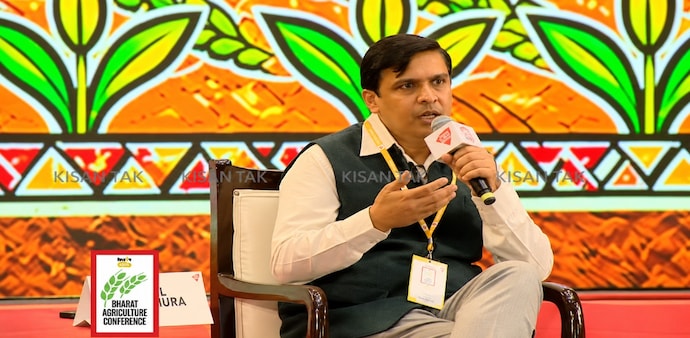
'There should be a farm score': Star Agribazaar CBO Atul Chhura explains how technology could reshape farmer loans
Chhura said farmers can deposit their produce at a Star Agri warehouse after harvest instead of taking it immediately to the mandi during the harvest season.
- Nov 11, 2026,
- Updated Nov 11, 2026 3:03 PM IST
Technology could make it easier for farmers to access formal credit and get better prices for their produce, Atul Chhura, Chief Business Officer of Star Agribazaar Technology Private Limited, said at the Bharat Agriculture Conclave 2026 on Wednesday.
In the session discussing ‘Khet, Kamai Aur Karz’, Chhura said digital initiatives such as AgriStack could help banks assess farmers based on their land, crops, cultivation costs and expected earnings.
He also highlighted how digital warehouse platforms can allow farmers to store their produce, access loans against warehouse receipts and sell it when market conditions are favourable.
Digital warehouses can help farmers avoid distress sales
Chhura said Star Agri has been working in agricultural commodity storage for the past two decades. The company also provides warehouse receipts that farmers can use as collateral to obtain loans from banks.
However, the facility is currently used mainly by traders and processors rather than farmers, he said.
“What is surprising is that, despite our continuous efforts over the past two decades to ensure that farmers benefit from this facility, it is primarily traders and processors who are currently taking advantage of it,” Chhura said.
“The number of farmers using this facility remains very low,” he added.
Chhura said farmers can deposit their produce at a Star Agri warehouse after harvest instead of taking it immediately to the mandi during the harvest season.
“Once you deposit your produce, our company takes full responsibility for its storage, preservation and maintenance,” he said.
The process is now handled through a digital platform, Chhura said. This includes issuing warehouse receipts, sending them to banks, completing the farmer's KYC, opening a loan account and disbursing the loan.
Don't Miss: 310 of 651 agricultural districts climate-vulnerable, says PM’s Principal Secretary P.K. Mishra
“From issuing warehouse receipts and sending them to banks to completing the farmer's KYC, opening a loan account and disbursing the loan, the entire process can now be completed in just 24 hours,” he said.
The same platform can also be used when farmers want to sell their stored produce and repay the loan. The sale proceeds can be used to repay the bank, while the remaining amount is transferred to the farmer.
“All of this is now possible with just one click through an integrated digital platform,” Chhura noted.
AgriStack could help banks understand a farmer's farm
Chhura said another major development is AgriStack, which the government has been working on over the past six years.
According to him, AgriStack brings together three key components: Farmer ID, Farm ID and Crop ID.
The idea is that a farmer could eventually apply for a loan through a mobile application, while the lending institution could access relevant information about the farmer and the farm.
“For example, the lender will be able to determine where the farmer's land is located, which crops were cultivated there in previous years, which crop is currently being grown, how much it will cost to cultivate that crop and how much revenue the farmer is expected to earn from selling it,” Chhura added.
He said the digital framework for such a system has already been developed. Digitisation of land records and the creation of Farmer IDs could make these services more accessible to farmers.
Why farmers may need a 'farm score'
Chhura said technology could also change the way banks assess farmers for loans.
“Today, when an individual approaches a bank for a loan, the bank evaluates their CIBIL score. Similarly, when a farmer approaches a bank for a loan, there should be a farm score,” he highlighted.
Such a score, he explained, should take into account the farmer's experience in cultivating a particular farm, expected crop yield, cultivation costs and potential earnings.
“This would enable banks to extend loans to farmers beyond the existing Kisan Credit Card (KCC) framework,” Chhura said.
Banks could then provide working capital loans based on the actual agricultural activities taking place on the farmer's land, he said.
Technology could lower borrowing costs
The larger aim, according to Chhura, is to make formal credit more affordable for farmers.
“Today, farmers often borrow money from the market at interest rates of 20% to 22%,” he said.
“With these technological developments, the objective is to make loans available to them at interest rates of just 7% to 8%,” Chhura added.
He said the combination of AgriStack, other government digital initiatives and technology-driven companies could make affordable credit easier for farmers to access.
“Through AgriStack, the government's digital initiatives and the efforts of technology-driven companies like ours, we believe that accessing affordable loans will become much simpler for farmers in the coming years,” Chhura said.