
'True founder of Bengaluru's IT hub is Jyoti Basu': Sanjeev Sanyal on Kolkata's lost tech edge
I remember distinctly that when IBM was bringing in big mainframe computers, there was actually a strike in Kolkata against them, says Sanjeev Sanyal
- Aug 30, 2026,
- Updated Aug 30, 2026 4:04 PM IST
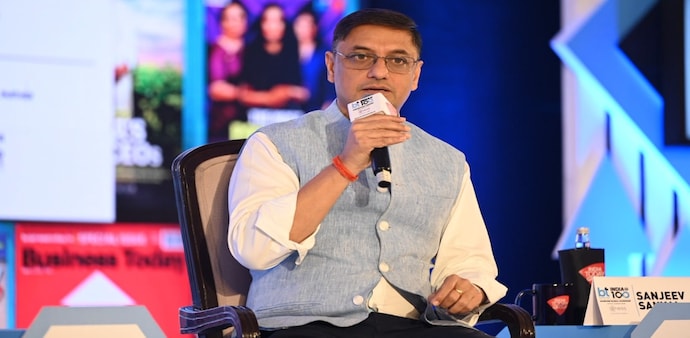
Sanjeev Sanyal, economist and a member of the Economic Advisory Council to the Prime Minister, has blamed decades of economic decline and hostility to industry for Kolkata losing its position as one of India's leading economic centres.
Sanyal, in a podcast conversation with Abhijit Majumder, co-founder of The Bengal Inc, recalled how Kolkata once had a major presence in India's emerging technology industry. He also remembered a strike against IBM when the company was bringing large mainframe computers to the city.
"I remember distinctly that when IBM was bringing in big mainframe computers, there was actually a strike in Kolkata against them," Sanyal said. "One can say that the true founder of Bengaluru's IT hub is actually Jyoti Basu. All the talent then left and went off there."
In Case You Missed It: 'Kolkata has become a city of old age pensioners': FM Swapan Dasgupta on Bengal's decline and skill shortage
Basu was West Bengal's chief minister from 1977 to 2000, leading the Left Front government for more than 23 years. His tenure saw land reforms, stronger panchayati raj institutions, and a powerful trade-union movement.
At the same time, the Left government's policies and the strong influence of trade unions were widely blamed for discouraging industrial investment and contributing to the state's economic decline.
After the Left Front was voted out of power in 2011, after 34 years of uninterrupted rule, Mamata Banerjee's Trinamool Congress ruled the state for 15 years. The BJP ended her 15-year rule in May 2026.
Must Read: BT India @ 100: 'India’s manufacturing story bigger than 16% GDP', says Sanjeev Sanyal
Kolkata's Economic Decline
Sanyal said Bengal’s relative economic position had deteriorated sharply over the past half-century.
In 1960-61, he said, the average Bengali had a per capita income 27% higher than the national average. Today, it is more than 20% below the national average, he said.
"When I was born in 1970, Kolkata was still the single biggest economic hub of India," the economist said of Kolkata. "Bombay was coming up as a rival, but Kolkata was still the biggest industrial hub."
He said the Kolkata Stock Exchange was then a serious stock exchange, and several economic activities were based in the city. "There are many activities that were hubbed out of Kolkata. In fact, India's information technology hub...a lot of it was based out of Kolkata. It was all deliberately undermined."
Kolkata Could Lead Eastern India’s Growth
Asked about his prescription for reviving Bengal, Sanyal said there are many things that need to be done across the state, but he would start with Kolkata because it is the easiest place to begin.
The economist said that Kolkata, despite decades of decline, remains the biggest urban hub in eastern India and its revival could help address the wider economic gap between eastern India and the rest of the country.
"And Eastern India, I've said this before, is distinctly behind the rest of the country. If you look at a map and plot all the social, economic, and other indicators, you will see one thing very distinctly. India is not about a north-south gap - it is very much an east-west gap. And one of the reasons for this is that eastern India does not have any big urban hub, which grows very fast."
The economist further said that rapid economic growth is closely linked to large urban centres. Southern India, he noted, has grown around Bengaluru, Hyderabad, and Chennai. Western India has been driven by Mumbai, Pune, and Ahmedabad, while northern India has Delhi-NCR and its expanding network towards Chandigarh, Noida, and Jaipur.
"Eastern India doesn't have either one or even a network of them," he said. "So this is a lacuna that has to be filled."
He said Kolkata has the scale and infrastructure to become the starting point. Bhubaneswar, Ranchi, Patna, and Guwahati also have capacity, he said, but Kolkata could lead the process and eventually connect these urban centres.
"It has the infrastructure of a metropolis. It has legacy institutions. It has the sheer bulk. Despite 50 years of decline, there are still some industrial capabilities. And some memory of a time of having been a major economic hub," Sanyal said.
Sanjeev Sanyal, economist and a member of the Economic Advisory Council to the Prime Minister, has blamed decades of economic decline and hostility to industry for Kolkata losing its position as one of India's leading economic centres.
Sanyal, in a podcast conversation with Abhijit Majumder, co-founder of The Bengal Inc, recalled how Kolkata once had a major presence in India's emerging technology industry. He also remembered a strike against IBM when the company was bringing large mainframe computers to the city.
"I remember distinctly that when IBM was bringing in big mainframe computers, there was actually a strike in Kolkata against them," Sanyal said. "One can say that the true founder of Bengaluru's IT hub is actually Jyoti Basu. All the talent then left and went off there."
In Case You Missed It: 'Kolkata has become a city of old age pensioners': FM Swapan Dasgupta on Bengal's decline and skill shortage
Basu was West Bengal's chief minister from 1977 to 2000, leading the Left Front government for more than 23 years. His tenure saw land reforms, stronger panchayati raj institutions, and a powerful trade-union movement.
At the same time, the Left government's policies and the strong influence of trade unions were widely blamed for discouraging industrial investment and contributing to the state's economic decline.
After the Left Front was voted out of power in 2011, after 34 years of uninterrupted rule, Mamata Banerjee's Trinamool Congress ruled the state for 15 years. The BJP ended her 15-year rule in May 2026.
Must Read: BT India @ 100: 'India’s manufacturing story bigger than 16% GDP', says Sanjeev Sanyal
Kolkata's Economic Decline
Sanyal said Bengal’s relative economic position had deteriorated sharply over the past half-century.
In 1960-61, he said, the average Bengali had a per capita income 27% higher than the national average. Today, it is more than 20% below the national average, he said.
"When I was born in 1970, Kolkata was still the single biggest economic hub of India," the economist said of Kolkata. "Bombay was coming up as a rival, but Kolkata was still the biggest industrial hub."
He said the Kolkata Stock Exchange was then a serious stock exchange, and several economic activities were based in the city. "There are many activities that were hubbed out of Kolkata. In fact, India's information technology hub...a lot of it was based out of Kolkata. It was all deliberately undermined."
Kolkata Could Lead Eastern India’s Growth
Asked about his prescription for reviving Bengal, Sanyal said there are many things that need to be done across the state, but he would start with Kolkata because it is the easiest place to begin.
The economist said that Kolkata, despite decades of decline, remains the biggest urban hub in eastern India and its revival could help address the wider economic gap between eastern India and the rest of the country.
"And Eastern India, I've said this before, is distinctly behind the rest of the country. If you look at a map and plot all the social, economic, and other indicators, you will see one thing very distinctly. India is not about a north-south gap - it is very much an east-west gap. And one of the reasons for this is that eastern India does not have any big urban hub, which grows very fast."
The economist further said that rapid economic growth is closely linked to large urban centres. Southern India, he noted, has grown around Bengaluru, Hyderabad, and Chennai. Western India has been driven by Mumbai, Pune, and Ahmedabad, while northern India has Delhi-NCR and its expanding network towards Chandigarh, Noida, and Jaipur.
"Eastern India doesn't have either one or even a network of them," he said. "So this is a lacuna that has to be filled."
He said Kolkata has the scale and infrastructure to become the starting point. Bhubaneswar, Ranchi, Patna, and Guwahati also have capacity, he said, but Kolkata could lead the process and eventually connect these urban centres.
"It has the infrastructure of a metropolis. It has legacy institutions. It has the sheer bulk. Despite 50 years of decline, there are still some industrial capabilities. And some memory of a time of having been a major economic hub," Sanyal said.