
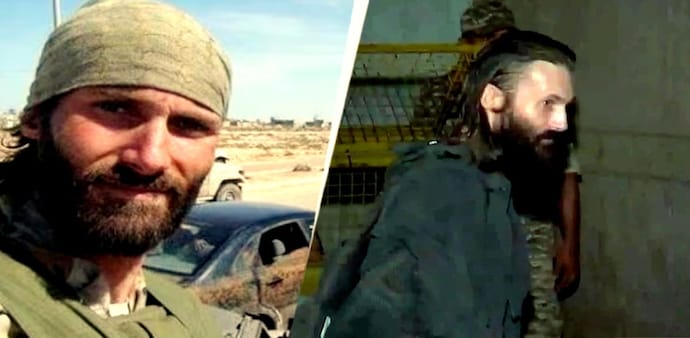
US mercenary Matthew VanDyke makes fresh Russia-Ukraine war claim after 6 months in Tihar, says he’ll reveal ‘shocking details’
US mercenary Matthew VanDyke makes fresh Russia-Ukraine war claim after 6 months in Tihar, says he’ll reveal ‘shocking details’
VanDyke was arrested by the National Investigation Agency (NIA) on March 13 along with six Ukrainians.
Business Today Desk
- Nov 10, 2026,
- Updated Nov 10, 2026 10:39 AM IST
American mercenary Matthew VanDyke, who was released from Delhi’s Tihar Jail in September, has claimed that his arrest along with six Ukrainian nationals was linked to Russia’s ongoing war against Ukraine, India Today reported.
VanDyke, who faces allegations of training ethnic armed groups in Myanmar, has also said he will reveal “shocking details” about the case in the coming months.
Advertisement
"India threw me and several Ukrainians in prison for over six months. This was part of Russia's war against Ukraine," VanDyke tweeted on Monday night.
"I will reveal shocking details about this story over the next few months in both posts and media interviews," he added.
VanDyke was arrested by the National Investigation Agency (NIA) on March 13 along with six Ukrainians. The agency has accused the group of travelling to Myanmar to train ethnic armed groups in weapons handling and drone warfare.
VanDyke was released from Tihar Jail on September 24 after securing default bail. He was later allowed to travel to the US and is expected to return to India in February for the next court hearing.
Advertisement
Don't Miss: ‘High crimes, abuse of power’: US Defence Secretary Pete Hegseth may face impeachment vote this week
VanDyke says he will return to India in February
VanDyke's latest remarks came weeks after he returned to India for a court hearing. On October 23, the Rouse Avenue court allowed him and the six Ukrainian nationals to remain outside India until their next hearing on February 24, 2027.
Responding to questions on social media, VanDyke also rejected suggestions that the US government had pressured India to secure his release.
When a user claimed that Washington had intervened on his behalf, he asked why they believed he had been freed because of US government pressure.
He also rejected a question about smuggling arms into India, saying the Indian government had never accused him of doing so.
Advertisement
Amid warnings from users against returning to India, VanDyke said he would be back in the country in February to attend court proceedings, just as he had returned in October.
He also said he had not personally sought permission to leave India and that the decision was taken by his lawyers.
Responding to another user who suggested he would be a fugitive if he failed to return after his visit to the US, VanDyke reiterated that he had appeared before the court on October 23 and would return for the next hearing in February.
He added that his return would not be for the reasons the user appeared to believe.
Why was VanDyke arrested?
The NIA arrested VanDyke at Kolkata airport on March 13. The six Ukrainians were arrested at airports in Delhi and Lucknow.
The agency alleged that the group travelled to Mizoram without the required permits before crossing into Myanmar. According to the NIA, they then provided training in weapons handling and drone warfare to ethnic armed groups.
Advertisement
The agency had also told the court that it was investigating allegations that the group was involved in a drone attack on a civilian aircraft in Myanmar. The specific incident being investigated was not immediately clear.
How did VanDyke get bail?
On September 18, the Rouse Avenue court granted VanDyke default bail on a personal bond of Rs 1 lakh and a surety of the same amount.
The relief came after the NIA failed to file a chargesheet invoking the relevant offences under the Unlawful Activities (Prevention) Act (UAPA) within the legally prescribed period.
The court directed VanDyke to remain in Delhi after his release and appear before the NIA whenever summoned for questioning. He later sought permission to travel to the US to meet his family.
The court subsequently allowed VanDyke and the six Ukrainian nationals to travel to their respective countries for a month.
The Ukrainians were granted bail on personal bonds and cash deposits of Rs 1 lakh each. They were also discharged under certain provisions of the Immigration and Foreigners Act after the Foreigners Regional Registration Office compounded the alleged violations, imposing a fine of Rs 5.5 lakh on each of them.
Read more!