
‘Water is a red line’: Pak PM Shehbaz Sharif threatens direct response to India over Indus Waters Treaty
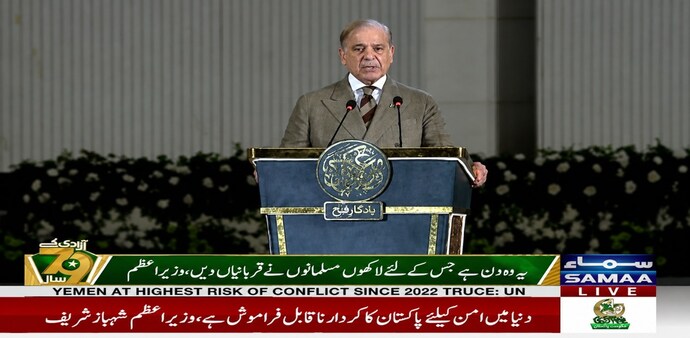
Addressing an event in Islamabad ahead of Pakistan’s Independence Day, Sharif said Pakistan wanted peace but would not compromise on its water rights. He accused India of acting against regional peace by keeping the 1960 Indus Waters Treaty in abeyance.
- Aug 14, 2026,
- Updated Aug 14, 2026 4:26 PM IST
Pakistan Prime Minister Shehbaz Sharif has issued a fresh warning to India over the Indus Waters Treaty, saying Islamabad will not compromise on its water rights and would give a “direct response” if New Delhi does not change course.
Sharif said Pakistan wanted peace but warned that its preference for avoiding conflict should not be interpreted as weakness. He also referred to the military confrontation between India and Pakistan in May 2025, saying any future challenge to Pakistan’s sovereignty or defence would invite an even stronger response.
Addressing an event in Islamabad ahead of Pakistan’s Independence Day, Sharif said Pakistan wanted peace but would not compromise on its water rights. Sharif described every drop of water belonging to Pakistan as a “red line”. He accused India of acting against regional peace by keeping the 1960 Indus Waters Treaty in abeyance.
Why the Indus Waters Treaty matters
Signed in 1960 after negotiations involving the World Bank, the Indus Waters Treaty governs the sharing of the Indus river system between India and Pakistan.
The agreement gives India rights over the eastern rivers — Ravi, Beas and Sutlej — while Pakistan receives the bulk of the waters of the western rivers — Indus, Jhelum and Chenab. India is permitted certain uses of the western rivers, including limited irrigation and hydropower generation, subject to treaty provisions.
The pact survived wars and repeated diplomatic crises for decades, making its suspension a significant escalation in bilateral relations.
India suspended the treaty after Pahalgam attack
India announced that it was keeping the Indus Waters Treaty in abeyance following the April 2025 Pahalgam terror attack.
Pakistan has rejected India's position and maintained that the treaty cannot be unilaterally suspended. The water dispute has since become intertwined with wider security tensions between the two countries.
For Pakistan, the stakes are particularly high because the Indus river system is crucial to agriculture, drinking water and electricity generation.
With the treaty already in abeyance and relations still tense after the May 2025 conflict, the Pakistani prime minister’s “red line” warning adds another potential flashpoint to an already fragile relationship.
Pakistan Prime Minister Shehbaz Sharif has issued a fresh warning to India over the Indus Waters Treaty, saying Islamabad will not compromise on its water rights and would give a “direct response” if New Delhi does not change course.
Sharif said Pakistan wanted peace but warned that its preference for avoiding conflict should not be interpreted as weakness. He also referred to the military confrontation between India and Pakistan in May 2025, saying any future challenge to Pakistan’s sovereignty or defence would invite an even stronger response.
Addressing an event in Islamabad ahead of Pakistan’s Independence Day, Sharif said Pakistan wanted peace but would not compromise on its water rights. Sharif described every drop of water belonging to Pakistan as a “red line”. He accused India of acting against regional peace by keeping the 1960 Indus Waters Treaty in abeyance.
Why the Indus Waters Treaty matters
Signed in 1960 after negotiations involving the World Bank, the Indus Waters Treaty governs the sharing of the Indus river system between India and Pakistan.
The agreement gives India rights over the eastern rivers — Ravi, Beas and Sutlej — while Pakistan receives the bulk of the waters of the western rivers — Indus, Jhelum and Chenab. India is permitted certain uses of the western rivers, including limited irrigation and hydropower generation, subject to treaty provisions.
The pact survived wars and repeated diplomatic crises for decades, making its suspension a significant escalation in bilateral relations.
India suspended the treaty after Pahalgam attack
India announced that it was keeping the Indus Waters Treaty in abeyance following the April 2025 Pahalgam terror attack.
Pakistan has rejected India's position and maintained that the treaty cannot be unilaterally suspended. The water dispute has since become intertwined with wider security tensions between the two countries.
For Pakistan, the stakes are particularly high because the Indus river system is crucial to agriculture, drinking water and electricity generation.
With the treaty already in abeyance and relations still tense after the May 2025 conflict, the Pakistani prime minister’s “red line” warning adds another potential flashpoint to an already fragile relationship.