
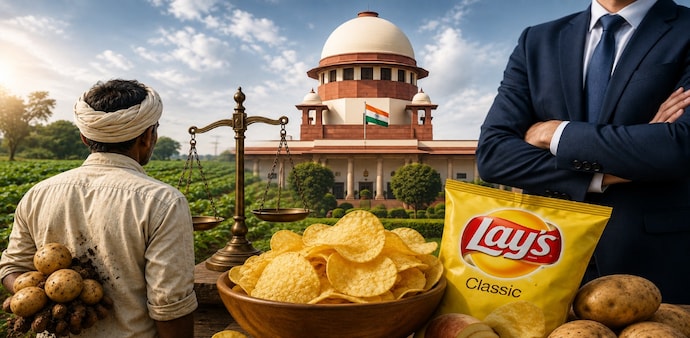
Who owns the potato in your chips? PepsiCo vs farmers Supreme Court case could reshape farmers’ rights
The case has raised questions over the scope of breeder rights under law and the protections available to farmers.
- Aug 5, 2026,
- Updated Aug 5, 2026 3:33 PM IST
The legal fight over the potato used in Lay’s chips has now reached the Supreme Court, sharpening a wider clash over corporate claims and farmers’ rights. According to a report by AajTak, farmers’ groups and activists have challenged a Delhi High Court ruling that restored PepsiCo’s plant protection registration rights, or breeder rights, over FL 2027, also known as FC5.
The dispute centres on FL 2027, a potato variety developed specifically for making chips and wafers. It has low moisture content, making it commercially suitable for chip manufacturing, and is not meant for ordinary kitchen use. The case has raised questions over the scope of breeder rights under law and the protections available to farmers.
PepsiCo has claimed that it developed this variety and holds exclusive rights over it under the Protection of Plant Varieties and Farmers’ Rights Act, 2001. The company’s argument is that the breeder’s exclusive rights rest with it. Its counsel has said that the registration granted in 2016 gives PepsiCo the full right to produce, sell and market this variety, and that no one else can grow it without permission.
Farmer organisations, however, have argued that Indian law gives farmers an unbroken right to grow, save and sell seeds. PepsiCo has maintained that it is not acting against ordinary small farmers, but only in cases where commercial cultivation of this potato was allegedly being carried out at the behest of competing chips manufacturing companies.
The farmers and petitioners have argued that their protection under Section 39 of the farmers’ rights law outweighs PepsiCo’s claim of monopoly. Senior advocate Colin Gonsalves and the petitioners have submitted that Section 39(1)(iv) gives farmers clear protection. They have argued that farmers are free to grow, save, exchange and sell seeds of any protected variety, as long as they do not sell it as a "branded seed".
The petitioners have also raised the issue of food sovereignty, saying that complete corporate control over a food crop would threaten India’s agricultural system and farmers’ livelihoods. The matter before the Supreme Court now brings into focus PepsiCo’s claim of exclusive breeder rights over FL 2027 and the farmers’ claim that the law protects their right to use and sell seeds of protected varieties.
FAQs
- +−
What is the Supreme Court case over Lay’s chips potato variety FL 2027 about?
The case concerns PepsiCo’s claimed breeder rights over FL 2027, also called FC5, a potato variety used for making chips. Farmers’ groups and activists have challenged the restoration of these rights, saying farmers are still protected under Indian law.
- +−
Why is FL 2027 potato important for chip manufacturing?
FL 2027 has low moisture content, which makes it suitable for producing chips and wafers. It is a specialised commercial potato and is not meant for regular kitchen use.
- +−
What rights is PepsiCo claiming under the law?
PepsiCo says it developed FL 2027 and holds exclusive rights under the Protection of Plant Varieties and Farmers’ Rights Act, 2001. The company argues that its 2016 registration gives it the right to produce, sell and market this variety.
- +−
What are farmers and petitioners arguing against PepsiCo’s claim?
The petitioners say Section 39 of the law protects farmers’ rights to grow, save, exchange and sell seeds of protected varieties, as long as they are not sold as branded seeds. They argue this protection is stronger than PepsiCo’s monopoly claim.
- +−
Why does this potato rights dispute matter for Indian farmers?
The dispute has become important because it raises wider questions about farmers’ rights, corporate control over food crops and food sovereignty in India. The Supreme Court’s decision could affect how breeder rights and farmer protections are balanced in future.
The legal fight over the potato used in Lay’s chips has now reached the Supreme Court, sharpening a wider clash over corporate claims and farmers’ rights. According to a report by AajTak, farmers’ groups and activists have challenged a Delhi High Court ruling that restored PepsiCo’s plant protection registration rights, or breeder rights, over FL 2027, also known as FC5.
The dispute centres on FL 2027, a potato variety developed specifically for making chips and wafers. It has low moisture content, making it commercially suitable for chip manufacturing, and is not meant for ordinary kitchen use. The case has raised questions over the scope of breeder rights under law and the protections available to farmers.
PepsiCo has claimed that it developed this variety and holds exclusive rights over it under the Protection of Plant Varieties and Farmers’ Rights Act, 2001. The company’s argument is that the breeder’s exclusive rights rest with it. Its counsel has said that the registration granted in 2016 gives PepsiCo the full right to produce, sell and market this variety, and that no one else can grow it without permission.
Farmer organisations, however, have argued that Indian law gives farmers an unbroken right to grow, save and sell seeds. PepsiCo has maintained that it is not acting against ordinary small farmers, but only in cases where commercial cultivation of this potato was allegedly being carried out at the behest of competing chips manufacturing companies.
The farmers and petitioners have argued that their protection under Section 39 of the farmers’ rights law outweighs PepsiCo’s claim of monopoly. Senior advocate Colin Gonsalves and the petitioners have submitted that Section 39(1)(iv) gives farmers clear protection. They have argued that farmers are free to grow, save, exchange and sell seeds of any protected variety, as long as they do not sell it as a "branded seed".
The petitioners have also raised the issue of food sovereignty, saying that complete corporate control over a food crop would threaten India’s agricultural system and farmers’ livelihoods. The matter before the Supreme Court now brings into focus PepsiCo’s claim of exclusive breeder rights over FL 2027 and the farmers’ claim that the law protects their right to use and sell seeds of protected varieties.